State Key Laboratory of Medicinal Chemical Biology, Frontiers Science Center for Cell Responses, College of Pharmacy and Tianjin Key Laboratory of Molecular Drug Research, Nankai University, Tianjin 300350, China.
College of Life Sciences, Nankai University, Tianjin 300350, China.
Proc Natl Acad Sci U S A. 2022 Oct 18;119(42):e2203702119. doi: 10.1073/pnas.2203702119. Epub 2022 Oct 10.
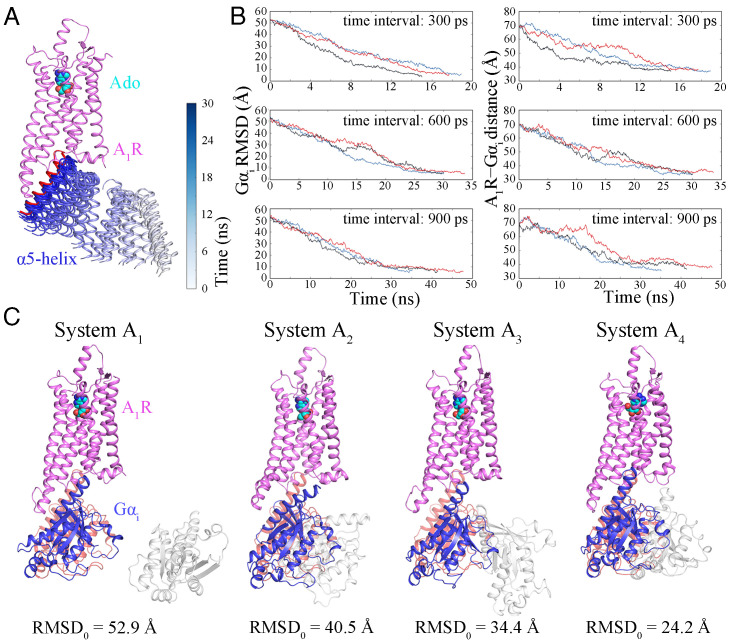
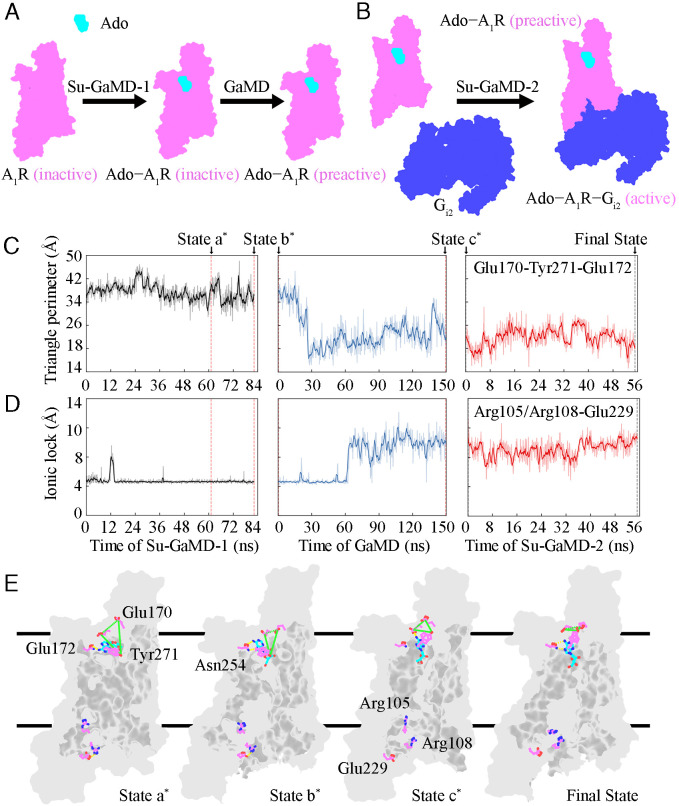
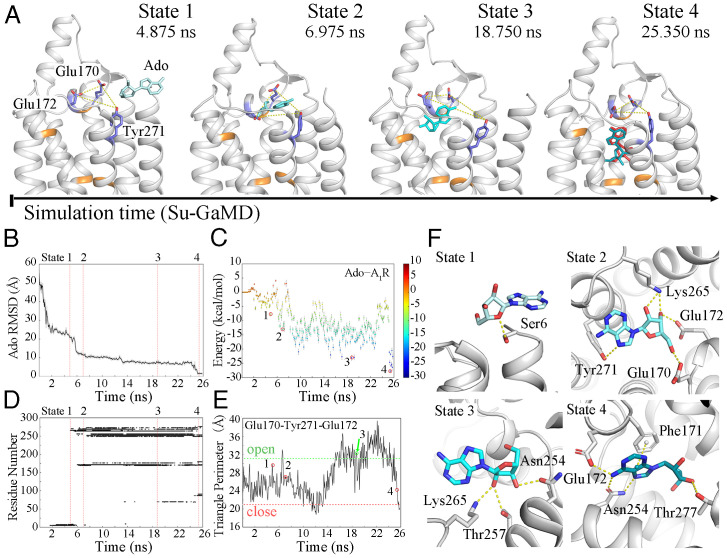
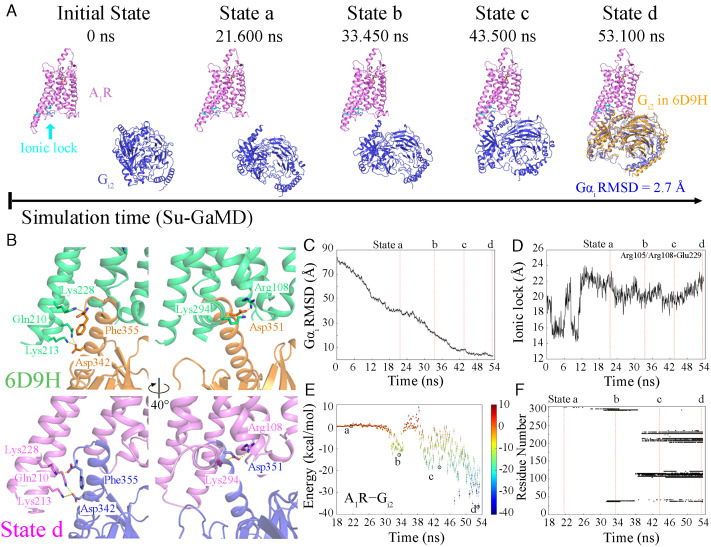
The full activation process of G protein-coupled receptor (GPCR) plays an important role in cellular signal transduction. However, it remains challenging to simulate the whole process in which the GPCR is recognized and activated by a ligand and then couples to the G protein on a reasonable simulation timescale. Here, we developed a molecular dynamics (MD) approach named supervised (Su) Gaussian accelerated MD (GaMD) by incorporating a tabu-like supervision algorithm into a standard GaMD simulation. By using this Su-GaMD method, from the active and inactive structure of adenosine A receptor (AR), we successfully revealed the full activation mechanism of AR, including adenosine (Ado)-AR recognition, preactivation of AR, and AR-G protein recognition, in hundreds of nanoseconds of simulations. The binding of Ado to the extracellular side of AR initiates conformational changes and the preactivation of AR. In turn, the binding of G to the intracellular side of AR causes a decrease in the volume of the extracellular orthosteric site and stabilizes the binding of Ado to AR. Su-GaMD could be a useful tool to reconstruct or even predict ligand-protein and protein-protein recognition pathways on a short timescale. The intermediate states revealed in this study could provide more detailed complementary structural characterizations to facilitate the drug design of AR in the future.
G 蛋白偶联受体 (GPCR) 的完全激活过程在细胞信号转导中起着重要作用。然而,模拟 GPCR 被配体识别和激活,然后与 G 蛋白偶联的整个过程仍然具有挑战性,因为这需要在合理的模拟时间尺度内完成。在这里,我们开发了一种分子动力学 (MD) 方法,称为有监督 (Su) 高斯加速 MD (GaMD),通过将类似于禁忌的监督算法纳入标准 GaMD 模拟中。通过使用这种 Su-GaMD 方法,我们从腺苷 A 受体 (AR) 的活性和非活性结构中,成功地揭示了 AR 的完全激活机制,包括腺苷 (Ado)与 AR 的识别、AR 的预激活以及 AR-G 蛋白的识别,这在数百纳秒的模拟中完成。Ado 与 AR 的细胞外侧结合引发构象变化和 AR 的预激活。反过来,G 与 AR 的细胞内结合导致细胞外正位点的体积减小,并稳定 Ado 与 AR 的结合。Su-GaMD 可以成为一种有用的工具,在短时间内重建甚至预测配体-蛋白和蛋白-蛋白识别途径。本研究中揭示的中间状态可以提供更详细的结构特征,有助于未来 AR 的药物设计。