Department of Sports Research, Japan Institute of Sports Sciences, 3-15-1 Nishigaoka Kita-ku, Tokyo, 115-0056, Japan.
Faculty of Law, Hokkai-Gakuen University, 4-1-40 Asahimachi Toyohira-ku, Sapporo City, Hokkaido, 062-8605, Japan.
J Physiol Anthropol. 2022 Oct 10;41(1):34. doi: 10.1186/s40101-022-00309-w.
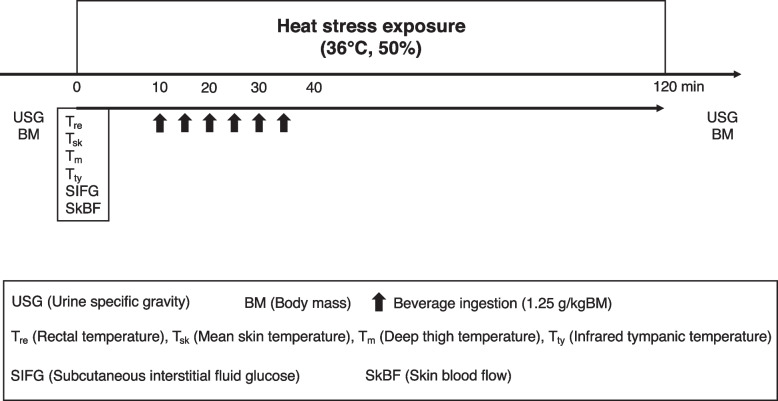
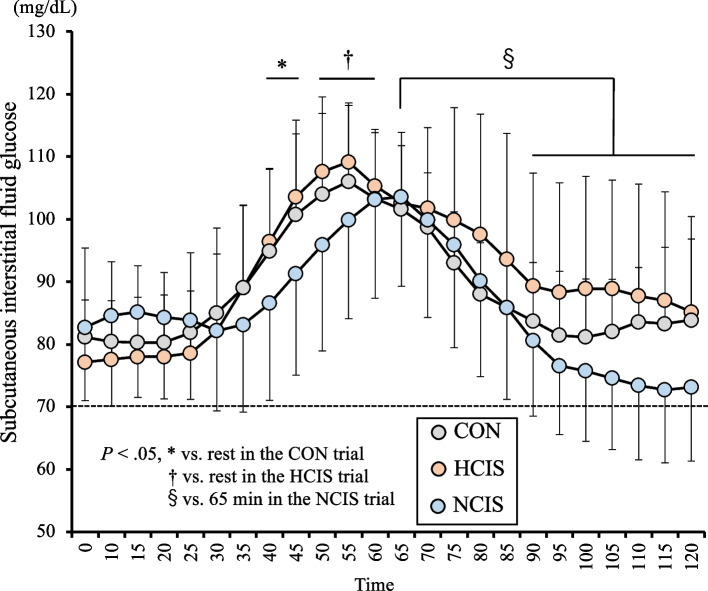
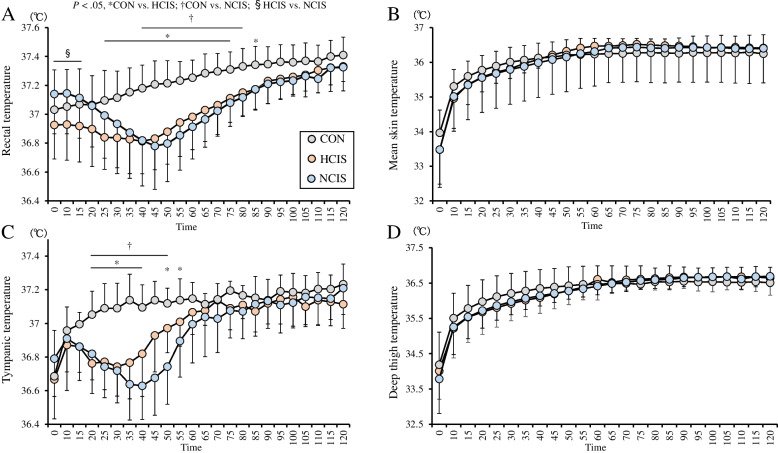
The purpose of this study was to compare the effects of ingesting ice slurries with two different carbohydrate contents on body temperatures and the subcutaneous interstitial fluid glucose level during heat exposure. Seven physically active men underwent one of three interventions: the ingestion of 7.5 g/kg of a control beverage (CON: 26°C), a normal-carbohydrate ice slurry (NCIS: -1°C), or a high-carbohydrate ice slurry (HCIS: -5°C). The participants were monitored for a 120-min period that included 10 min of rest, 25 min of exposure to the experimental cooling intervention (during which the beverage was ingested), and 85 min of seated rest in a climate chamber (36°C, 50% relative humidity). The rectal temperature in the HCIS and NCIS trials was lower than that in the CON trial from 40 to 75 min. The infrared tympanic temperature was also lower in the HCIS and NCIS trials than in the CON trial from 20 to 50 min, whereas the deep thigh or mean skin temperatures were not significantly different among the three groups. From 90 to 120 min, the subcutaneous interstitial fluid glucose level in the NCIS trial was lower than that at 65 min; however, reductions were not seen in the HCIS and CON trials. These findings suggest that both HCIS ingestion and conventional NCIS ingestion were effective cooling strategies for reducing thermal strain, while HCIS ingestion may also enable a higher subcutaneous interstitial fluid glucose level to be maintained, ensuring an adequate supply of required muscle substrates.
本研究旨在比较摄入两种不同碳水化合物含量的冰沙对热暴露时体温和皮下组织间液葡萄糖水平的影响。7 名有运动习惯的男性参与了以下三种干预措施之一:摄入 7.5 g/kg 的对照饮料(CON:26°C)、正常碳水化合物冰沙(NCIS:-1°C)或高碳水化合物冰沙(HCIS:-5°C)。参与者在 120 分钟的监测期间接受监测,包括 10 分钟的休息、25 分钟的实验冷却干预(在此期间摄入饮料)以及 85 分钟的气候室(36°C,50%相对湿度)坐姿休息。在 HCIS 和 NCIS 试验中,直肠温度从 40 分钟到 75 分钟比 CON 试验低。从 20 分钟到 50 分钟,HCIS 和 NCIS 试验的红外鼓膜温度也比 CON 试验低,而大腿深部或平均皮肤温度在三组之间没有显著差异。从 90 分钟到 120 分钟,NCIS 试验的皮下组织间液葡萄糖水平低于 65 分钟;然而,HCIS 和 CON 试验中并未出现降低。这些发现表明,HCIS 摄入和常规 NCIS 摄入都是有效降低热应激的冷却策略,而 HCIS 摄入还可能维持更高的皮下组织间液葡萄糖水平,确保足够的肌肉所需底物供应。