Department of Medicine, Respirology, 10033London Health Science Center, London, ON, Canada.
Department of Agricultural, Food and Nutritional Science, 3158University of Alberta, Edmonton, AB, Canada.
Chron Respir Dis. 2022 Jan-Dec;19:14799731221133387. doi: 10.1177/14799731221133387.
Computed tomography (CT) is commonly utilized in chronic obstructive pulmonary disease (COPD) for lung cancer screening and emphysema characterization. Computed tomography-morphometric analysis of body composition (muscle mass and adiposity) has gained increased recognition as a marker of disease severity and prognosis. This systematic review aimed to describe the CT-methodology used to assess body composition and identify the association of body composition measures and disease severity, health-related quality of life (HRQL), cardiometabolic risk factors, respiratory exacerbations, and survival in patients with COPD.
Six databases were searched (inception-September 2021) for studies evaluating adult COPD patients using thoracic or abdominal CT-muscle or adiposity body composition measures. The systematic review was conducted in accordance with the PRISMA guidelines.
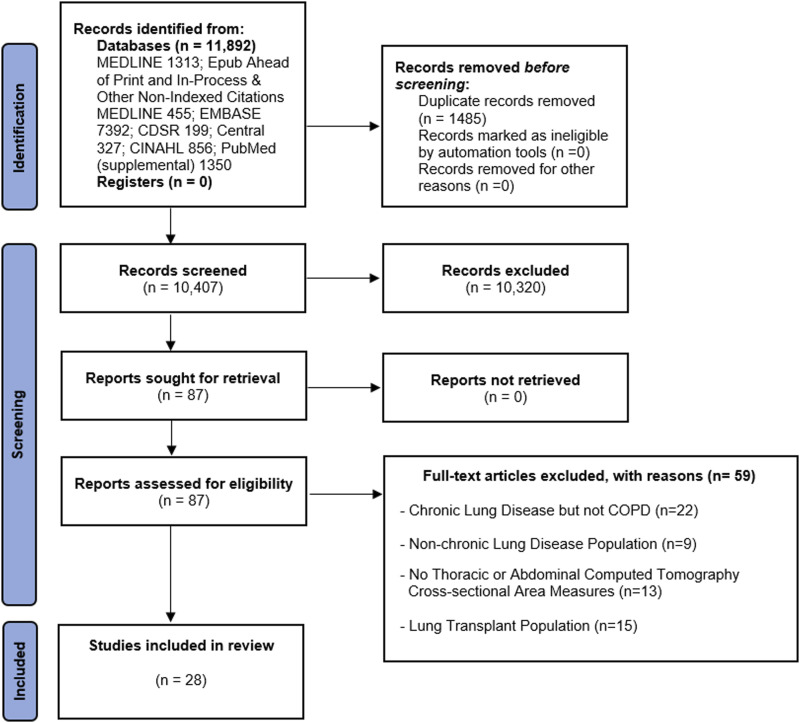
Twenty eight articles were included with 15,431 COPD patients, across all GOLD stages with 77% males, age range (mean/median 59-78 years), and BMI range 19.8-29.3 kg/m. There was heterogeneity in assessment of muscle mass and adiposity using thoracic ( = 22) and abdominal ( = 8) CT-scans, capturing different muscle groups, anatomic locations, and adiposity compartments (visceral, subcutaneous, and epicardial). Low muscle mass and increased adiposity were associated with increased COPD severity measures (lung function, exercise capacity, dyspnea) and lower HRQL, but were not consistent across studies. Increased visceral adiposity ( = 6) was associated with cardiovascular disease or risk factors (hypertension, hyperlipidemia, and diabetes). Low muscle CSA was prognostic of respiratory exacerbations or mortality in three of six studies, whereas the relationship with increased intermuscular adiposity and greater mortality was only observed in one of three studies.
There was significant variability in CT-body composition measures. In several studies, low muscle mass was associated with increased disease severity and lower HRQL, whereas adiposity with cardiovascular disease/risk factors. Given the heterogeneity in body composition measures and clinical outcomes, the prognostic utility of CT-body composition in COPD requires further study.
计算机断层扫描(CT)常用于慢性阻塞性肺疾病(COPD)的肺癌筛查和肺气肿特征分析。CT 体成分分析(肌肉质量和脂肪含量)作为疾病严重程度和预后的标志物,越来越受到认可。本系统评价旨在描述用于评估体成分的 CT 方法,并确定体成分测量值与疾病严重程度、健康相关生活质量(HRQL)、心血管代谢危险因素、呼吸恶化和 COPD 患者生存之间的相关性。
从六个数据库(2021 年 9 月前)中检索评估使用胸部或腹部 CT 肌肉或脂肪体成分测量值的成年 COPD 患者的研究。系统评价符合 PRISMA 指南。
纳入 28 篇文章,共 15431 例 COPD 患者,涵盖所有 GOLD 分期,男性占 77%,年龄范围(平均/中位数 59-78 岁),BMI 范围 19.8-29.3kg/m。使用胸部( = 22)和腹部( = 8)CT 扫描评估肌肉质量和脂肪含量存在异质性,可捕捉到不同的肌肉群、解剖位置和脂肪含量部位(内脏、皮下和心外膜)。肌肉质量低和脂肪含量增加与 COPD 严重程度指标(肺功能、运动能力、呼吸困难)降低和 HRQL 降低相关,但各研究结果不一致。内脏脂肪增加( = 6)与心血管疾病或危险因素(高血压、高血脂和糖尿病)相关。低肌肉 CSA 在 6 项研究中的 3 项中与呼吸恶化或死亡率相关,而肌肉间脂肪增加与死亡率增加的相关性仅在 3 项研究中的 1 项中观察到。
CT 体成分测量值存在显著差异。在几项研究中,肌肉质量低与疾病严重程度增加和 HRQL 降低相关,而脂肪含量与心血管疾病/危险因素相关。鉴于体成分测量值和临床结局的异质性,CT 体成分在 COPD 中的预后作用尚需进一步研究。