Chen Lu, Qing Ailing, Zhu Tao, Yang Pingliang, Ye Ling
Department of Pain Management, West China Hospital, Sichuan University, Chengdu, China.
Department of Anesthesiology, West China School of Public Health and West China Fourth Hospital, Sichuan University, Chengdu, China.
Front Neurol. 2022 Sep 26;13:948024. doi: 10.3389/fneur.2022.948024. eCollection 2022.
To evaluate the efficacy and safety of extracorporeal shockwave therapy (ESWT) for postherpetic neuralgia.
Randomized single-blind clinical study.
Patients with postherpetic neuralgia.
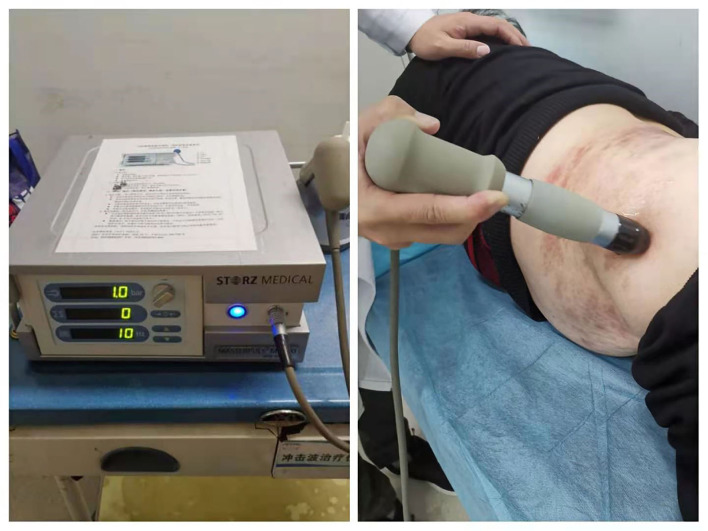
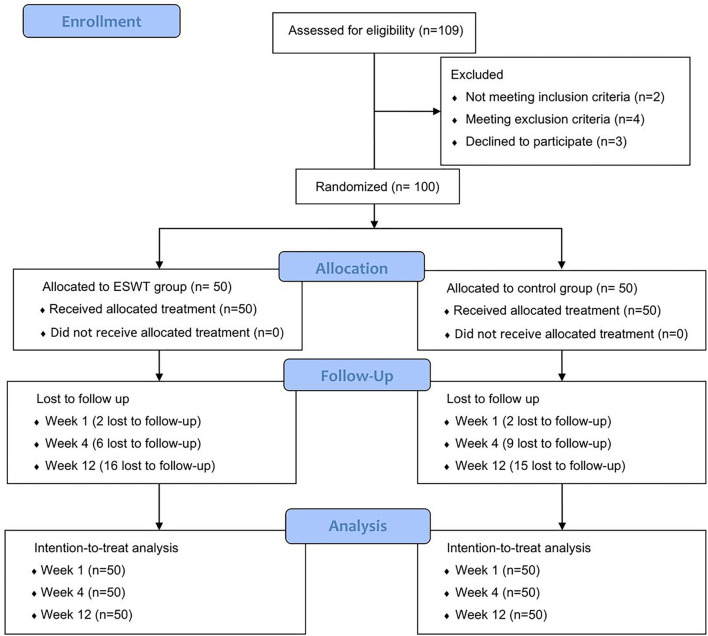
Patients were randomly divided into the control group and the ESWT group. The control group received conventional treatment while the ESWT group received conventional treatment and ESWT. The primary outcome is pain degree as assessed by the numeric rating scale (NRS), and secondary outcomes include brief pain inventory (BPI), Self-rating Anxiety Scale (SAS), Self-rating Depression Scale (SDS), and Pittsburgh Sleep Quality Index (PSQI). Data were collected at baseline and at weeks 1, 4, and 12. Linear mixed-effects models were applied to repeated measurement data.
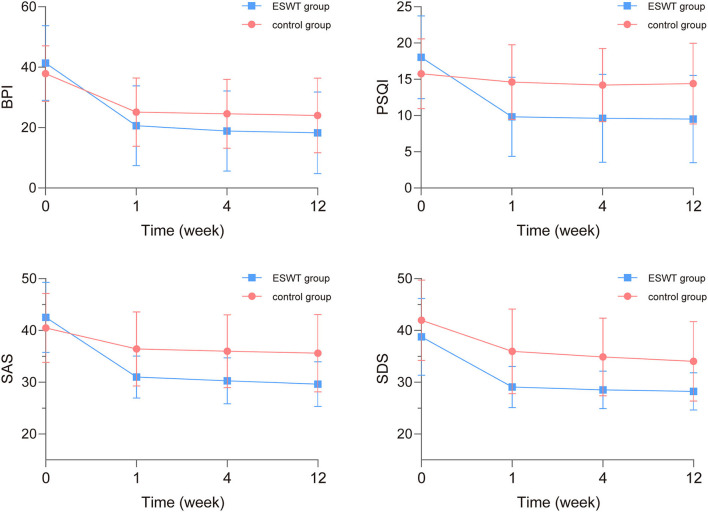
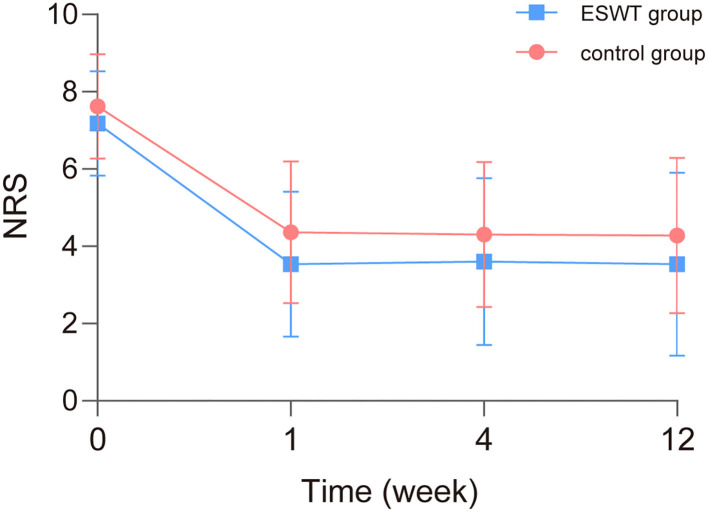
The scores on the NRS, BPI, SAS, SDS, and PSQI decreased over time in both groups. The NRS and SDS scores of the ESWT group were statistically lower than the control group. There was no time × group interaction in the mixed model analysis. Baseline age was correlated with NRS scores and BPI scores, and invasive treatment was related to PSQI scores, with no interaction effect for baseline confounders observed. No adverse events were observed during the process of this trial.
Extracorporeal shockwave therapy combined with conventional treatment could relieve pain and improve the psychological state in patients with postherpetic neuralgia without serious adverse effects.
评估体外冲击波疗法(ESWT)治疗带状疱疹后神经痛的疗效和安全性。
随机单盲临床研究。
带状疱疹后神经痛患者。
将患者随机分为对照组和ESWT组。对照组接受常规治疗,而ESWT组接受常规治疗和ESWT。主要结局是通过数字评定量表(NRS)评估的疼痛程度,次要结局包括简明疼痛问卷(BPI)、自评焦虑量表(SAS)、自评抑郁量表(SDS)和匹兹堡睡眠质量指数(PSQI)。在基线以及第1、4和12周收集数据。对重复测量数据应用线性混合效应模型。
两组的NRS、BPI、SAS、SDS和PSQI评分均随时间下降。ESWT组的NRS和SDS评分在统计学上低于对照组。混合模型分析中不存在时间×组间交互作用。基线年龄与NRS评分和BPI评分相关,侵入性治疗与PSQI评分相关,未观察到基线混杂因素的交互作用。在本试验过程中未观察到不良事件。
体外冲击波疗法联合常规治疗可缓解带状疱疹后神经痛患者的疼痛并改善其心理状态,且无严重不良反应。