Laboratory for Oxidative Stress (LabOS), Ruđer Bošković Institute, HR-10000 Zagreb, Croatia.
Department of Analytical Chemistry, Medical University of Bialystok, A. Mickiewicza 2D, 15-222 Bialystok, Poland.
Int J Mol Sci. 2022 Oct 5;23(19):11810. doi: 10.3390/ijms231911810.
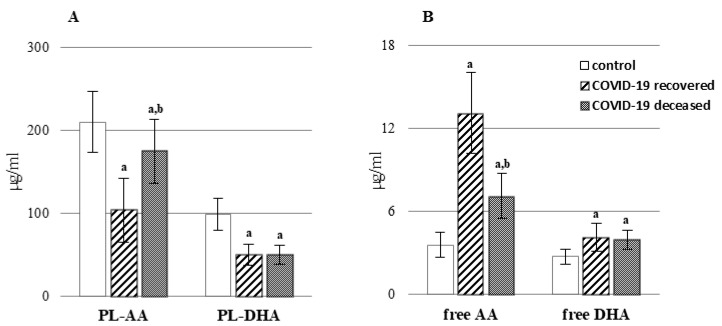
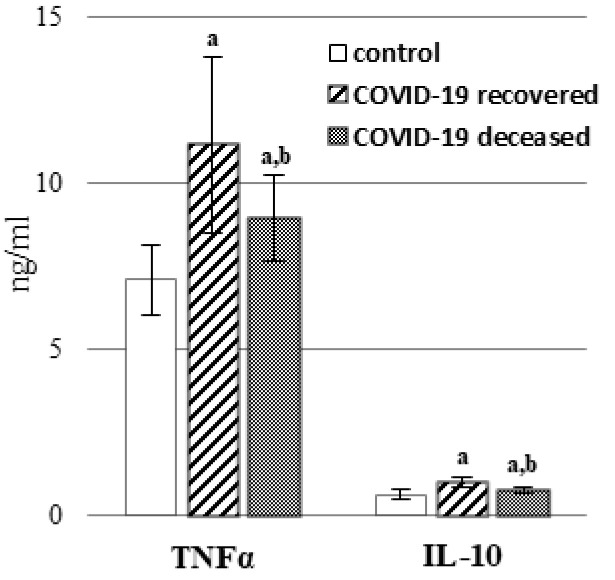
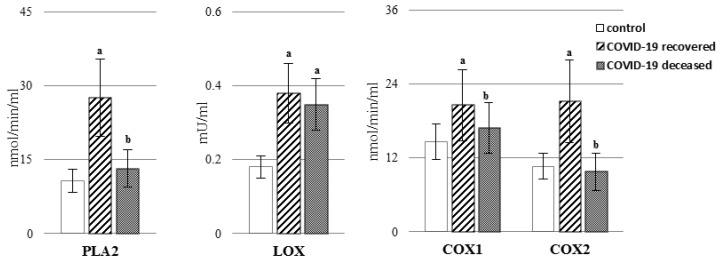
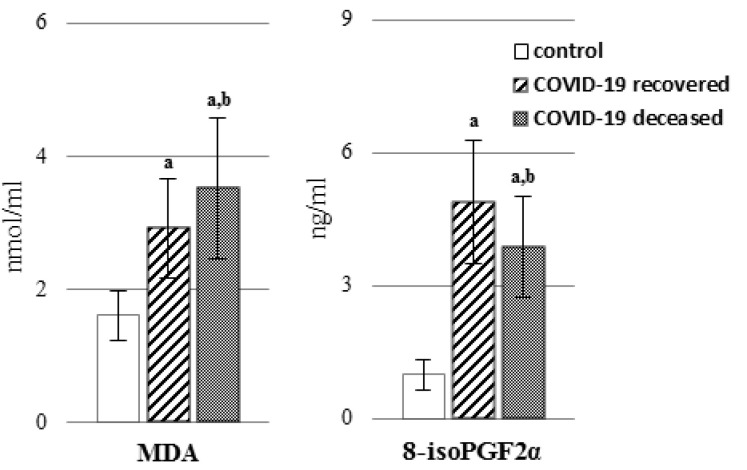
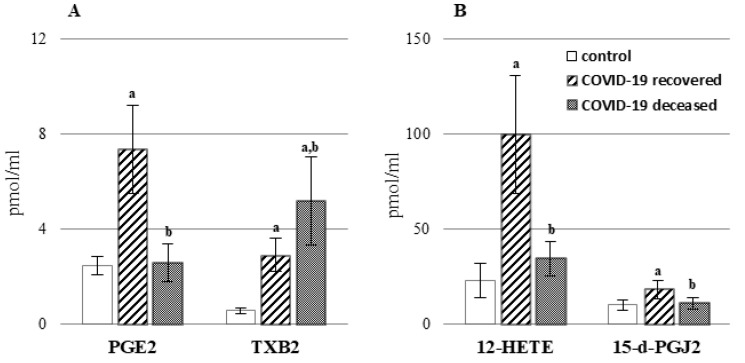
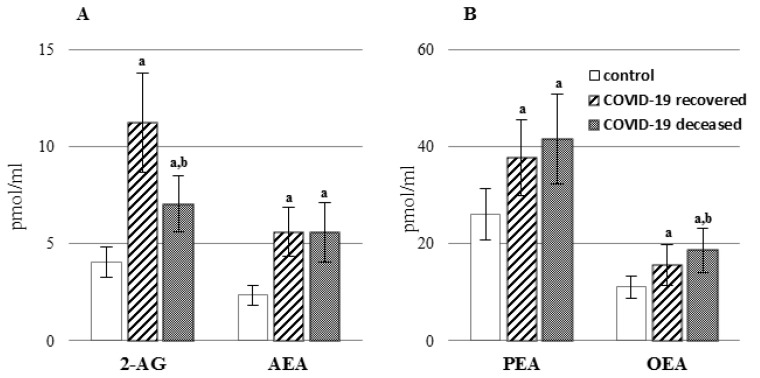
As a result of SARS-CoV-2 infection, inflammation develops, which promotes oxidative stress, leading to modification of phospholipid metabolism. Therefore, the aim of this study is to compare the effects of COVID-19 on the levels of phospholipid and free polyunsaturated fatty acids (PUFAs) and their metabolites produced in response to reactions with reactive oxygen species (ROS) and enzymes (cyclooxygenases-(COXs) and lipoxygenase-(LOX)) in the plasma of patients who either recovered or passed away within a week of hospitalization. In the plasma of COVID-19 patients, especially of the survivors, the actions of ROS and phospholipase A2 (PLA2) cause a decrease in phospholipid fatty acids level and an increase in free fatty acids (especially arachidonic acid) despite increased COXs and LOX activity. This is accompanied by an increased level in lipid peroxidation products (malondialdehyde and 8-isoprostaglandin F2α) and lipid mediators generated by enzymes. There is also an increase in eicosanoids, both pro-inflammatory as follows: thromboxane B2 and prostaglandin E2, and anti-inflammatory as follows: 15-deoxy-Δ-12,14-prostaglandin J2 and 12-hydroxyeicosatetraenoic acid, as well as endocannabinoids (anandamide-(AEA) and 2-arachidonylglycerol-(2-AG)) observed in the plasma of patients who recovered. Moreover, the expression of tumor necrosis factor α and interleukins (IL-6 and IL-10) is increased in patients who recovered. However, in the group of patients who died, elevated levels of N-oleoylethanolamine and N-palmitoylethanolamine are found. Since lipid mediators may have different functions depending on the onset of pathophysiological processes, a stronger pro-inflammatory response in patients who have recovered may be the result of the defensive response to SARS-CoV-2 in survivors associated with specific changes in the phospholipid metabolism, which could also be considered a prognostic factor.
由于 SARS-CoV-2 感染,会引发炎症,从而促进氧化应激,导致磷脂代谢发生改变。因此,本研究旨在比较 COVID-19 对住院一周内康复或死亡的患者血浆中磷脂和游离多不饱和脂肪酸(PUFAs)及其对活性氧(ROS)和酶(环加氧酶(COXs)和脂加氧酶(LOX))反应产生的代谢物水平的影响。在 COVID-19 患者的血浆中,特别是在幸存者的血浆中,ROS 和磷脂酶 A2(PLA2)的作用会导致磷脂脂肪酸水平降低,游离脂肪酸(特别是花生四烯酸)增加,尽管 COXs 和 LOX 活性增加。这伴随着脂质过氧化产物(丙二醛和 8-异前列腺素 F2α)和酶产生的脂质介质水平的增加。还有内源性大麻素(如血栓素 B2 和前列腺素 E2 等促炎物质,以及 15-脱氧-Δ-12,14-前列腺素 J2 和 12-羟二十碳四烯酸等抗炎物质)和内源性大麻素(如花生四烯酸乙醇胺(AEA)和 2-花生四烯酰甘油(2-AG))在康复患者的血浆中也有所增加。此外,康复患者的肿瘤坏死因子α和白细胞介素(IL-6 和 IL-10)的表达增加。然而,在死亡患者组中,发现 N-油酰乙醇胺和 N-棕榈酰乙醇胺的水平升高。由于脂质介质的功能可能取决于病理生理过程的发生,因此康复患者更强的促炎反应可能是幸存者对 SARS-CoV-2 的防御反应的结果,这种反应与磷脂代谢的特定变化有关,也可以被认为是一个预后因素。