• 文献检索
  • 文档翻译
  • 深度研究
  • 学术资讯
  • Suppr Zotero 插件Zotero 插件
  • 邀请有礼
  • 套餐&价格
  • 历史记录
应用&插件
Suppr Zotero 插件Zotero 插件浏览器插件Mac 客户端Windows 客户端微信小程序
定价
高级版会员购买积分包购买API积分包
服务
文献检索文档翻译深度研究API 文档MCP 服务
关于我们
关于 Suppr公司介绍联系我们用户协议隐私条款
关注我们

Suppr 超能文献

核心技术专利:CN118964589B侵权必究
粤ICP备2023148730 号-1Suppr @ 2026

文献检索

告别复杂PubMed语法,用中文像聊天一样搜索,搜遍4000万医学文献。AI智能推荐,让科研检索更轻松。

立即免费搜索

文件翻译

保留排版,准确专业,支持PDF/Word/PPT等文件格式,支持 12+语言互译。

免费翻译文档

深度研究

AI帮你快速写综述,25分钟生成高质量综述,智能提取关键信息,辅助科研写作。

立即免费体验

使用迁移学习构建跨人群多基因风险评分。

The construction of cross-population polygenic risk scores using transfer learning.

机构信息

Department of Biostatistics, University of Michigan School of Public Health, Ann Arbor, MI 48109, USA.

Department of Biostatistics, University of Michigan School of Public Health, Ann Arbor, MI 48109, USA; Rogel Cancer Center, University of Michigan Medicine, Ann Arbor, MI 48109, USA.

出版信息

Am J Hum Genet. 2022 Nov 3;109(11):1998-2008. doi: 10.1016/j.ajhg.2022.09.010. Epub 2022 Oct 13.

DOI:10.1016/j.ajhg.2022.09.010
PMID:36240765
原文链接:https://pmc.ncbi.nlm.nih.gov/articles/PMC9674947/
Abstract

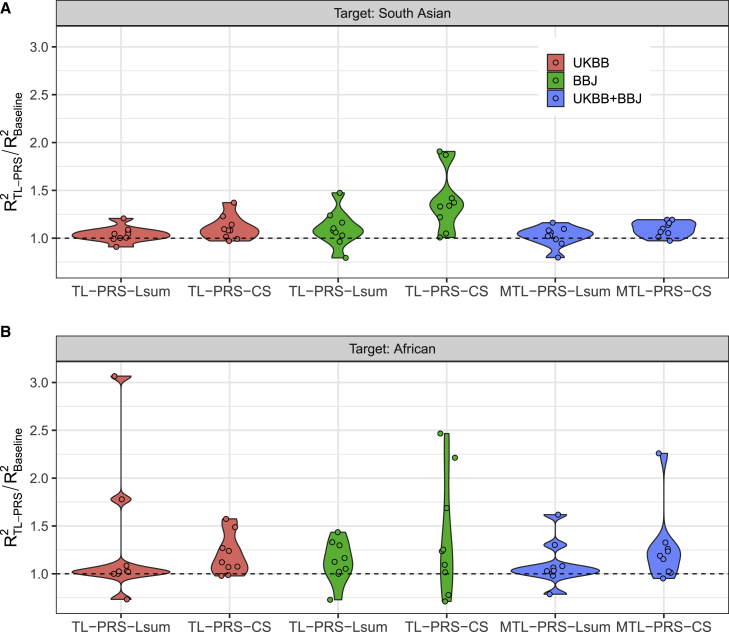
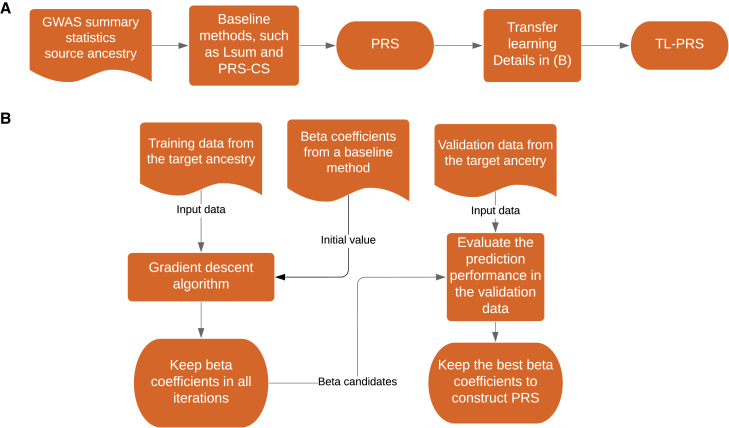
As most existing genome-wide association studies (GWASs) were conducted in European-ancestry cohorts, and as the existing polygenic risk score (PRS) models have limited transferability across ancestry groups, PRS research on non-European-ancestry groups needs to make efficient use of available data until we attain large sample sizes across all ancestry groups. Here we propose a PRS method using transfer learning techniques. Our approach, TL-PRS, uses gradient descent to fine-tune the baseline PRS model from an ancestry group with large sample GWASs to the dataset of target ancestry. In our application of constructing PRS for seven quantitative and two dichotomous traits for 10,285 individuals of South Asian ancestry and 8,168 individuals of African ancestry in UK Biobank, TL-PRS using PRS-CS as a baseline method obtained 25% average relative improvement for South Asian samples and 29% for African samples compared to the standard PRS-CS method in terms of predicted R. Our approach increases the transferability of PRSs across ancestries and thereby helps reduce existing inequities in genetics research.

摘要

由于大多数现有的全基因组关联研究(GWAS)都是在欧洲血统队列中进行的,而且现有的多基因风险评分(PRS)模型在不同血统群体之间的可转移性有限,因此,在我们获得所有血统群体的大样本量之前,非欧洲血统群体的 PRS 研究需要有效地利用现有数据。在这里,我们提出了一种使用迁移学习技术的 PRS 方法。我们的方法 TL-PRS 使用梯度下降来微调来自具有大量样本 GWAS 的血统群体的基线 PRS 模型,以适应目标血统的数据集。在我们为 UK Biobank 中 10285 名南亚血统和 8168 名非洲血统的个体构建七个定量和两个二分性状的 PRS 的应用中,TL-PRS 使用 PRS-CS 作为基线方法,与标准的 PRS-CS 方法相比,南亚样本的平均相对改善为 25%,非洲样本的平均相对改善为 29%,在预测 R 方面。我们的方法提高了 PRS 在不同血统之间的可转移性,从而有助于减少遗传研究中的现有不平等现象。
https://cdn.ncbi.nlm.nih.gov/pmc/blobs/bdef/9674947/880e7d59a1f0/gr6.jpg
https://cdn.ncbi.nlm.nih.gov/pmc/blobs/bdef/9674947/3844161a2c76/gr1.jpg
https://cdn.ncbi.nlm.nih.gov/pmc/blobs/bdef/9674947/e43a205e58ba/gr2.jpg
https://cdn.ncbi.nlm.nih.gov/pmc/blobs/bdef/9674947/b53a2bbb6d97/gr3.jpg
https://cdn.ncbi.nlm.nih.gov/pmc/blobs/bdef/9674947/66cd4f0623b7/gr4.jpg
https://cdn.ncbi.nlm.nih.gov/pmc/blobs/bdef/9674947/0a8b532b2b0d/gr5.jpg
https://cdn.ncbi.nlm.nih.gov/pmc/blobs/bdef/9674947/880e7d59a1f0/gr6.jpg
https://cdn.ncbi.nlm.nih.gov/pmc/blobs/bdef/9674947/3844161a2c76/gr1.jpg
https://cdn.ncbi.nlm.nih.gov/pmc/blobs/bdef/9674947/e43a205e58ba/gr2.jpg
https://cdn.ncbi.nlm.nih.gov/pmc/blobs/bdef/9674947/b53a2bbb6d97/gr3.jpg
https://cdn.ncbi.nlm.nih.gov/pmc/blobs/bdef/9674947/66cd4f0623b7/gr4.jpg
https://cdn.ncbi.nlm.nih.gov/pmc/blobs/bdef/9674947/0a8b532b2b0d/gr5.jpg
https://cdn.ncbi.nlm.nih.gov/pmc/blobs/bdef/9674947/880e7d59a1f0/gr6.jpg

相似文献

1
The construction of cross-population polygenic risk scores using transfer learning.使用迁移学习构建跨人群多基因风险评分。
Am J Hum Genet. 2022 Nov 3;109(11):1998-2008. doi: 10.1016/j.ajhg.2022.09.010. Epub 2022 Oct 13.
2
Performance of Polygenic Risk Scores for Primary Open-Angle Glaucoma in Populations of African Descent.非洲裔人群中原发性开角型青光眼多基因风险评分的表现
JAMA Ophthalmol. 2025 Jan 1;143(1):7-14. doi: 10.1001/jamaophthalmol.2024.4784.
3
BridgePRS leverages shared genetic effects across ancestries to increase polygenic risk score portability.BridgePRS 利用跨种族的共享遗传效应来提高多基因风险评分的可转移性。
Nat Genet. 2024 Jan;56(1):180-186. doi: 10.1038/s41588-023-01583-9. Epub 2023 Dec 20.
4
Evaluating approaches for constructing polygenic risk scores for prostate cancer in men of African and European ancestry.评估构建非洲裔和欧洲裔男性前列腺癌多基因风险评分的方法。
Am J Hum Genet. 2023 Jul 6;110(7):1200-1206. doi: 10.1016/j.ajhg.2023.05.010. Epub 2023 Jun 12.
5
Polygenic burden in focal and generalized epilepsies.多基因负担在局灶性和全面性癫痫中的作用。
Brain. 2019 Nov 1;142(11):3473-3481. doi: 10.1093/brain/awz292.
6
Constructing a multi-ancestry polygenic risk score for uterine fibroids using publicly available data highlights need for inclusive genetic research.利用公开可用数据构建子宫肌瘤的多血统多基因风险评分凸显了包容性基因研究的必要性。
Pac Symp Biocomput. 2025;30:268-280. doi: 10.1142/9789819807024_0020.
7
Development and Validation of a Breast Cancer Polygenic Risk Score on the Basis of Genetic Ancestry Composition.基于遗传祖源构成的乳腺癌多基因风险评分的开发和验证。
JCO Precis Oncol. 2022 Nov;6:e2200084. doi: 10.1200/PO.22.00084.
8
Improving polygenic prediction in ancestrally diverse populations.提高在祖源多样化人群中的多基因预测能力。
Nat Genet. 2022 May;54(5):573-580. doi: 10.1038/s41588-022-01054-7. Epub 2022 May 5.
9
Polygenic prediction of major depressive disorder and related traits in African ancestries UK Biobank participants.非洲裔英国生物银行参与者中重度抑郁症及相关性状的多基因预测
Mol Psychiatry. 2025 Jan;30(1):151-157. doi: 10.1038/s41380-024-02662-x. Epub 2024 Jul 16.
10
On cross-ancestry cancer polygenic risk scores.基于多种族癌症多基因风险评分的研究。
PLoS Genet. 2021 Sep 16;17(9):e1009670. doi: 10.1371/journal.pgen.1009670. eCollection 2021 Sep.

引用本文的文献

1
Bridging Data Gaps in Healthcare: A Scoping Review of Transfer Learning in Structured Data Analysis.弥合医疗保健领域的数据差距:结构化数据分析中迁移学习的范围综述
Health Data Sci. 2025 Sep 3;5:0321. doi: 10.34133/hds.0321. eCollection 2025.
2
An Efficient Lasso Framework for Admixture-Aware Polygenic Scores.一种用于混合体感知多基因分数的高效套索框架。
bioRxiv. 2025 Aug 27:2025.08.26.671106. doi: 10.1101/2025.08.26.671106.
3
Incorporating local ancestry information to predict genetically associated DNA methylation in admixed populations.

本文引用的文献

1
Identifying and correcting for misspecifications in GWAS summary statistics and polygenic scores.识别并校正全基因组关联研究汇总统计数据和多基因评分中的错误设定。
HGG Adv. 2022 Aug 18;3(4):100136. doi: 10.1016/j.xhgg.2022.100136. eCollection 2022 Oct 13.
2
Improving polygenic prediction in ancestrally diverse populations.提高在祖源多样化人群中的多基因预测能力。
Nat Genet. 2022 May;54(5):573-580. doi: 10.1038/s41588-022-01054-7. Epub 2022 May 5.
3
PUMAS: fine-tuning polygenic risk scores with GWAS summary statistics.PUMAS:使用 GWAS 汇总统计数据调整多基因风险评分。
纳入本地祖先信息以预测混合人群中与基因相关的DNA甲基化。
Brief Bioinform. 2025 Jul 2;26(4). doi: 10.1093/bib/bbaf325.
4
Almost Free Enhancement of Multi-Population PRS: From Data-Fission to Pseudo-GWAS Subsampling.多群体PRS的近乎免费增强:从数据裂变到伪全基因组关联研究子采样
bioRxiv. 2025 Jun 20:2025.06.16.659952. doi: 10.1101/2025.06.16.659952.
5
Cutting-edge AI tools revolutionizing scientific research in life sciences.前沿人工智能工具正在彻底改变生命科学领域的科学研究。
BioTechnologia (Pozn). 2025 Mar 31;106(1):77-102. doi: 10.5114/bta/200803. eCollection 2025.
6
Methodological opportunities in genomic data analysis to advance health equity.基因组数据分析中促进健康公平的方法学机遇。
Nat Rev Genet. 2025 May 15. doi: 10.1038/s41576-025-00839-w.
7
JointPRS: A data-adaptive framework for multi-population genetic risk prediction incorporating genetic correlation.JointPRS:一种用于多群体遗传风险预测的数据自适应框架,纳入了遗传相关性。
Nat Commun. 2025 Apr 24;16(1):3841. doi: 10.1038/s41467-025-59243-x.
8
Interplay between polygenic risk and family processes in predicting trajectories of adolescent externalizing behaviors.多基因风险与家庭环境因素在预测青少年外化行为轨迹中的相互作用。
Front Psychiatry. 2025 Mar 12;16:1505035. doi: 10.3389/fpsyt.2025.1505035. eCollection 2025.
9
Transfer Learning Prediction of Early Exposures and Genetic Risk Score on Adult Obesity in Two Minority Cohorts.两个少数民族队列中成人肥胖早期暴露和遗传风险评分的迁移学习预测
Prev Sci. 2025 Feb;26(2):234-245. doi: 10.1007/s11121-025-01781-3. Epub 2025 Feb 6.
10
Polygenic prediction for underrepresented populations through transfer learning by utilizing genetic similarity shared with European populations.通过利用与欧洲人群共享的遗传相似性,借助迁移学习对代表性不足的人群进行多基因预测。
Brief Bioinform. 2024 Nov 22;26(1). doi: 10.1093/bib/bbaf048.
Genome Biol. 2021 Sep 6;22(1):257. doi: 10.1186/s13059-021-02479-9.
4
Improved genetic prediction of complex traits from individual-level data or summary statistics.从个体水平数据或汇总统计信息中提高复杂性状的遗传预测能力。
Nat Commun. 2021 Jul 7;12(1):4192. doi: 10.1038/s41467-021-24485-y.
5
Scalable generalized linear mixed model for region-based association tests in large biobanks and cohorts.基于区域的大型生物库和队列关联检验的可扩展广义线性混合模型。
Nat Genet. 2020 Jun;52(6):634-639. doi: 10.1038/s41588-020-0621-6. Epub 2020 May 18.
6
Polygenic risk scores: from research tools to clinical instruments.多基因风险评分:从研究工具到临床工具。
Genome Med. 2020 May 18;12(1):44. doi: 10.1186/s13073-020-00742-5.
7
Analysis of polygenic risk score usage and performance in diverse human populations.多基因风险评分在不同人群中的使用和表现分析。
Nat Commun. 2019 Jul 25;10(1):3328. doi: 10.1038/s41467-019-11112-0.
8
Polygenic prediction via Bayesian regression and continuous shrinkage priors.基于贝叶斯回归和连续收缩先验的多基因预测。
Nat Commun. 2019 Apr 16;10(1):1776. doi: 10.1038/s41467-019-09718-5.
9
What Are Polygenic Scores and Why Are They Important?多基因评分是什么,为什么它们很重要?
JAMA. 2019 May 14;321(18):1820-1821. doi: 10.1001/jama.2019.3893.
10
Clinical use of current polygenic risk scores may exacerbate health disparities.现行多基因风险评分的临床应用可能会加剧健康差异。
Nat Genet. 2019 Apr;51(4):584-591. doi: 10.1038/s41588-019-0379-x. Epub 2019 Mar 29.