Lien Centre for Palliative Care, Duke-NUS Medical School, Singapore, Singapore.
Program in Health Services and Systems Research, Duke-NUS Medical School, Singapore, Singapore.
BMC Palliat Care. 2022 Oct 14;21(1):183. doi: 10.1186/s12904-022-01075-3.
Patients with advanced cancer prioritise health-related quality of life (HrQoL) in end-of-life care, however an understanding of pre-death HrQoL trajectories is lacking. We aimed to delineate and describe the trajectories of physical, social, emotional and functional HrQoL during last year of life among advanced cancer patients. We assessed associations between these trajectories and patient socio-demographic characteristics, healthcare use and place of death.
We used data from 345 decedents from a prospective cohort study of 600 patients with a solid advanced cancer receiving secondary care at public hospitals in Singapore. Patients were surveyed every three months until death and HrQoL was assessed using the Functional Assessment of Cancer Therapy - General (FACT-G) questionnaire. Interviews were conducted between July 2016 and December 2019. Group-based multi-trajectory modelling was used to assess potential heterogeneity in the four HrQoL dimensions during patients' last year of life.
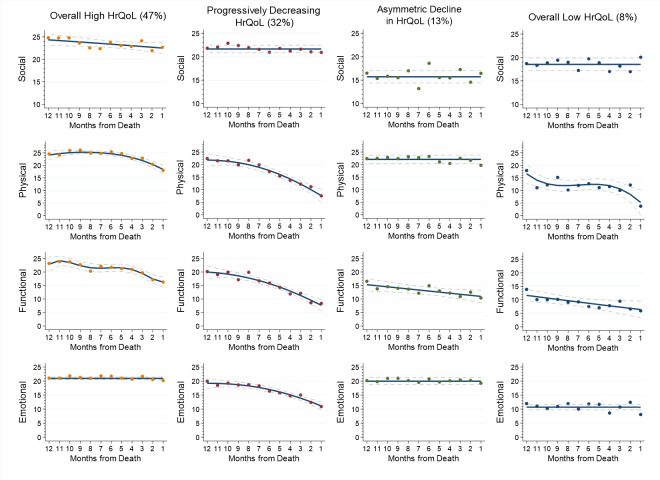
We identified four distinct trajectories of HrQoL - (1) overall high HrQoL (47% of sample), (2) progressively decreasing HrQoL (32%), (3) asymmetric decline in HrQoL (13%), (4) overall low HrQoL (8%). Compared to patients with secondary or above education, those with primary education or less (β = 1.39, SE = 0.55, p-value = 0.012) were more likely to have "progressively decreasing HrQoL" or "overall low HrQoL" in contrast to "overall high HrQoL". Compared to patients with 'overall high HrQoL', those with 'overall low HrQoL' had longer length of hospital stay during the last year of life (β = 0.47, SE = 0.21, p-value = 0.026) and were more likely to die in a hospice/care home (β = 1.86, SE = 0.66, p-value = 0.005).
Our results showed heterogeneity in deterioration of HrQoL among patients with advanced cancer in the last year of life. Systematic monitoring of HrQoL, early identification and referral of high-risk patients to palliative care may provide timely relief and mitigate the steep decline in their HrQoL.
NCT02850640.
晚期癌症患者在临终关怀中优先考虑与健康相关的生活质量(HrQoL),但对死亡前 HrQoL 轨迹的了解却很有限。我们旨在描绘和描述晚期癌症患者生命最后一年中身体、社会、情感和功能 HrQoL 的轨迹。我们评估了这些轨迹与患者社会人口统计学特征、医疗保健使用情况和死亡地点之间的关系。
我们使用了来自新加坡公立医院接受二级护理的 600 名实体晚期癌症患者前瞻性队列研究中的 345 名死者的数据。患者每三个月接受一次调查,直到死亡,并使用癌症治疗功能评估-一般(FACT-G)问卷评估 HrQoL。访谈于 2016 年 7 月至 2019 年 12 月进行。使用基于群组的多轨迹建模来评估患者生命最后一年中四个 HrQoL 维度的潜在异质性。
我们确定了四个不同的 HrQoL 轨迹——(1)总体高 HrQoL(样本的 47%),(2)逐渐下降的 HrQoL(32%),(3)HrQoL 不对称下降(13%),(4)总体低 HrQoL(8%)。与具有中学或以上教育程度的患者相比,具有小学或以下教育程度的患者(β=1.39,SE=0.55,p 值=0.012)更有可能出现“逐渐下降的 HrQoL”或“总体低 HrQoL”,而不是“总体高 HrQoL”。与“总体高 HrQoL”患者相比,“总体低 HrQoL”患者在生命的最后一年中住院时间更长(β=0.47,SE=0.21,p 值=0.026),更有可能在临终关怀/养老院死亡(β=1.86,SE=0.66,p 值=0.005)。
我们的研究结果表明,晚期癌症患者在生命的最后一年中,HrQoL 的恶化存在异质性。系统监测 HrQoL,早期识别和转介高危患者接受姑息治疗,可能会提供及时的缓解,并减轻他们的 HrQoL 急剧下降。
NCT02850640。