Xing Wenjuan, Zhang Shu, Wang Zheng, Jiang Dan, Han Shangfeng, Luo Yuejia
College of Economics and Management, Qilu Normal University, Jinan, China.
College of Teacher Education, Qilu Normal University, Jinan, China.
Front Psychol. 2022 Sep 30;13:1003719. doi: 10.3389/fpsyg.2022.1003719. eCollection 2022.
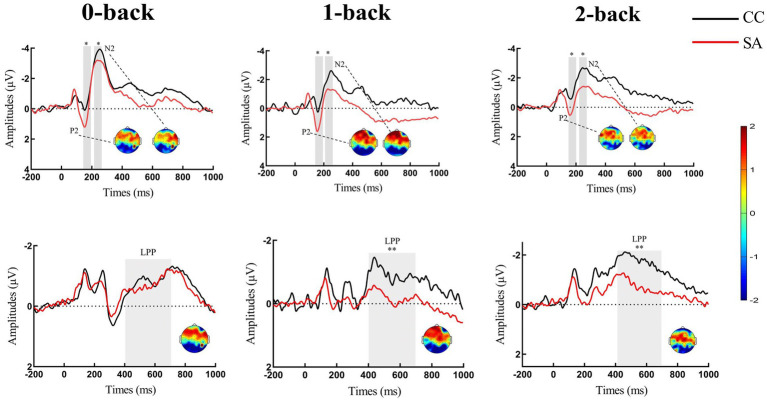
Chronic stress impairs working memory (WM), but few studies have explored the protective factors of the impairment. We aimed to investigate the effect of self-awareness on WM processing in people under chronic stress. Participants under chronic stress completed an n-back task after a self-awareness priming paradigm during which electroencephalograms were recorded. The behavioral results showed that participants whose self-awareness was primed reacted faster and more accurately than the controls. Event-related potentials (ERPs) revealed the following (1) P2 was more positive in the self-awareness group than in the controls, indicating that self-awareness enhanced allocation of attention resources at the encoding stage. (2) N2 was attenuated in the self-awareness group compared with the controls, indicating that smaller attention control efforts were required to complete WM tasks adequately after self-awareness priming; and (3) enhanced late positive potential (LPP) was evoked in the self-awareness group compared with the controls, suggesting self-awareness enabled participants to focus attention resources on the information at the maintenance stage. Critically, mediational analyses showed that LPP mediated the relationship between self-awareness and WM response times. This result suggests that the fact that participants whose self-awareness was primed were able to achieve better behavioral performances may be attributed to their mobilization of sustained attention resources at the maintenance stage. In summary, self-awareness exerted a protective effect on WM in those under chronic stress, which may be due to the enhancements in the allocation and mobilization of attention. These results could be used to develop more specific coping strategies for people under chronic stress.
慢性应激会损害工作记忆(WM),但很少有研究探讨这种损害的保护因素。我们旨在研究自我意识对慢性应激人群WM加工的影响。慢性应激参与者在自我意识启动范式后完成了一项n-back任务,在此期间记录脑电图。行为结果表明,自我意识被启动的参与者比对照组反应更快、更准确。事件相关电位(ERP)显示如下:(1)自我意识组的P2比对照组更正,表明自我意识增强了编码阶段注意力资源的分配。(2)与对照组相比,自我意识组的N2减弱,表明自我意识启动后,完成WM任务所需的注意力控制努力更小;(3)与对照组相比,自我意识组诱发了增强的晚期正电位(LPP),表明自我意识使参与者能够在维持阶段将注意力资源集中在信息上。至关重要的是,中介分析表明LPP介导了自我意识与WM反应时间之间的关系。这一结果表明,自我意识被启动的参与者能够取得更好行为表现这一事实,可能归因于他们在维持阶段调动了持续的注意力资源。总之,自我意识对慢性应激人群的WM具有保护作用,这可能是由于注意力分配和调动的增强。这些结果可用于为慢性应激人群制定更具体的应对策略。