Department of Exercise Biochemistry, Exercise Science School, Beijing Sport University, Beijing, Peking, China.
Norwegian School of Sport Sciences, Department of Physical Performance, Oslo, Norway.
J Int Soc Sports Nutr. 2022 Oct 12;19(1):623-637. doi: 10.1080/15502783.2022.2131460. eCollection 2022.
The purpose of this study is to explore the effect of carbohydrate only or carbohydrate plus protein supplementation on endurance capacity and muscle damage.
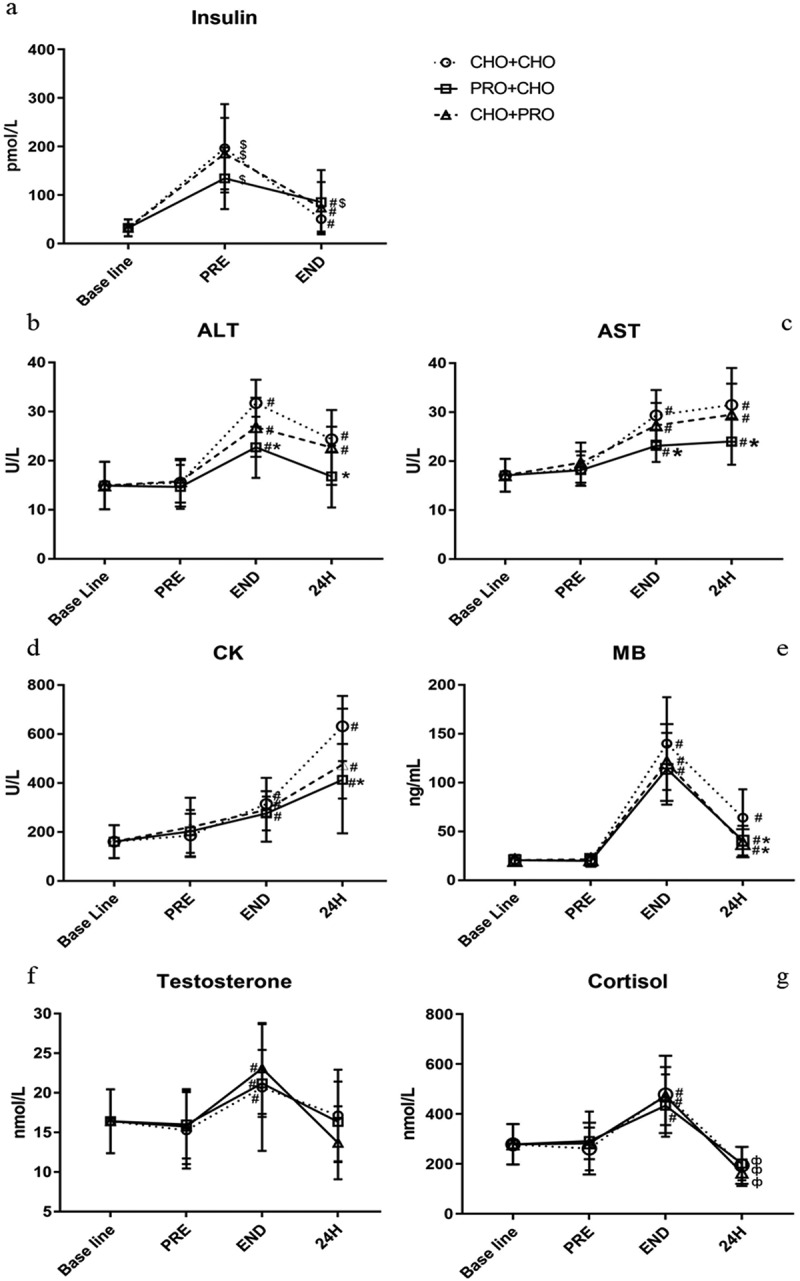
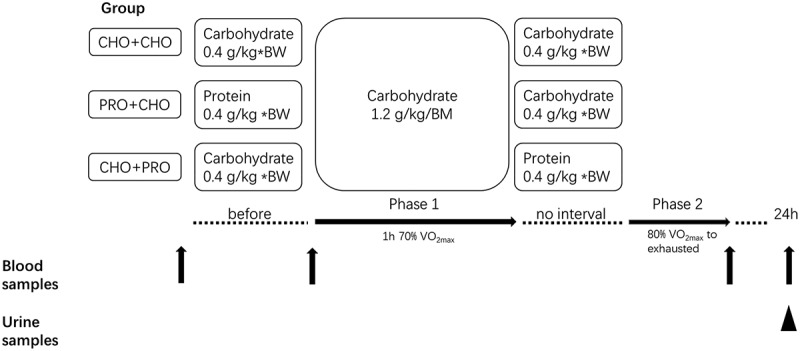
Ten recreationally active male runners (VO: 53.61 ± 3.86 ml/kg·min) completed run-to-exhaustion test three times with different intakes of intervention drinks. There was a 7-day wash-out period between tests. Each test started with 60 minutes of running at 70% VO (phase 1), followed by an endurance capacity test: time-to-exhaustion running at 80% VO (phase 2). Participants randomly ingested either 1) 0.4 g/kg BM carbohydrate before phase 1 and before phase 2 (CHO+CHO), 2) 0.4 g/kg BM protein before phase 1 and 0.4 g/kg BM carbohydrate before phase 2 (PRO+CHO), or 3) 0.4 g/kg BM carbohydrate before phase 1 and 0.4 g/kg BM protein before phase 2 (CHO+PRO). All subjects ingested carbohydrate (CHO) 1.2 g/kg BM during phase 1, and blood samples were obtained before, immediately, and 24 h after exercise for measurements of alanine aminotransferase (ALT), aspartate aminotransferase (AST), creatine kinase (CK), and myoglobin (MB).
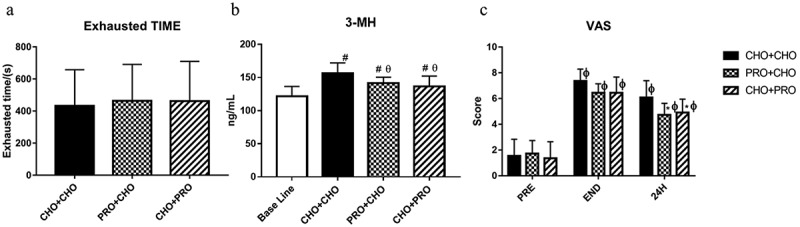
There was no significant difference in time to exhaustion between the three supplement strategies (CHO+CHO: 432 ± 225 s; PRO+CHO: 463 ± 227 s; CHO+PRO: 461 ± 248 s). However, ALT and AST were significantly lower in PRO+CHO than in CHO+CHO 24 h after exercise (ALT: 16.80 ± 6.31 vs. 24.39 ± 2.54 U/L; AST: 24.06 ± 4.77 vs. 31.51 ± 7.53 U/L, < 0.05). MB was significantly lower in PRO+CHO and CHO+PRO than in CHO+CHO 24 h after exercise (40.7 ± 15.2; 38.1 ± 14.3; 64.3 ± 28.9 ng/mL, respectively, < 0.05). CK increased less in PRO+CHO compared to CHO+CHO 24 h after exercise (404.22 ± 75.31 VS. 642.33 ± 68.57 U/L, < 0.05).
Carbohydrate and protein supplement strategies can reduce muscle damage caused by endurance exercise, but they do not improve endurance exercise capacity.
本研究旨在探讨仅补充碳水化合物或碳水化合物加蛋白质对耐力和肌肉损伤的影响。
10 名有经验的男性跑步者(VO 53.61 ± 3.86 ml/kg·min)在不同干预饮料摄入的情况下完成了 3 次极限耐力测试。每次测试之间有 7 天的洗脱期。每次测试都从 60 分钟 70% VO 的跑步开始(第 1 阶段),然后进行耐力测试:80% VO 的时间耗尽跑步(第 2 阶段)。参与者随机摄入以下 1)第 1 阶段和第 2 阶段前摄入 0.4g/kg BM 碳水化合物(CHO+CHO),2)第 1 阶段摄入 0.4g/kg BM 蛋白质,第 2 阶段摄入 0.4g/kg BM 碳水化合物(PRO+CHO),或 3)第 1 阶段摄入 0.4g/kg BM 碳水化合物,第 2 阶段摄入 0.4g/kg BM 蛋白质(CHO+PRO)。所有受试者在第 1 阶段摄入 1.2g/kg BM 碳水化合物,在运动前、运动后立即和 24 小时后采集血液样本,用于测量丙氨酸氨基转移酶(ALT)、天门冬氨酸氨基转移酶(AST)、肌酸激酶(CK)和肌红蛋白(MB)。
三种补充策略之间的耐力时间没有显著差异(CHO+CHO:432 ± 225 s;PRO+CHO:463 ± 227 s;CHO+PRO:461 ± 248 s)。然而,PRO+CHO 在运动后 24 小时时 ALT 和 AST 显著低于 CHO+CHO(ALT:16.80 ± 6.31 比 24.39 ± 2.54 U/L;AST:24.06 ± 4.77 比 31.51 ± 7.53 U/L,<0.05)。PRO+CHO 和 CHO+PRO 在运动后 24 小时时 MB 显著低于 CHO+CHO(40.7 ± 15.2;38.1 ± 14.3;64.3 ± 28.9 ng/mL,分别,<0.05)。PRO+CHO 在运动后 24 小时时 CK 增加量显著低于 CHO+CHO(404.22 ± 75.31 VS. 642.33 ± 68.57 U/L,<0.05)。
碳水化合物和蛋白质补充策略可以减轻耐力运动引起的肌肉损伤,但不能提高耐力运动能力。