Gui Zhaohuan, Sun Fenghua, Si Gangyan, Chen Yajun
Department of Maternal and Child Health, School of Public Health, Sun Yat-Sen University, Guangzhou, Guangdong, China.
Department of Health and Physical Education, The Education University of Hong Kong, Tai Po, Hong Kong.
PLoS One. 2017 Oct 12;12(10):e0185982. doi: 10.1371/journal.pone.0185982. eCollection 2017.
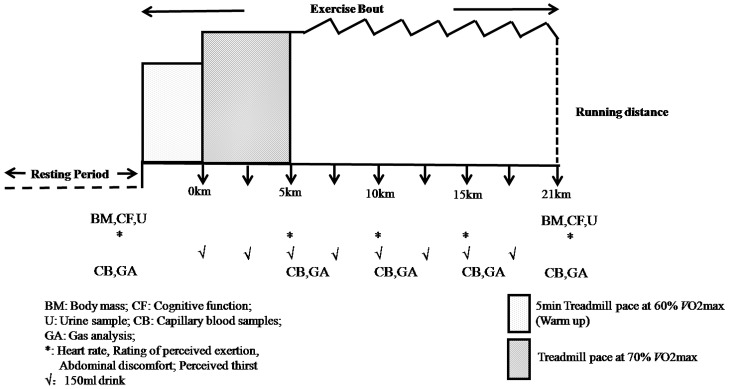
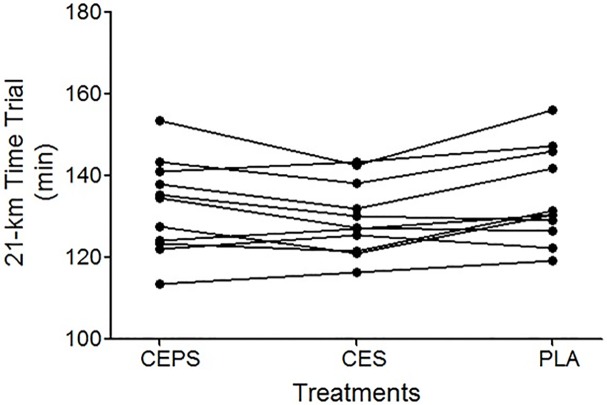
This study compared the effects of a carbohydrate-electrolyte-protein solution (CEPS, 2% protein plus 4% carbohydrate), carbohydrate-electrolyte solution (CES, 6% carbohydrate), and noncaloric sweetened placebo (PLA) on both 21-km running performance and cognitive function. Eleven female recreational endurance runners performed a 21-km time-trial running on three occasions, separated by at least 28 days. In a randomized cross-over design, they ingested CEPS, CES, or PLA at a rate of 150 mL every 2.5 km with no time feedback. A cognitive function test was performed before and after the run. Participants ingested approximately 24 g/h carbohydrate plus 12 g/h protein in CEPS trial, and 36 g/h carbohydrate in CES trial during each 21-km trial. Time to complete the time-trial was slightly shorter (P < 0.05) during CES (129.6 ± 8.8 min) than PLA (134.6 ± 11.5 min), with no differences between CEPS and the other two trials. The CEPS trial showed higher composite of visual motor speed than the PLA trial (P < 0.05). In conclusion, CES feedings might improve 21-km time-trial performance in female recreational runners compared with a PLA. However, adding protein to the CES provided no additional time-trial performance benefit. CEPS feeding during prolonged exercise could benefit visual motor speed compared to PLA alone, but no differences in the performance of the other cognitive function tests were found.
本研究比较了碳水化合物 - 电解质 - 蛋白质溶液(CEPS,2%蛋白质加4%碳水化合物)、碳水化合物 - 电解质溶液(CES,6%碳水化合物)和无热量甜味安慰剂(PLA)对21公里跑步成绩和认知功能的影响。11名女性业余耐力跑者分三次进行21公里计时跑,每次间隔至少28天。采用随机交叉设计,她们在每2.5公里处以150毫升的速率摄入CEPS、CES或PLA,且无时间反馈。在跑步前后进行认知功能测试。在每次21公里测试中,参与者在CEPS试验中每小时摄入约24克碳水化合物加12克蛋白质,在CES试验中每小时摄入36克碳水化合物。在CES试验(129.6±8.8分钟)中完成计时跑的时间比PLA试验(134.6±11.5分钟)略短(P<0.05),CEPS与其他两项试验之间无差异。CEPS试验的视觉运动速度综合得分高于PLA试验(P<0.05)。总之,与PLA相比,CES喂养可能会提高女性业余跑者的21公里计时跑成绩。然而,在CES中添加蛋白质并未带来额外的计时跑成绩提升。与单独使用PLA相比,长时间运动期间CEPS喂养可能有益于视觉运动速度,但在其他认知功能测试的表现上未发现差异。