Department of Cellular Logistics, Max Planck Institute for Multidisciplinary Sciences, Göttingen, Germany.
Nat Commun. 2022 Oct 18;13(1):6172. doi: 10.1038/s41467-022-33697-9.
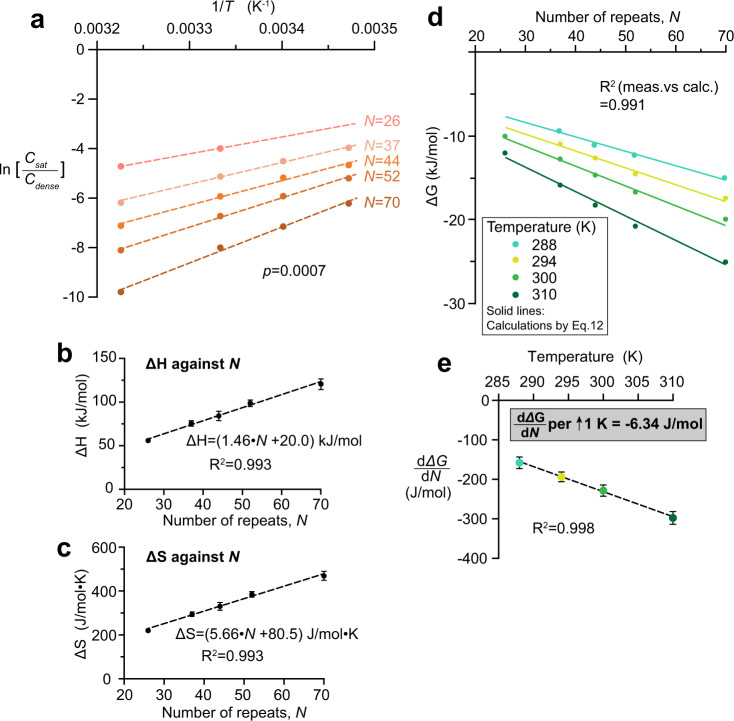
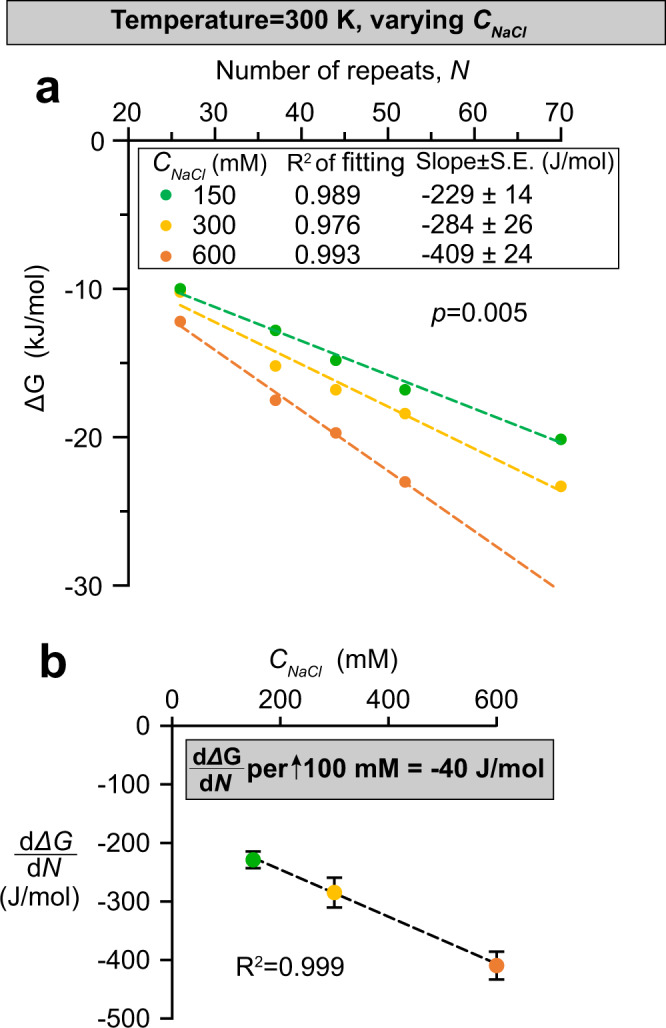
The permeability barrier of nuclear pore complexes (NPCs) controls nucleocytoplasmic transport. It retains inert macromolecules but allows facilitated passage of nuclear transport receptors that shuttle cargoes into or out of nuclei. The barrier can be described as a condensed phase assembled from cohesive FG repeat domains, including foremost the charge-depleted FG domain of Nup98. We found that Nup98 FG domains show an LCST-type phase separation, and we provide comprehensive and orthogonal experimental datasets for a quantitative description of this behaviour. A derived thermodynamic model correlates saturation concentration with repeat number, temperature, and ionic strength. It allows estimating the enthalpy, entropy, and ΔG (0.2 kJ/mol, 0.1 k·T) contributions per repeat to phase separation and inter-repeat cohesion. While changing the cohesion strength strongly impacts the strictness of barrier, these numbers provide boundary conditions for in-depth modelling not only of barrier assembly but also of NPC passage.
核孔复合体 (NPC) 的渗透性屏障控制着核质转运。它保留了无活性的大分子,但允许核转运受体促进货物进出细胞核。该屏障可以被描述为一个凝聚相,由有黏附力的 FG 重复结构域组装而成,其中最重要的是 Nup98 的电荷耗尽 FG 结构域。我们发现 Nup98 FG 结构域表现出 LCST 型相分离,并提供了全面和正交的实验数据集,以对这种行为进行定量描述。推导出的热力学模型将饱和浓度与重复数、温度和离子强度相关联。它允许估计每个重复对相分离和重复间黏附的焓、熵和 ΔG (0.2 kJ/mol, 0.1 k·T) 贡献。虽然改变黏附力会强烈影响屏障的严格程度,但这些数字不仅为屏障组装的深入建模提供了边界条件,也为 NPC 通道的建模提供了边界条件。