Department of Sport Science, Institute III, Otto-Von-Guericke University Magdeburg, Zschokkestraße 32, 39104, Magdeburg, Germany.
Department of Orthopedics, Rostock University Medical Center, Rostock, Germany.
Sports Med. 2023 Jan;53(1):7-31. doi: 10.1007/s40279-022-01748-2. Epub 2022 Oct 18.
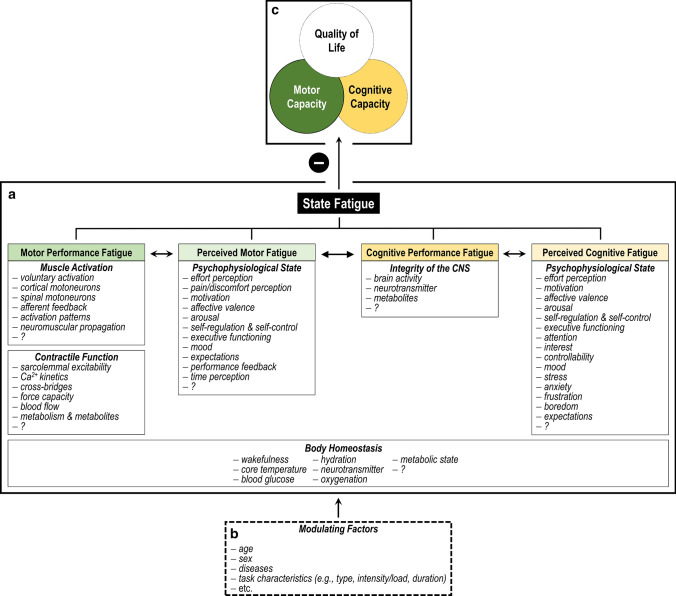
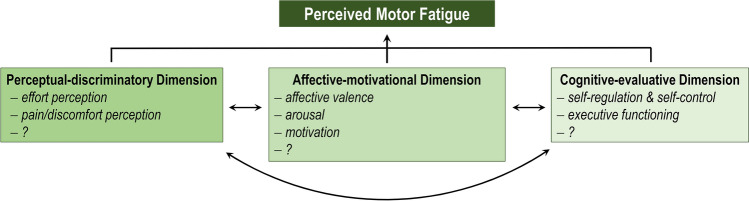
Fatigue has been defined differently in the literature depending on the field of research. The inconsistent use of the term fatigue complicated scientific communication, thereby limiting progress towards a more in-depth understanding of the phenomenon. Therefore, Enoka and Duchateau (Med Sci Sports Exerc 48:2228-38, 2016, [3]) proposed a fatigue framework that distinguishes between trait fatigue (i.e., fatigue experienced by an individual over a longer period of time) and motor or cognitive task-induced state fatigue (i.e., self-reported disabling symptom derived from the two interdependent attributes performance fatigability and perceived fatigability). Thereby, performance fatigability describes a decrease in an objective performance measure, while perceived fatigability refers to the sensations that regulate the integrity of the performer. Although this framework served as a good starting point to unravel the psychophysiology of fatigue, several important aspects were not included and the interdependence of the mechanisms driving performance fatigability and perceived fatigability were not comprehensively discussed. Therefore, the present narrative review aimed to (1) update the fatigue framework suggested by Enoka and Duchateau (Med Sci Sports Exerc 48:2228-38, 2016, [3]) pertaining the taxonomy (i.e., cognitive performance fatigue and perceived cognitive fatigue were added) and important determinants that were not considered previously (e.g., effort perception, affective valence, self-regulation), (2) discuss the mechanisms underlying performance fatigue and perceived fatigue in response to motor and cognitive tasks as well as their interdependence, and (3) provide recommendations for future research on these interactions. We propose to define motor or cognitive task-induced state fatigue as a psychophysiological condition characterized by a decrease in motor or cognitive performance (i.e., motor or cognitive performance fatigue, respectively) and/or an increased perception of fatigue (i.e., perceived motor or cognitive fatigue). These dimensions are interdependent, hinge on different determinants, and depend on body homeostasis (e.g., wakefulness, core temperature) as well as several modulating factors (e.g., age, sex, diseases, characteristics of the motor or cognitive task). Consequently, there is no single factor primarily determining performance fatigue and perceived fatigue in response to motor or cognitive tasks. Instead, the relative weight of each determinant and their interaction are modulated by several factors.
疲劳在不同的文献中根据研究领域的不同而有不同的定义。术语的不一致使用使得科学交流变得复杂,从而限制了对该现象更深入理解的进展。因此,Enoka 和 Duchateau(Med Sci Sports Exerc 48:2228-38, 2016, [3])提出了一个疲劳框架,将特质疲劳(即个体在较长时间内经历的疲劳)与运动或认知任务引起的状态疲劳(即源自两个相互依存的属性表现易疲劳性和感知疲劳性的自我报告的致残症状)区分开来。因此,表现易疲劳性描述了客观表现测量值的下降,而感知疲劳性则指的是调节执行者完整性的感觉。尽管该框架是解开疲劳心理生理学的一个良好起点,但仍有几个重要方面未包括在内,并且没有全面讨论驱动表现易疲劳性和感知疲劳性的机制之间的相互依赖性。因此,本叙事综述旨在:(1)更新 Enoka 和 Duchateau(Med Sci Sports Exerc 48:2228-38, 2016, [3])提出的有关分类(即增加了认知表现疲劳和感知认知疲劳)和以前未考虑的重要决定因素的疲劳框架;(2)讨论运动和认知任务引起的状态疲劳和感知疲劳的机制及其相互依赖性;(3)为这些相互作用的未来研究提供建议。我们建议将运动或认知任务引起的状态疲劳定义为一种心理生理学状态,其特征是运动或认知表现下降(即运动或认知表现疲劳,分别)和/或疲劳感增加(即感知运动或认知疲劳)。这些维度是相互依赖的,取决于不同的决定因素,并取决于身体的内稳态(例如,觉醒,核心温度)以及几个调节因素(例如,年龄,性别,疾病,运动或认知任务的特征)。因此,没有一个单一的因素主要决定对运动或认知任务的反应的表现疲劳和感知疲劳。相反,每个决定因素的相对权重及其相互作用受到多种因素的调节。