Centre for Ecological and Evolutionary Synthesis (CEES), Department of Biosciences, University of Oslo, Oslo 0315, Norway.
Royal Botanic Garden Edinburgh, Edinburgh EH3 5NZ, UK.
Proc Biol Sci. 2022 Oct 26;289(1985):20221107. doi: 10.1098/rspb.2022.1107. Epub 2022 Oct 19.
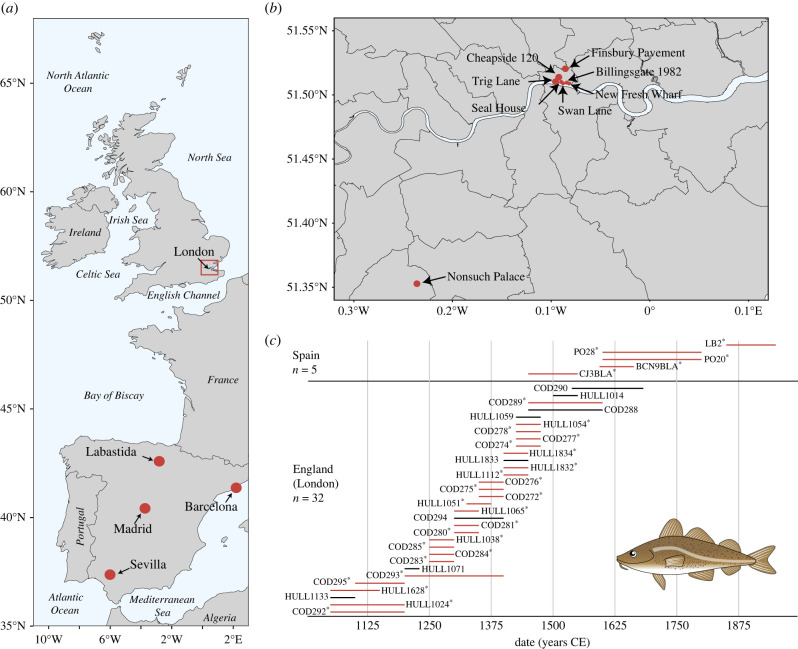
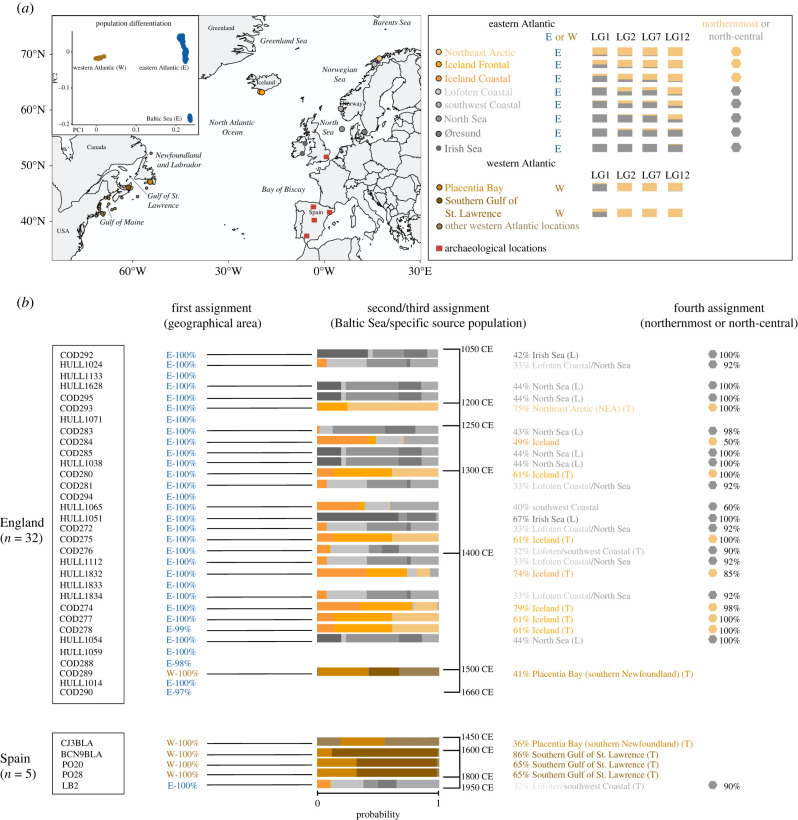
Understanding the historical emergence and growth of long-range fisheries can provide fundamental insights into the timing of ecological impacts and the development of coastal communities during the last millennium. Whole-genome sequencing approaches can improve such understanding by determining the origin of archaeological fish specimens that may have been obtained from historic trade or distant water. Here, we used genome-wide data to individually infer the biological source of 37 ancient Atlantic cod specimens ( 1050-1950 CE) from England and Spain. Our findings provide novel genetic evidence that eleventh- to twelfth-century specimens from London were predominantly obtained from nearby populations, while thirteenth- to fourteenth-century specimens were derived from distant sources. Our results further suggest that Icelandic cod was indeed exported to London earlier than previously reported. Our observations confirm the chronology and geography of the trans-Atlantic cod trade from Newfoundland to Spain starting by the early sixteenth century. Our findings demonstrate the utility of whole-genome sequencing and ancient DNA approaches to describe the globalization of marine fisheries and increase our understanding regarding the extent of the North Atlantic fish trade and long-range fisheries in medieval and early modern times.
了解长距离渔业的历史起源和发展,可以为了解上千年间生态影响的时间以及沿海社区的发展提供基础认识。全基因组测序方法可以通过确定考古鱼类标本的起源来改进这种认识,这些标本可能是从历史贸易或远水地区获得的。在这里,我们使用全基因组数据来单独推断来自英格兰和西班牙的 37 个古代大西洋鳕鱼标本(公元 1050-1950 年)的生物来源。我们的研究结果提供了新的遗传证据,表明来自伦敦的 11 至 12 世纪的标本主要来自附近的种群,而 13 至 14 世纪的标本则来自遥远的来源。我们的研究结果进一步表明,冰岛鳕鱼确实比之前报道的更早出口到伦敦。我们的观察结果证实了从 16 世纪初开始,从纽芬兰到西班牙的跨大西洋鳕鱼贸易的时间和地理顺序。我们的研究结果表明,全基因组测序和古代 DNA 方法可用于描述海洋渔业的全球化,并增加我们对北大西洋鱼类贸易的范围以及中世纪和近代长距离渔业的了解。