University of Michigan Medical School, University of Michigan, Ann Arbor.
Division of Reproductive Endocrinology and Infertility, Department of Obstetrics and Gynecology, University of Michigan, Ann Arbor.
JAMA Netw Open. 2022 Oct 3;5(10):e2236273. doi: 10.1001/jamanetworkopen.2022.36273.
Adult sexual assault (SA) survivors experience numerous emergent health problems, yet few seek emergency medical care. Quantifying the number and types of survivors presenting to US emergency departments (EDs) after SA can inform health care delivery strategies to reduce survivor morbidity and mortality.
To quantify ED use and factors that influenced seeking ED care for adult SA from 2006 through 2019.
DESIGN, SETTING, AND PARTICIPANTS: This cross-sectional study used SA data from the Nationwide Emergency Department Sample from 2006 through 2019, which includes more than 35.8 million observations of US ED visits from 989 hospitals, a 20% stratified sample of hospital-based EDs. The study also used the Federal Bureau of Investigation's Uniform Crime Reporting Program, which includes annual crime data from more than 18 000 law enforcement agencies representing more than 300 million US inhabitants. The study sample included any adult aged 18 to 65 years with an ED visit in the Nationwide Emergency Department Sample coded as SA. The data were analyzed between January 2020 and June 2022.
Annual SA-related ED visits, subsequent hospital admissions, and associated patient-related factors (age, sex, race and ethnicity, income quartile, and insurance) were analyzed using descriptive statistics.
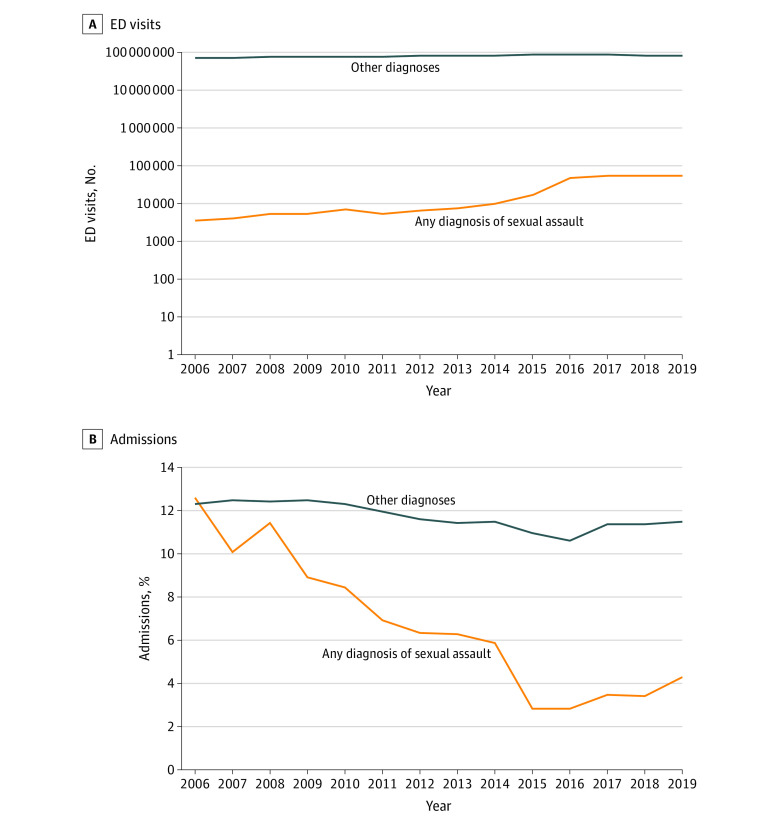
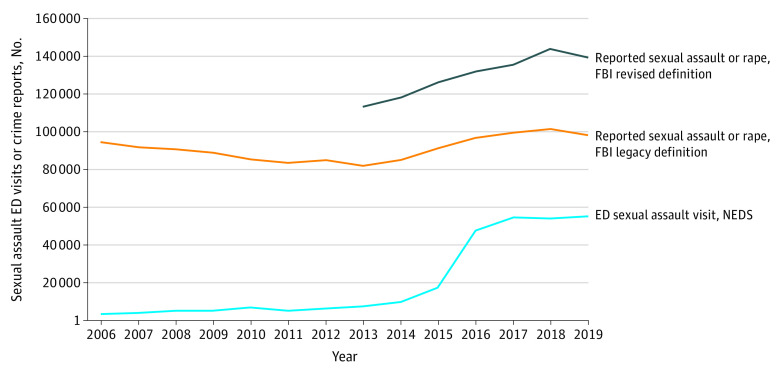
Data were from 120 to 143 million weighted ED visits reported annually from 2006 through 2019. Sexual assault-related ED visits increased more than 1533.0% from 3607 in 2006 to 55 296 in 2019. Concurrently, admission rates for these visits declined from 12.6% to 4.3%. Female, younger, and lower-income individuals were more likely to present to the ED after SA. Older and Medicaid-insured patients were more likely to be admitted. Overall, the rate of ED visits for SA outpaced law enforcement reporting.
This cross-sectional study found that US adult SA ED visits increased from 2006 through 2019 and highlighted the populations who access emergency care most frequently and who more likely need inpatient care. These data can inform policies and the programming needed to support this vulnerable population.
成人性侵犯(SA)幸存者会经历许多突发的健康问题,但很少有人寻求紧急医疗护理。量化在美国急诊部(ED)就诊的 SA 幸存者人数和类型,可以为减少幸存者发病率和死亡率的医疗保健提供策略提供信息。
从 2006 年到 2019 年,量化 ED 的使用情况以及影响成人性侵犯后寻求 ED 护理的因素。
设计、地点和参与者:这项横断面研究使用了 2006 年至 2019 年全国急诊部样本中的 SA 数据,该数据包括来自 989 家医院的超过 3580 万次美国 ED 就诊观察,这是基于医院的 ED 的 20%分层样本。该研究还使用了联邦调查局的统一犯罪报告计划,该计划包括来自代表超过 3 亿美国居民的 18000 多个执法机构的年度犯罪数据。研究样本包括在全国急诊部样本中就诊的任何年龄在 18 至 65 岁之间的 ED 就诊者,该就诊者被编码为 SA。数据在 2020 年 1 月至 2022 年 6 月之间进行了分析。
使用描述性统计方法分析了每年的 SA 相关 ED 就诊、随后的住院治疗以及与患者相关的因素(年龄、性别、种族和民族、收入四分位数和保险)。
数据来自 2006 年至 2019 年每年报告的 1.2 亿至 1.43 亿次加权 ED 就诊。与性侵犯相关的 ED 就诊次数从 2006 年的 3607 次增加了 1533.0%,达到 2019 年的 55296 次。与此同时,这些就诊的入院率从 12.6%下降到 4.3%。女性、年轻和低收入人群在遭受性侵犯后更有可能到 ED 就诊。年龄较大和接受医疗补助保险的患者更有可能被收治入院。总体而言,SA 的 ED 就诊率超过了执法报告。
这项横断面研究发现,美国成人 SA 的 ED 就诊量从 2006 年到 2019 年有所增加,并强调了最常获得紧急护理和更需要住院治疗的人群。这些数据可以为支持这一弱势群体的政策和规划提供信息。