Sousa Ana Beatriz, Águas Artur P, Barbosa Mário A, Barbosa Judite N
i3S-Instituto de Inovação e Investigação em Saúde, Universidade do Porto, Rua Alfredo Allen, 208, 4200-125 Porto, Portugal.
INEB-Instituto de Engenharia Biomédica, Rua Alfredo Allen, 208, 4200-125 Porto, Portugal.
Regen Biomater. 2022 Sep 6;9:rbac065. doi: 10.1093/rb/rbac065. eCollection 2022.
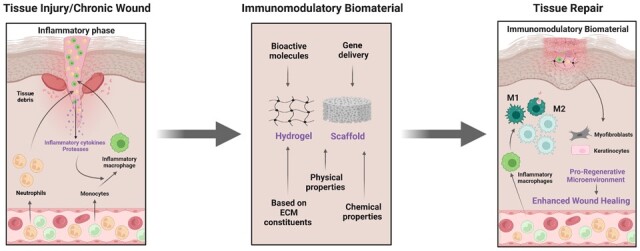
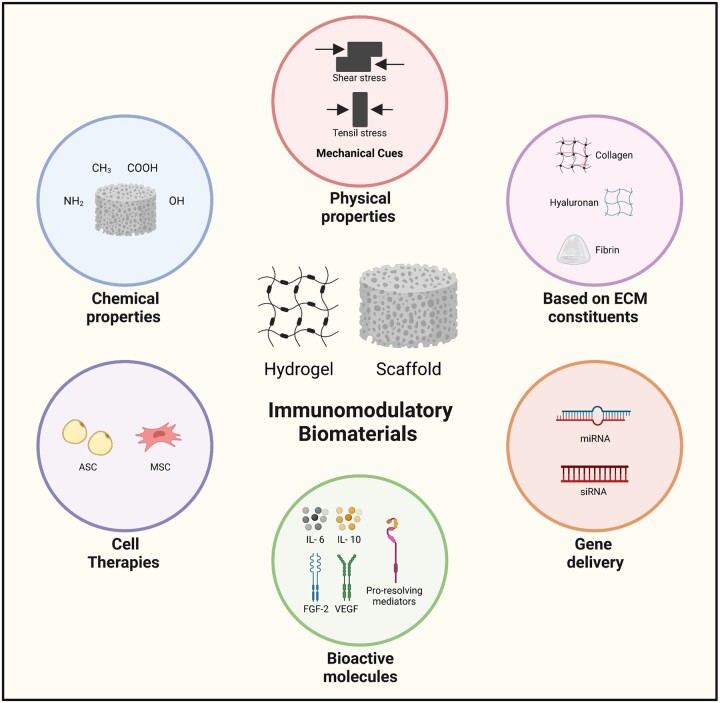
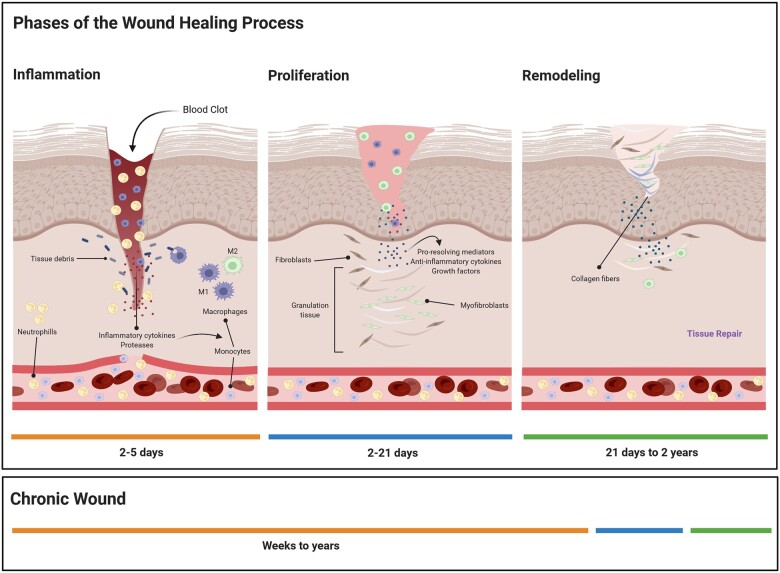
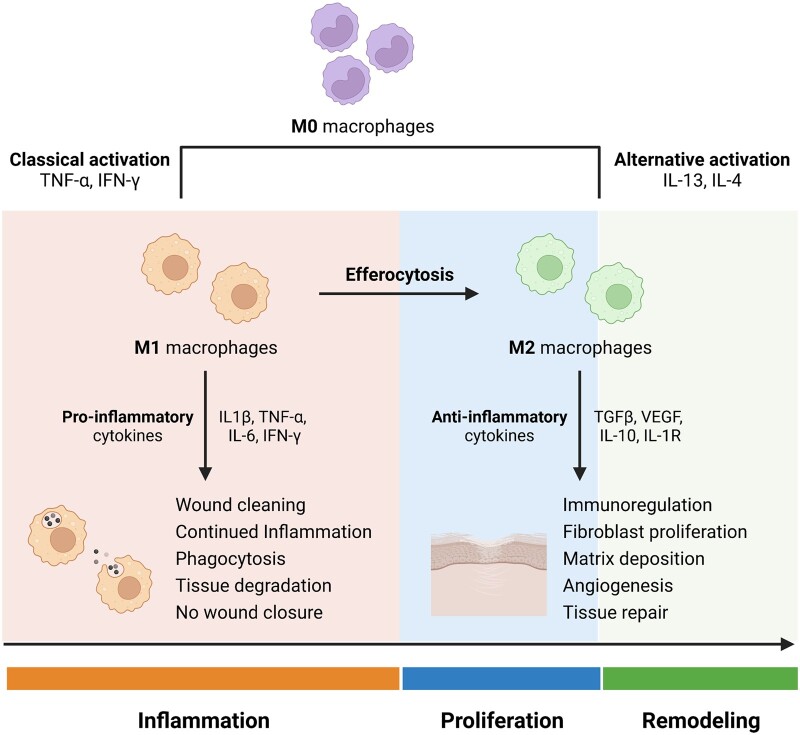
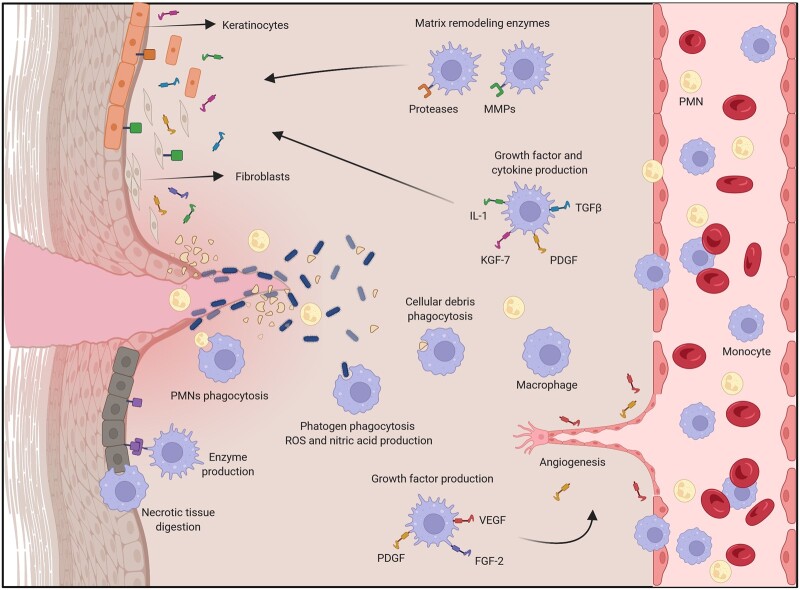
Successful wound healing is a process that has three overlying phases: inflammatory, proliferative and remodeling. Chronic wounds are characterized by a perpetuated inflammation that inhibits the proliferative and remodeling phases and impairs the wound healing. Macrophages are key modulators of the wound healing process. Initially, they are responsible for the wound cleaning and for the phagocytosis of pathogens and afterwards they lead to the resolution of the inflammatory response and they express growth factors important for angiogenesis and cytokines and growth factors needed for cell proliferation and deposition of extracellular matrix. The phenotype of the macrophage changes gradually throughout the healing process from the initial M1 pro-inflammatory phenotype characteristic of the acute response to the M2 pro-regenerative phenotype that allows an accurate tissue repair. In chronic wounds, M1 pro-inflammatory macrophages persist and impair tissue repair. As such, immunomodulatory biomaterials arise as promising solutions to accelerate the wound healing process. In this review, we discuss the importance of macrophages and their polarization throughout the different phases of wound healing; macrophage dysfunction in chronic wounds and the use of immunomodulatory biomaterials to overcome the critical problem of chronic wounds-the continued inflammatory phase that impairs healing.
炎症期、增殖期和重塑期。慢性伤口的特征是炎症持续存在,这会抑制增殖期和重塑期,损害伤口愈合。巨噬细胞是伤口愈合过程的关键调节因子。最初,它们负责伤口清洁和病原体吞噬,随后它们促使炎症反应消退,并表达对血管生成重要的生长因子以及细胞增殖和细胞外基质沉积所需的细胞因子和生长因子。在整个愈合过程中,巨噬细胞的表型逐渐从急性反应特有的初始M1促炎表型转变为允许精确组织修复的M2促再生表型。在慢性伤口中,M1促炎巨噬细胞持续存在并损害组织修复。因此,免疫调节生物材料成为加速伤口愈合过程的有前景的解决方案。在这篇综述中,我们讨论了巨噬细胞及其在伤口愈合不同阶段的极化的重要性;慢性伤口中的巨噬细胞功能障碍以及使用免疫调节生物材料来克服慢性伤口的关键问题——损害愈合的持续炎症期。