
心脏手术后延迟拔管的早期识别:风险预测模型的开发与验证
Early identification of delayed extubation following cardiac surgery: Development and validation of a risk prediction model.
作者信息
Li Xia, Liu Jie, Xu Zhenzhen, Wang Yanting, Chen Lu, Bai Yunxiao, Xie Wanli, Wu Qingping
机构信息
Department of Anesthesiology, Union Hospital, Tongji Medical College, Huazhong University of Science and Technology, Wuhan, China.
出版信息
Front Cardiovasc Med. 2022 Oct 4;9:1002768. doi: 10.3389/fcvm.2022.1002768. eCollection 2022.
BACKGROUND
Successful weaning and extubation after cardiac surgery is an important step of postoperative recovery. Delayed extubation is associated with poor prognosis and high mortality, thereby contributing to a substantial economic burden. The aim of this study was to develop and validate a prediction model estimate the risk of delayed extubation after cardiac surgery based on perioperative risk factors.
METHODS
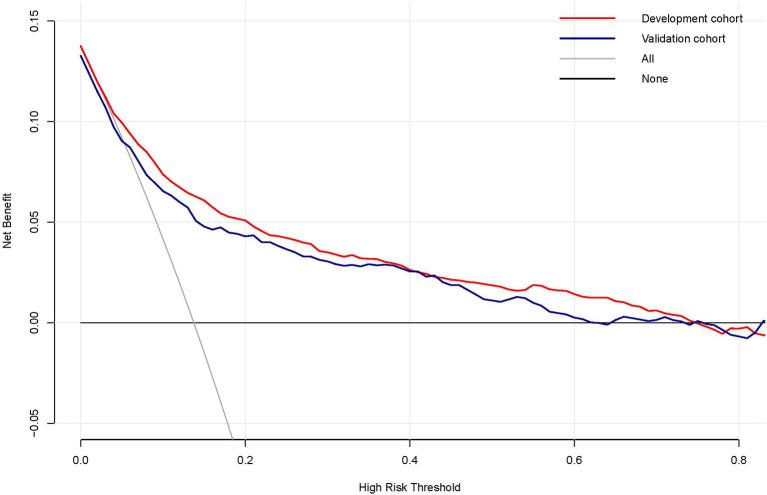
We performed a retrospective cohort study of adult patients undergoing cardiac surgery from 2014 to 2019. Eligible participants were randomly assigned into the development and validation cohorts, with a ratio of 7:3. Variables were selected using least absolute shrinkage and selection operator (LASSO) logistic regression model with 10-fold cross-validation. Multivariable logistic regression was applied to develop a predictive model by introducing the predictors selected from the LASSO regression. Receiver operating characteristic (ROC) curve, calibration plot, decision curve analysis (DCA) and clinical impact curve were used to evaluate the performance of the predictive risk score model.
RESULTS
Among the 3,919 adults included in our study, 533 patients (13.6%) experienced delayed extubation. The median ventilation time was 68 h in the group with delayed extubation and 21 h in the group without delayed extubation. A predictive scoring system was derived based on 10 identified risk factors based on 10 identified risk factors including age, BMI ≥ 28 kg/m, EF < 50%, history of cardiac surgery, type of operation, emergency surgery, CPB ≥ 120 min, duration of surgery, IABP and eGFR < 60 mL/min/1.73 m. According to the scoring system, the patients were classified into three risk intervals: low, medium and high risk. The model performed well in the validation set with AUC of 0.782 and a non-significant -value of 0.901 in the Hosmer-Lemeshow test. The DCA curve and clinical impact curve showed a good clinical utility of this model.
CONCLUSIONS
We developed and validated a prediction score model to predict the risk of delayed extubation after cardiac surgery, which may help identify high-risk patients to target with potential preventive measures.
背景
心脏手术后成功脱机和拔管是术后恢复的重要步骤。延迟拔管与预后不良和高死亡率相关,从而带来巨大的经济负担。本研究的目的是基于围手术期危险因素开发并验证一个预测模型,以估计心脏手术后延迟拔管的风险。
方法
我们对2014年至2019年接受心脏手术的成年患者进行了一项回顾性队列研究。符合条件的参与者被随机分配到开发队列和验证队列,比例为7:3。使用具有10折交叉验证的最小绝对收缩和选择算子(LASSO)逻辑回归模型选择变量。通过引入从LASSO回归中选择的预测变量,应用多变量逻辑回归来开发预测模型。使用受试者工作特征(ROC)曲线、校准图、决策曲线分析(DCA)和临床影响曲线来评估预测风险评分模型的性能。
结果
在我们研究纳入的3919名成年人中,533名患者(13.6%)经历了延迟拔管。延迟拔管组的中位通气时间为68小时,未延迟拔管组为21小时。基于包括年龄、BMI≥28kg/m²、射血分数(EF)<50%、心脏手术史、手术类型、急诊手术、体外循环(CPB)≥120分钟、手术持续时间、主动脉内球囊反搏(IABP)和估算肾小球滤过率(eGFR)<60mL/min/1.73m²在内的10个确定的危险因素,得出了一个预测评分系统。根据该评分系统,患者被分为三个风险区间:低、中、高风险。该模型在验证集中表现良好,曲线下面积(AUC)为0.782,在Hosmer-Lemeshow检验中的P值为0.901,无统计学意义。DCA曲线和临床影响曲线显示该模型具有良好的临床实用性。
结论
我们开发并验证了一个预测评分模型,以预测心脏手术后延迟拔管的风险,这可能有助于识别高危患者,以便采取潜在的预防措施。


 Zotero 插件