Di Novi Cinzia, Leporatti Lucia, Levaggi Rosella, Montefiori Marcello
European Commission, Joint Research Centre (JRC), Via E.Fermi 2749, Ispra, VA 21027, Italy.
Department of Economics, University of Genoa, Via Vivaldi 5, Genoa 16126, Italy.
J Econ Behav Organ. 2022 Dec;204:1-14. doi: 10.1016/j.jebo.2022.10.012. Epub 2022 Oct 14.
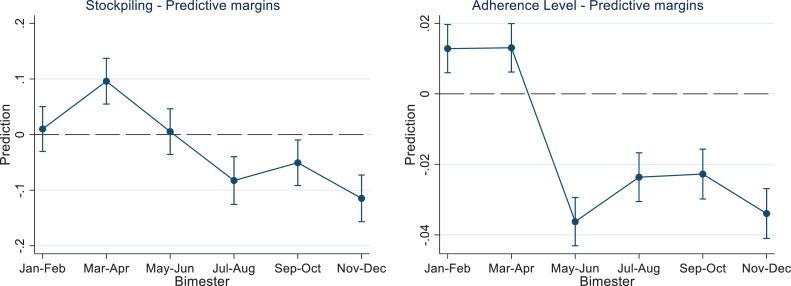
Our study investigates the potential impact that COVID-19 and lockdown restrictions may have had on drug utilization and the role of patient age and education in reshaping it. We focused on patients affected by diabetes mellitus, who are likely to suffer a higher degree of morbidity and mortality due to COVID-19. We used a bi-monthly administrative panel dataset from January 2019 to December 2020 from Liguria (Italy), one of the regions with the highest number of individuals over the age of 65 in Europe. The results demonstrated that, after the initial shock, when patients tried to increase their personal stock of drugs to overcome the risk of possible additional barriers generated by the coronavirus, the hoarding effect almost disappeared. Adherence has drastically reduced during the COVID-19 pandemic and has never reached pre-COVID levels again. Older and poorly educated patients seem to have suffered more from the restrictions imposed by the lockdown and fear of contagion and they may be the ideal target group when considering possible policy interventions to improve adherence.
我们的研究调查了新冠疫情和封锁限制措施可能对药物使用产生的潜在影响,以及患者年龄和教育程度在重塑药物使用方面所起的作用。我们重点关注了糖尿病患者,他们因新冠疫情可能面临更高的发病率和死亡率。我们使用了来自意大利利古里亚地区2019年1月至2020年12月的双月行政面板数据集,该地区是欧洲65岁以上人口数量最多的地区之一。结果表明,在最初的冲击过后,当患者试图增加个人药品储备以克服新冠病毒可能带来的额外障碍风险时,囤积效应几乎消失了。在新冠疫情期间,依从性大幅下降,再也没有恢复到疫情前的水平。年龄较大和受教育程度较低的患者似乎受封锁限制和对感染的恐惧影响更大,在考虑可能改善依从性的政策干预措施时,他们可能是理想的目标群体。