Flanagan Christie A, Finney Rutten Lila J, Kisiel John B, Lent Jennifer K, Bachtold Joseph F, Swartz Andrew W, Redwood Diana G
Alaska Native Tribal Health Consortium, United States.
Mayo Clinic College of Medicine and Sciences, United States.
Contemp Clin Trials Commun. 2022 Oct 10;30:101016. doi: 10.1016/j.conctc.2022.101016. eCollection 2022 Dec.
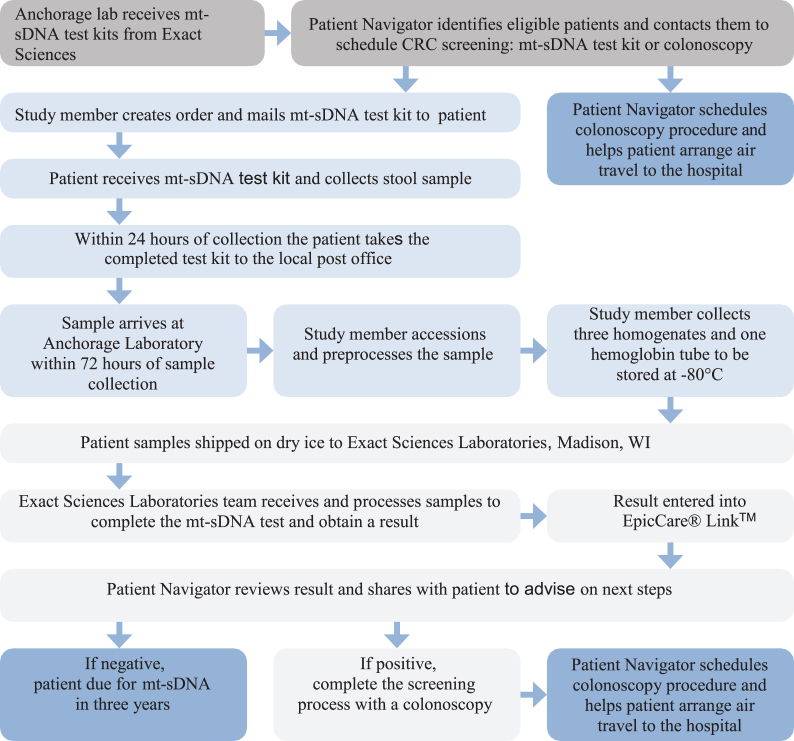
Alaska Native (AN) people experience twice the rate of colorectal cancer (CRC) as US Whites. There is a need for increased screening and early detection. We describe the development and implementation of a randomized controlled trial of the multi-target stool DNA test (mt-sDNA; Cologuard® Exact Sciences, Madison WI) to increase CRC screening among AN people.
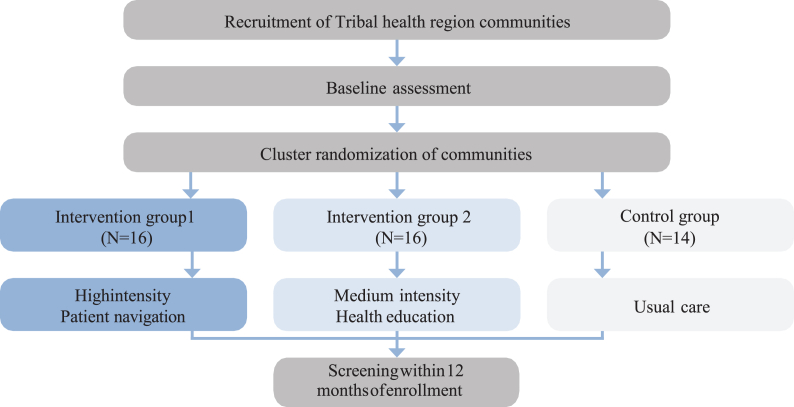
A total of 32 rural/remote AN communities were randomized to a varied intensity intervention (patient navigation vs mailed health education) compared to 14 communities receiving usual opportunistic care. Outcome measures include screening completion and method used (mt-sDNA vs colonoscopy). Health care provider interviews and AN patient focus groups will be used to assess patient-, provider-, and system-level CRC screening promoters and barriers.
The study began in April 2020 during the COVID-19 pandemic, resulting in a number of challenges and study adaptations. These included difficulty finding laboratory space, lack of timely mail service due to flight reductions across the state, and travel restrictions that led to postponement of in-person focus groups. Videoconferencing platforms for Tribal engagement replaced face-to-face interactions. After an extensive search, a laboratory with space available was identified and the preprocessing laboratory established. Study staff will work closely with patients to monitor mail service to get mt-sDNA kits sent on time. We are also exploring the use of videoconferencing platforms as alternatives to in-person focus groups.
Despite the challenges encountered during the COVID-19 pandemic, we successfully initiated the intervention and established the first mt-sDNA preprocessing laboratory in Alaska.
阿拉斯加原住民(AN)患结直肠癌(CRC)的比率是美国白人的两倍。需要加强筛查和早期检测。我们描述了一项多靶点粪便DNA检测(mt-sDNA;Cologuard®,Exact Sciences公司,威斯康星州麦迪逊)随机对照试验的开展和实施情况,以增加AN人群的CRC筛查。
总共32个农村/偏远AN社区被随机分配到不同强度的干预组(患者导航与邮寄健康教育),与之相比,14个社区接受常规机会性护理。结果指标包括筛查完成情况和使用的方法(mt-sDNA与结肠镜检查)。将通过对医疗保健提供者的访谈和AN患者焦点小组来评估患者、提供者和系统层面的CRC筛查促进因素和障碍。
该研究于2020年4月在新冠疫情期间开始,带来了一些挑战并对研究进行了调整。这些挑战包括难以找到实验室空间、由于全州航班减少导致邮件服务不及时,以及旅行限制导致面对面焦点小组推迟。用于部落参与的视频会议平台取代了面对面互动。经过广泛搜索,找到了一个有可用空间的实验室并建立了预处理实验室。研究人员将与患者密切合作,监测邮件服务以便按时发送mt-sDNA检测试剂盒。我们还在探索使用视频会议平台替代面对面焦点小组。
尽管在新冠疫情期间遇到了挑战,但我们成功启动了干预措施,并在阿拉斯加建立了首个mt-sDNA预处理实验室。