• 文献检索
  • 文档翻译
  • 深度研究
  • 学术资讯
  • Suppr Zotero 插件Zotero 插件
  • 邀请有礼
  • 套餐&价格
  • 历史记录
应用&插件
Suppr Zotero 插件Zotero 插件浏览器插件Mac 客户端Windows 客户端微信小程序
定价
高级版会员购买积分包购买API积分包
服务
文献检索文档翻译深度研究API 文档MCP 服务
关于我们
关于 Suppr公司介绍联系我们用户协议隐私条款
关注我们

Suppr 超能文献

核心技术专利:CN118964589B侵权必究
粤ICP备2023148730 号-1Suppr @ 2026

文献检索

告别复杂PubMed语法,用中文像聊天一样搜索,搜遍4000万医学文献。AI智能推荐,让科研检索更轻松。

立即免费搜索

文件翻译

保留排版,准确专业,支持PDF/Word/PPT等文件格式,支持 12+语言互译。

免费翻译文档

深度研究

AI帮你快速写综述,25分钟生成高质量综述,智能提取关键信息,辅助科研写作。

立即免费体验

用于生物防范和应对的传染病预测:机器学习与深度学习方法的系统综述

Predicting infectious disease for biopreparedness and response: A systematic review of machine learning and deep learning approaches.

作者信息

Keshavamurthy Ravikiran, Dixon Samuel, Pazdernik Karl T, Charles Lauren E

机构信息

Pacific Northwest National Laboratory, Richland, WA 99354, USA.

Paul G. Allen School for Global Health, Washington State University, Pullman, WA 99164, USA.

出版信息

One Health. 2022 Oct 1;15:100439. doi: 10.1016/j.onehlt.2022.100439. eCollection 2022 Dec.

DOI:10.1016/j.onehlt.2022.100439
PMID:36277100
原文链接:https://pmc.ncbi.nlm.nih.gov/articles/PMC9582566/
Abstract

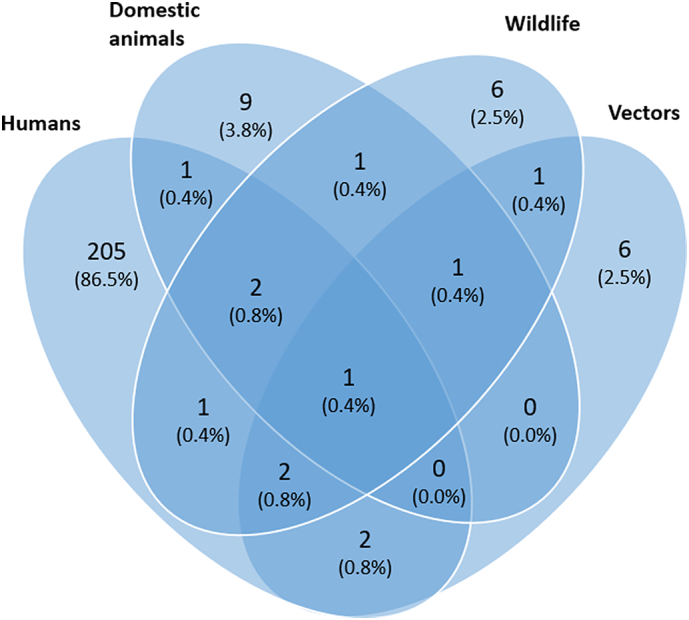
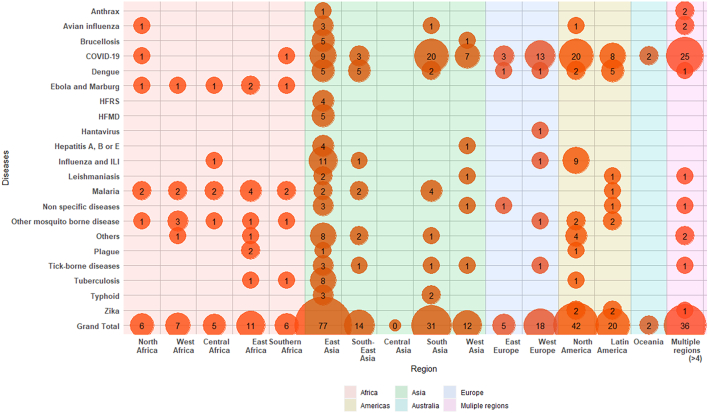
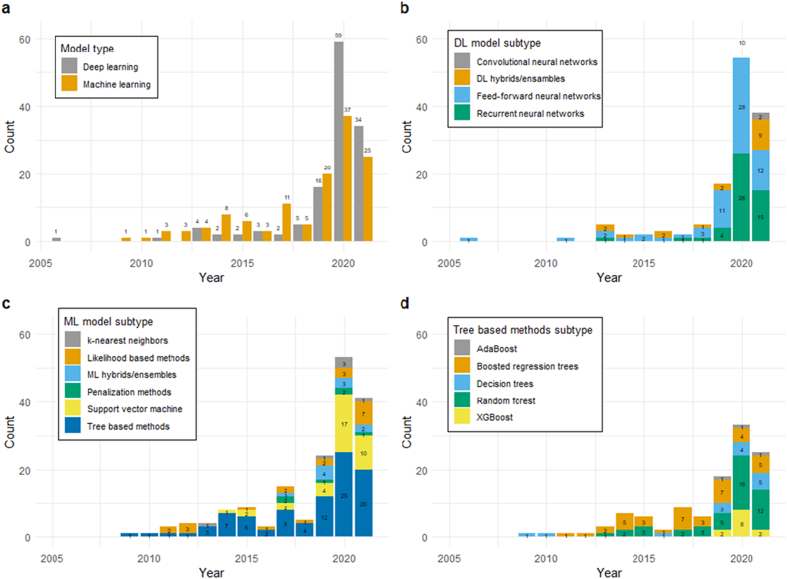
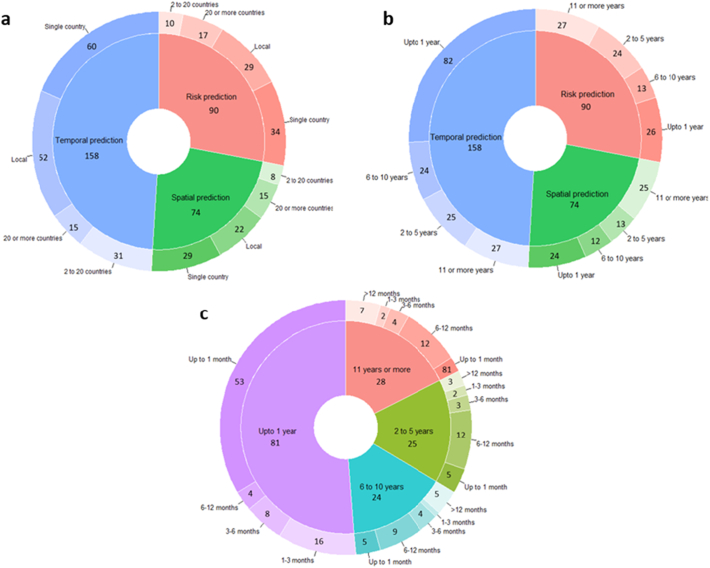
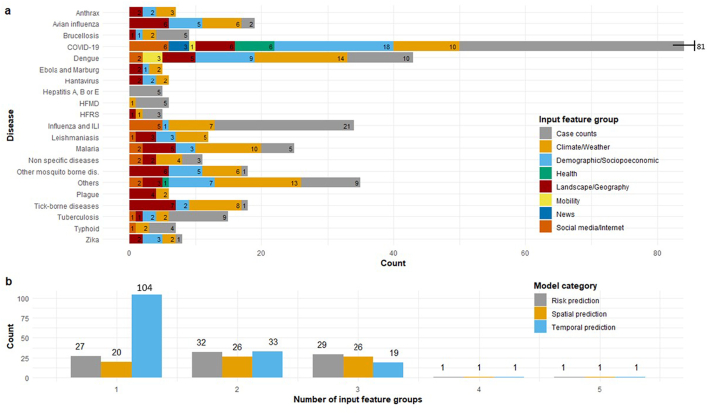
The complex, unpredictable nature of pathogen occurrence has required substantial efforts to accurately predict infectious diseases (IDs). With rising popularity of Machine Learning (ML) and Deep Learning (DL) techniques combined with their unique ability to uncover connections between large amounts of diverse data, we conducted a PRISMA systematic review to investigate advances in ID prediction for human and animal diseases using ML and DL. This review included the type of IDs modeled, ML and DL techniques utilized, geographical distribution, prediction tasks performed, input features utilized, spatial and temporal scales, error metrics used, computational efficiency, uncertainty quantification, and missing data handling methods. Among 237 relevant articles published between January 2001 and May 2021, highly contagious diseases in humans were most often represented, including COVID-19 (37.1%), influenza/influenza-like illnesses (9.3%), dengue (8.9%), and malaria (5.1%). Out of 37 diseases identified, 51.4% were zoonotic, 37.8% were human-only, and 8.1% were animal-only, with only 1.6% economically significant, non-zoonotic livestock diseases. Despite the number of zoonoses, 86.5% of articles modeled humans whereas only a few articles (5.1%) contained more than one host species. Eastern Asia (32.5%), North America (17.7%), and Southern Asia (13.1%) were the most represented locations. Frequent approaches included tree-based ML (38.4%) and feed-forward neural networks (26.6%). Articles predicted temporal incidence (66.7%), disease risk (38.0%), and/or spatial movement (31.2%). Less than 10% of studies addressed uncertainty quantification, computational efficiency, and missing data, which are essential to operational use and deployment. This study highlights trends and gaps in ML and DL for ID prediction, providing guidelines for future works to better support biopreparedness and response. To fully utilize ML and DL for improved ID forecasting, models should include the full disease ecology in a One-Health context, important food and agricultural diseases, underrepresented hotspots, and important metrics required for operational deployment.

摘要

病原体出现的复杂性和不可预测性使得人们付出了巨大努力来准确预测传染病(ID)。随着机器学习(ML)和深度学习(DL)技术的日益普及,以及它们揭示大量不同数据之间联系的独特能力,我们进行了一项PRISMA系统综述,以研究使用ML和DL对人类和动物疾病进行ID预测的进展。该综述涵盖了所建模的ID类型、所使用的ML和DL技术、地理分布、执行的预测任务、所使用的输入特征、时空尺度、误差度量、计算效率、不确定性量化以及缺失数据处理方法。在2001年1月至2021年5月发表的237篇相关文章中,人类的高传染性疾病最为常见,包括新冠肺炎(37.1%)、流感/流感样疾病(9.3%)、登革热(8.9%)和疟疾(5.1%)。在确定的37种疾病中,51.4%是人畜共患病,37.8%仅感染人类,8.1%仅感染动物,只有1.6%是具有经济重要性的非人畜共患家畜疾病。尽管人畜共患病数量众多,但86.5%的文章以人类为模型,而只有少数文章(5.1%)包含不止一种宿主物种。东亚(32.5%)、北美(17.7%)和南亚(13.1%)是文章中最常出现的地区。常见的方法包括基于树的ML(38.4%)和前馈神经网络(26.6%)。文章预测了时间发病率(66.7%)、疾病风险(38.0%)和/或空间移动(31.2%)。不到10%的研究涉及不确定性量化、计算效率和缺失数据,而这些对于实际应用和部署至关重要。本研究突出了ML和DL在ID预测方面的趋势和差距,为未来的工作提供了指导方针,以更好地支持生物防范和应对。为了充分利用ML和DL改进ID预测,模型应在“同一健康”背景下纳入完整的疾病生态学、重要的粮食和农业疾病、未得到充分研究的热点地区以及实际部署所需的重要指标。
https://cdn.ncbi.nlm.nih.gov/pmc/blobs/da9c/9582566/fe5a34f4f843/gr8.jpg
https://cdn.ncbi.nlm.nih.gov/pmc/blobs/da9c/9582566/db30c51aefb7/gr1.jpg
https://cdn.ncbi.nlm.nih.gov/pmc/blobs/da9c/9582566/9b0ae837e314/gr2.jpg
https://cdn.ncbi.nlm.nih.gov/pmc/blobs/da9c/9582566/b095ef8fbe82/gr3.jpg
https://cdn.ncbi.nlm.nih.gov/pmc/blobs/da9c/9582566/3d5dc714f59b/gr4.jpg
https://cdn.ncbi.nlm.nih.gov/pmc/blobs/da9c/9582566/36cc9f416d79/gr5.jpg
https://cdn.ncbi.nlm.nih.gov/pmc/blobs/da9c/9582566/19b82b28aff3/gr6.jpg
https://cdn.ncbi.nlm.nih.gov/pmc/blobs/da9c/9582566/faa171bb345d/gr7.jpg
https://cdn.ncbi.nlm.nih.gov/pmc/blobs/da9c/9582566/fe5a34f4f843/gr8.jpg
https://cdn.ncbi.nlm.nih.gov/pmc/blobs/da9c/9582566/db30c51aefb7/gr1.jpg
https://cdn.ncbi.nlm.nih.gov/pmc/blobs/da9c/9582566/9b0ae837e314/gr2.jpg
https://cdn.ncbi.nlm.nih.gov/pmc/blobs/da9c/9582566/b095ef8fbe82/gr3.jpg
https://cdn.ncbi.nlm.nih.gov/pmc/blobs/da9c/9582566/3d5dc714f59b/gr4.jpg
https://cdn.ncbi.nlm.nih.gov/pmc/blobs/da9c/9582566/36cc9f416d79/gr5.jpg
https://cdn.ncbi.nlm.nih.gov/pmc/blobs/da9c/9582566/19b82b28aff3/gr6.jpg
https://cdn.ncbi.nlm.nih.gov/pmc/blobs/da9c/9582566/faa171bb345d/gr7.jpg
https://cdn.ncbi.nlm.nih.gov/pmc/blobs/da9c/9582566/fe5a34f4f843/gr8.jpg

相似文献

1
Predicting infectious disease for biopreparedness and response: A systematic review of machine learning and deep learning approaches.用于生物防范和应对的传染病预测:机器学习与深度学习方法的系统综述
One Health. 2022 Oct 1;15:100439. doi: 10.1016/j.onehlt.2022.100439. eCollection 2022 Dec.
2
Folic acid supplementation and malaria susceptibility and severity among people taking antifolate antimalarial drugs in endemic areas.在流行地区,服用抗叶酸抗疟药物的人群中,叶酸补充剂与疟疾易感性和严重程度的关系。
Cochrane Database Syst Rev. 2022 Feb 1;2(2022):CD014217. doi: 10.1002/14651858.CD014217.
3
Data-driven modeling and prediction of blood glucose dynamics: Machine learning applications in type 1 diabetes.基于数据驱动的血糖动力学建模与预测:机器学习在 1 型糖尿病中的应用。
Artif Intell Med. 2019 Jul;98:109-134. doi: 10.1016/j.artmed.2019.07.007. Epub 2019 Jul 26.
4
The future of Cochrane Neonatal.考克兰新生儿协作网的未来。
Early Hum Dev. 2020 Nov;150:105191. doi: 10.1016/j.earlhumdev.2020.105191. Epub 2020 Sep 12.
5
Review of Machine Learning Techniques in Soft Tissue Biomechanics and Biomaterials.机器学习技术在软组织生物力学和生物材料中的应用综述。
Cardiovasc Eng Technol. 2024 Oct;15(5):522-549. doi: 10.1007/s13239-024-00737-y. Epub 2024 Jul 2.
6
Deep learning techniques for detection and prediction of pandemic diseases: a systematic literature review.用于大流行疾病检测与预测的深度学习技术:一项系统的文献综述
Multimed Tools Appl. 2023 May 29:1-35. doi: 10.1007/s11042-023-15805-z.
7
A Comparison of Infectious Disease Forecasting Methods across Locations, Diseases, and Time.不同地点、疾病和时间的传染病预测方法比较
Pathogens. 2022 Jan 29;11(2):185. doi: 10.3390/pathogens11020185.
8
Machine Learning Approaches to Predict Symptoms in People With Cancer: Systematic Review.预测癌症患者症状的机器学习方法:系统综述
JMIR Cancer. 2024 Mar 19;10:e52322. doi: 10.2196/52322.
9
Machine and Deep Learning for Tuberculosis Detection on Chest X-Rays: Systematic Literature Review.基于 X 光片的结核病检测中的机器和深度学习:系统文献综述。
J Med Internet Res. 2023 Jul 3;25:e43154. doi: 10.2196/43154.
10
Diagnosis of COVID-19 Using Machine Learning and Deep Learning: A Review.基于机器学习和深度学习的 COVID-19 诊断:综述。
Curr Med Imaging. 2021;17(12):1403-1418. doi: 10.2174/1573405617666210713113439.

引用本文的文献

1
Interpretable machine learning analysis of environmental characteristics on bacillary dysentery in Sichuan Province.四川省细菌性痢疾环境特征的可解释机器学习分析
Front Public Health. 2025 Jul 16;13:1598247. doi: 10.3389/fpubh.2025.1598247. eCollection 2025.
2
Machine Learning and Artificial Intelligence for Infectious Disease Surveillance, Diagnosis, and Prognosis.用于传染病监测、诊断和预后的机器学习与人工智能
Viruses. 2025 Jun 23;17(7):882. doi: 10.3390/v17070882.
3
Navigating the Interconnected Web of Health: A Comprehensive Review of the One Health Paradigm and Its Implications for Disease Management.

本文引用的文献

1
A Comparison of Infectious Disease Forecasting Methods across Locations, Diseases, and Time.不同地点、疾病和时间的传染病预测方法比较
Pathogens. 2022 Jan 29;11(2):185. doi: 10.3390/pathogens11020185.
2
Artificial Intelligence for Healthcare in Africa.非洲医疗保健领域的人工智能
Front Digit Health. 2020 Jul 7;2:6. doi: 10.3389/fdgth.2020.00006. eCollection 2020.
3
A Roadmap for Building Data Science Capacity for Health Discovery and Innovation in Africa.非洲健康发现与创新的数据科学能力建设路线图
探索健康的互联网络:“同一健康”范式及其对疾病管理影响的全面综述
Yonsei Med J. 2025 Apr;66(4):203-210. doi: 10.3349/ymj.2024.0108.
4
Meeting Global Health Needs via Infectious Disease Forecasting: Development of a Reliable Data-Driven Framework.通过传染病预测满足全球卫生需求:可靠的数据驱动框架的开发
JMIR Public Health Surveill. 2025 Mar 21;11:e59971. doi: 10.2196/59971.
5
Closing the air gap: the use of drones for studying wildlife ecophysiology.缩小差距:利用无人机研究野生动物生态生理学。
Biol Rev Camb Philos Soc. 2025 Jun;100(3):1206-1228. doi: 10.1111/brv.13181. Epub 2025 Jan 17.
6
Prediction analysis of human brucellosis cases in Ili Kazakh Autonomous Prefecture Xinjiang China based on time series.基于时间序列的中国新疆伊犁哈萨克自治州人间布鲁氏菌病病例预测分析
Sci Rep. 2025 Jan 7;15(1):1232. doi: 10.1038/s41598-024-80513-z.
7
The potential of remote sensing for improved infectious disease ecology research and practice.遥感技术在改善传染病生态学研究与实践方面的潜力。
Proc Biol Sci. 2024 Dec;291(2037):20241712. doi: 10.1098/rspb.2024.1712. Epub 2024 Dec 18.
8
A within-subject voxel-wise constant-block partial least squares correlation method to explore MRI-based brain structure-function relationship.一种用于探索基于磁共振成像(MRI)的脑结构-功能关系的受试者内体素级恒定块偏最小二乘相关方法。
Cogn Neurodyn. 2024 Jun;18(3):813-827. doi: 10.1007/s11571-023-09941-3. Epub 2023 Feb 18.
9
Machine learning to improve the understanding of rabies epidemiology in low surveillance settings.机器学习提高低监测环境中狂犬病流行病学的理解。
Sci Rep. 2024 Oct 28;14(1):25851. doi: 10.1038/s41598-024-76089-3.
10
Machine learning approaches for influenza A virus risk assessment identifies predictive correlates using ferret model in vivo data.用于甲型流感病毒风险评估的机器学习方法利用雪貂模型体内数据识别预测相关因素。
Commun Biol. 2024 Aug 1;7(1):927. doi: 10.1038/s42003-024-06629-0.
Front Public Health. 2021 Oct 11;9:710961. doi: 10.3389/fpubh.2021.710961. eCollection 2021.
4
Operational Considerations in Global Health Modeling.全球卫生建模中的操作考量
Pathogens. 2021 Oct 19;10(10):1348. doi: 10.3390/pathogens10101348.
5
Digital Biosurveillance for Zoonotic Disease Detection in Kenya.肯尼亚用于人畜共患病检测的数字生物监测
Pathogens. 2021 Jun 22;10(7):783. doi: 10.3390/pathogens10070783.
6
The roles of machine learning methods in limiting the spread of deadly diseases: A systematic review.机器学习方法在限制致命疾病传播中的作用:一项系统综述。
Heliyon. 2021 Jun;7(6):e07371. doi: 10.1016/j.heliyon.2021.e07371. Epub 2021 Jun 23.
7
Covid-19 Dynamic Monitoring and Real-Time Spatio-Temporal Forecasting.Covid-19 动态监测与实时时空预测。
Front Public Health. 2021 Apr 8;9:641253. doi: 10.3389/fpubh.2021.641253. eCollection 2021.
8
Development and dissemination of infectious disease dynamic transmission models during the COVID-19 pandemic: what can we learn from other pathogens and how can we move forward?新冠疫情期间传染病动力学传播模型的开发与传播:我们可以从其他病原体中学到什么,以及如何向前推进?
Lancet Digit Health. 2021 Jan;3(1):e41-e50. doi: 10.1016/S2589-7500(20)30268-5. Epub 2020 Dec 7.
9
Enhancing fine-grained intra-urban dengue forecasting by integrating spatial interactions of human movements between urban regions.通过整合城市区域间人类活动的空间相互作用,提高城市内登革热的精细预测精度。
PLoS Negl Trop Dis. 2020 Dec 21;14(12):e0008924. doi: 10.1371/journal.pntd.0008924. eCollection 2020 Dec.
10
Predicting population health with machine learning: a scoping review.利用机器学习预测人群健康:一项范围综述
BMJ Open. 2020 Oct 27;10(10):e037860. doi: 10.1136/bmjopen-2020-037860.