Division of Infectious Diseases, Department of Paediatrics, The Hospital for Sick Children, Toronto, Ontario, Canada.
Public Health Ontario, Toronto, Ontario, Canada.
JAMA Pediatr. 2022 Dec 1;176(12):1169-1175. doi: 10.1001/jamapediatrics.2022.3833.
Wearing a face mask in school can reduce SARS-CoV-2 transmission but it may also lead to increased hand-to-face contact, which in turn could increase infection risk through self-inoculation.
To evaluate the effect of wearing a face mask on hand-to-face contact by children while at school.
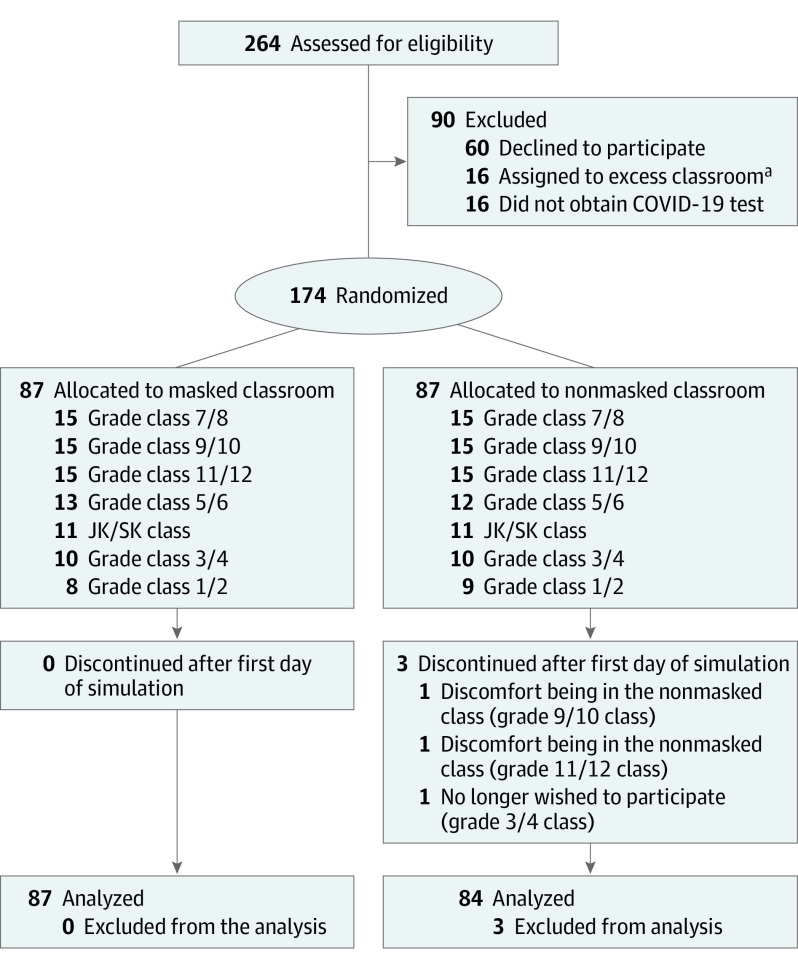
DESIGN, SETTING, AND PARTICIPANTS: This prospective randomized clinical trial randomized students from junior kindergarten to grade 12 at 2 schools in Toronto, Ontario, Canada, during August 2020 in a 1:1 ratio to either a mask or control class during a 2-day school simulation. Classes were video recorded from 4 angles to accurately capture outcomes.
Participants in the mask arm were instructed to bring their own mask and wear it at all times. Students assigned to control classes were not required to mask at any time (grade 4 and lower) or in the classroom where physical distancing could be maintained (grade 5 and up).
The primary outcome was the number of hand-to-face contacts per student per hour on day 2 of the simulation. Secondary outcomes included hand-to-mucosa contacts and hand-to-nonmucosa contacts. A mixed Poisson regression model was used to derive rate ratios (RRs), adjusted for age and sex with a random intercept for class with bootstrapped 95% CIs.
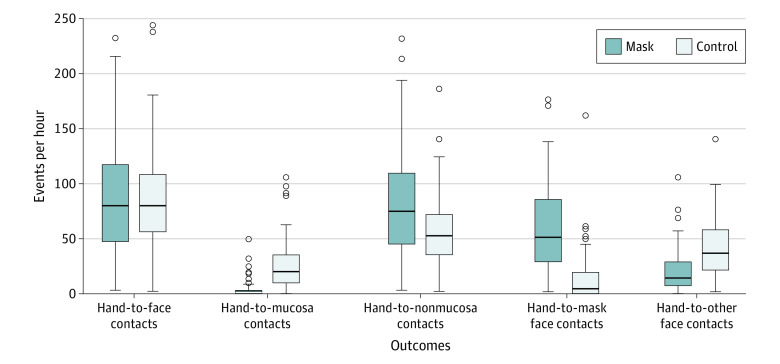
A total of 174 students underwent randomization and 171 students (mask group, 50.6% male; control group, 52.4% male) attended school on day 2. The rate of hand-to-face contacts did not differ significantly between the mask and the control groups (88.2 vs 88.7 events per student per hour; RR, 1.00; 95% CI, 0.78-1.28; P = >.99). When compared with the control group, the rate of hand-to-mucosa contacts was significantly lower in the mask group (RR, 0.12; 95% CI, 0.07-0.21), while the rate of hand-to-nonmucosa contacts was higher (RR, 1.40; 95% CI, 1.08-1.82).
In this clinical trial of simulated school attendance, hand-to-face contacts did not differ among students required to wear face masks vs students not required to wear face masks; however, hand-to-mucosa contracts were lower in the face mask group. This suggests that mask wearing is unlikely to increase infection risk through self-inoculation.
ClinicalTrials.gov Identifier: NCT04531254.
在学校佩戴口罩可以减少 SARS-CoV-2 的传播,但也可能导致学生更多地接触自己的手,从而增加通过自我接种感染的风险。
评估在校学生佩戴口罩对面部接触的影响。
设计、地点和参与者:这是一项在加拿大安大略省多伦多的 2 所学校进行的前瞻性随机临床试验,在 2020 年 8 月,将幼儿园到 12 年级的学生以 1:1 的比例随机分配到口罩组或对照组,在为期 2 天的学校模拟中,口罩组的学生被要求全程佩戴口罩,而对照组的学生则无需佩戴口罩(四年级及以下)或在可以保持身体距离的教室(五年级及以上)。
口罩组的学生被要求自带口罩并全程佩戴。被分配到对照组的学生在任何时候都不需要戴口罩(四年级及以下)或在可以保持身体距离的教室(五年级及以上)。
主要结局是模拟日 2 学生每小时的手部接触面部次数。次要结局包括手部接触黏膜和非黏膜。采用混合泊松回归模型计算率比(RR),根据年龄和性别进行调整,并对班级进行随机截距分析,置信区间为 95%。
共有 174 名学生接受了随机分组,其中 171 名学生(口罩组 50.6%为男性;对照组 52.4%为男性)在模拟日 2 上学。口罩组和对照组的手部接触面部的频率差异无统计学意义(88.2 次/小时vs 88.7 次/小时;RR,1.00;95%CI,0.78-1.28;P>.99)。与对照组相比,口罩组手部接触黏膜的频率明显较低(RR,0.12;95%CI,0.07-0.21),而手部接触非黏膜的频率较高(RR,1.40;95%CI,1.08-1.82)。
在这项模拟学校出勤的临床试验中,需要佩戴口罩的学生与不需要佩戴口罩的学生之间的手部接触频率没有差异;然而,口罩组的手部接触黏膜的频率较低。这表明佩戴口罩不太可能通过自我接种增加感染风险。
ClinicalTrials.gov 标识符:NCT04531254。