Coelho Sophie G, Segovia Alicia, Anthony Samantha J, Lin Jia, Pol Sarah, Crosbie Jennifer, Science Michelle, Matava Clyde T, Parekh Rulan S, Caldeira-Kulbakas Monica, Carroll Stacie, Greenwood Jodi L, Panzera Giovanna, Imgrund Ryan, Osokin Konstantin, Korczak Daphne J
Department of Psychiatry, Hospital for Sick Children, Toronto, Ontario, Canada.
Child Health Evaluative Sciences, Hospital for Sick Children, Toronto, Ontario, Canada.
Paediatr Child Health. 2022 May 5;27(Suppl 1):S15-S21. doi: 10.1093/pch/pxab102. eCollection 2022 Jun.
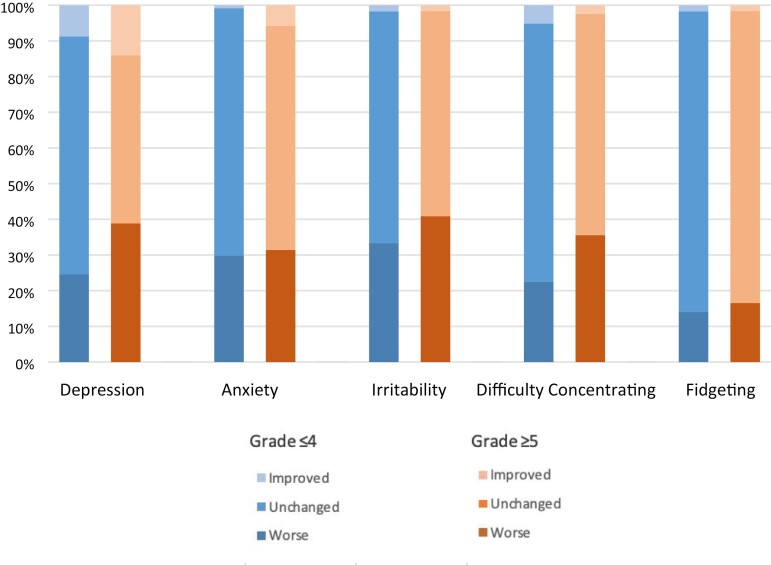
This study examined children's perspectives about returning to in-person school following lockdown due to the pandemic and about mask-wearing in class, as well as the mental health of children and parents during the pandemic.
This cross-sectional study was part of a 2-day school simulation exercise that randomized students to different masking recommendations. Parent-report of mental health and post-simulation child-report of COVID-19-related anxiety and mask-wearing were analyzed using descriptive and multiple regression analyses. Semi-structured focus groups were conducted with older students to supplement questionnaire data.
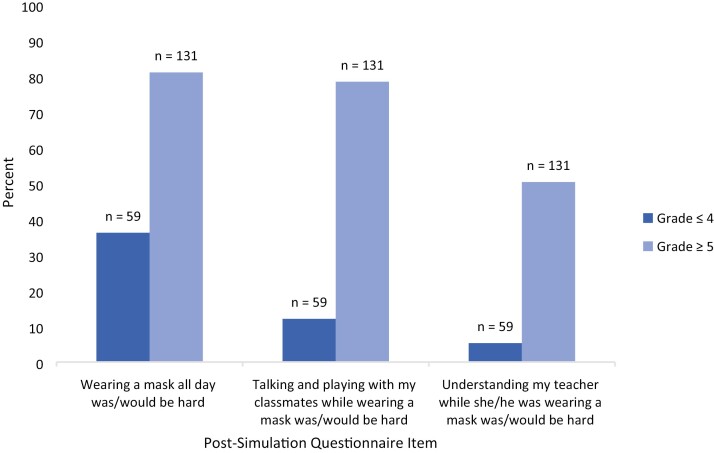
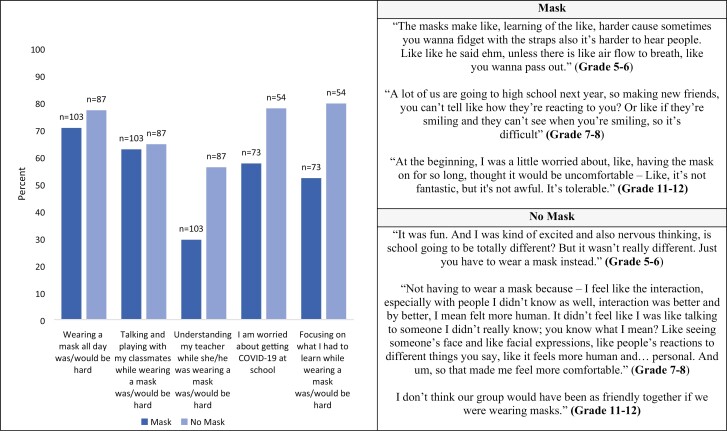
Of 190 students in this study, 31% were in grade 4 or lower 95% looked forward to returning to in-person school. Greater child anxiety about COVID-19 was predicted by increased parent/caregiver anxiety (β=0.67; P<0.001), and lower parental educational attainment (β=1.86; P<0.002). Older students were more likely than younger students to report that mask-wearing interfered with their abilities to interact with peers (χ(1)=31.16; P<0.001) and understand the teacher (χ(1)=13.97; P<0.001). Students in the group that did not require masks were more likely than students in the masking group to report worries about contracting COVID-19 at school (χ(1)=10.07; P<0.05), and anticipated difficulty wearing a mask (χ(1)=18.95; P<0.001).
For children anxious about COVID-19, parental anxiety and education about COVID-19 may be targets for intervention. Future research should examine the impact of prolonged implementation of public health mitigation strategies in school on academic achievement and children's mental health.
本研究调查了儿童对于疫情封锁后重返面对面授课学校的看法、对课堂佩戴口罩的看法,以及疫情期间儿童和家长的心理健康状况。
这项横断面研究是一项为期两天的学校模拟活动的一部分,该活动将学生随机分配到不同的口罩佩戴建议组。使用描述性分析和多元回归分析对家长报告的心理健康状况以及模拟活动后儿童报告的与新冠病毒相关的焦虑和口罩佩戴情况进行分析。对年龄较大的学生进行了半结构化焦点小组访谈,以补充问卷调查数据。
本研究中的190名学生中,31%为四年级及以下,95%的学生期待重返面对面授课学校。家长/照顾者焦虑情绪增加(β=0.67;P<0.001)以及家长教育程度较低(β=1.86;P<0.002)可预测儿童对新冠病毒的焦虑情绪更高。与年龄较小的学生相比,年龄较大的学生更有可能报告佩戴口罩妨碍了他们与同伴互动的能力(χ(1)=31.16;P<0.001)以及理解老师授课的能力(χ(1)=13.97;P<0.001)。与佩戴口罩组的学生相比,无需佩戴口罩组的学生更有可能报告担心在学校感染新冠病毒(χ(1)=10.07;P<0.05),并预计佩戴口罩会有困难(χ(1)=18.95;P<0.001)。
对于担心新冠病毒的儿童,家长对新冠病毒的焦虑情绪和相关教育可能是干预的目标。未来的研究应调查学校长期实施公共卫生缓解策略对学业成绩和儿童心理健康的影响。