Institute of Social and Preventive Medicine, University of Bern, Bern, Switzerland.
The Ryan White Center for Pediatric Infectious Disease and Global Health, Department of Pediatrics, Indiana University School of Medicine, Indianapolis, Indiana, USA.
J Int AIDS Soc. 2022 Oct;25(10):e26018. doi: 10.1002/jia2.26018.
COVID-19 stretched healthcare systems to their limits, particularly in settings with a pre-existing high burden of infectious diseases, including HIV and tuberculosis (TB). We studied the impact of COVID-19 on TB services at antiretroviral therapy (ART) clinics in low- and middle-income countries.
We surveyed ART clinics providing TB services in the International Epidemiology Databases to Evaluate AIDS (IeDEA) consortium in Africa and the Asia-Pacific until July 2021 (TB diagnoses until the end of 2021). We collected site-level data using standardized questionnaires.
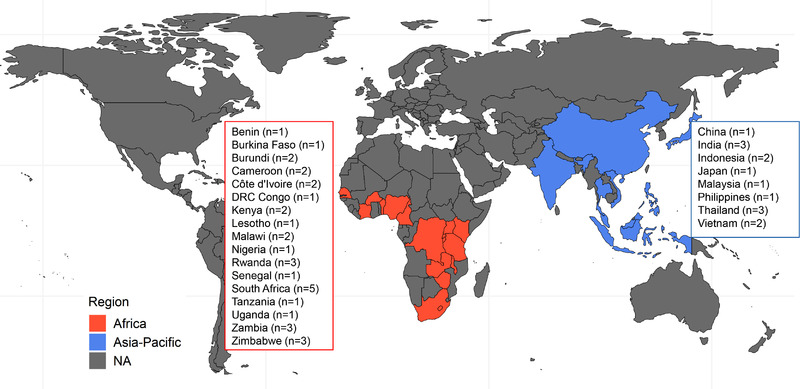
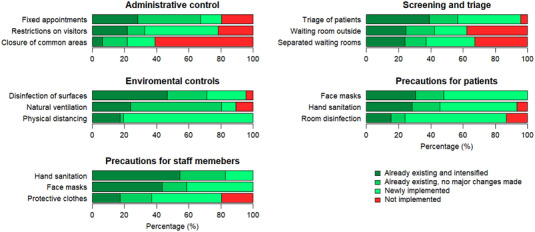
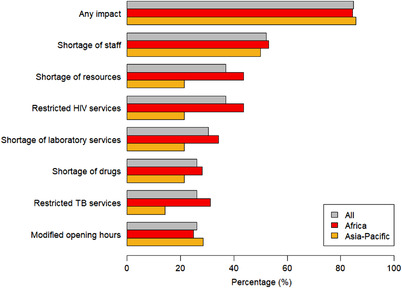
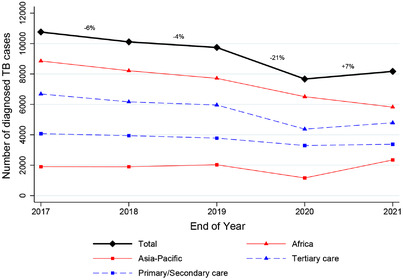
Of 46 participating ART clinics, 32 (70%) were in Africa and 14 (30%) in the Asia-Pacific; 52% provided tertiary care. Most clinics (85%) reported disrupted routine HIV care services during the pandemic, both in Africa (84%) and the Asia-Pacific (86%). The most frequently reported impacts were on staff (52%) and resource shortages (37%; protective clothing, face masks and disinfectants). Restrictions in TB health services were observed in 12 clinics (26%), mainly reduced access to TB diagnosis and postponed follow-up visits (6/12, 50% each), and restrictions in TB laboratory services (22%). Restrictions of TB services were addressed by dispensing TB drugs for longer periods than usual (7/12, 58%), providing telehealth services (3/12, 25%) and with changes in directly observed therapy (DOT) (e.g. virtual DOT, 3/12). The number of TB diagnoses at participating clinics decreased by 21% in 2020 compared to 2019; the decline was more pronounced in tertiary than primary/secondary clinics (24% vs. 12%) and in sites from the Asia-Pacific compared to Africa (46% vs. 14%). In 2021, TB diagnoses continued to decline in Africa (-8%) but not in the Asia-Pacific (+62%) compared to 2020. During the pandemic, new infection control measures were introduced or intensified at the clinics, including wearing face masks, hand sanitation and patient triage.
The COVID-19 pandemic led to staff shortages, reduced access to TB care and delays in follow-up visits for people with TB across IeDEA sites in Africa and the Asia-Pacific. Increased efforts are needed to restore and secure ongoing access to essential TB services in these contexts.
COVID-19 使医疗系统不堪重负,在那些已经存在传染病高负担的国家和地区尤其如此,包括艾滋病毒和结核病(TB)。我们研究了 COVID-19 对中低收入国家抗逆转录病毒治疗(ART)诊所的结核病服务的影响。
我们对非洲和亚太地区国际艾滋病流行病学数据库评估艾滋病(IeDEA)联盟中的提供结核病服务的 46 个 ART 诊所进行了调查,直到 2021 年 7 月(结核病诊断截至 2021 年底)。我们使用标准化问卷收集了站点层面的数据。
在参与的 46 个 ART 诊所中,32 个(70%)位于非洲,14 个(30%)位于亚太地区;52%提供三级护理。大多数诊所(85%)报告在大流行期间常规 HIV 护理服务中断,非洲(84%)和亚太地区(86%)均如此。最常报告的影响是人员(52%)和资源短缺(37%;防护服、口罩和消毒剂)。在 12 个诊所(26%)观察到结核病卫生服务的限制,主要是减少结核病诊断和推迟后续就诊(6/12,各占 50%),以及结核病实验室服务的限制(22%)。通过延长结核病药物的配发期(7/12,58%)、提供远程医疗服务(3/12,25%)以及改变直接观察治疗(DOT)(例如虚拟 DOT,3/12)来解决结核病服务的限制。与 2019 年相比,2020 年参与诊所的结核病诊断数量减少了 21%;在三级诊所比一级/二级诊所(24%比 12%)和在亚太地区的诊所比非洲的诊所(46%比 14%)更为明显。2021 年,与 2020 年相比,非洲的结核病诊断继续下降(-8%),但亚太地区(+62%)则没有。在大流行期间,新的感染控制措施在诊所中得到了引入或加强,包括戴口罩、手部卫生和患者分诊。
COVID-19 大流行导致非洲和亚太地区 IeDEA 各站点的结核病护理人员短缺、获得结核病护理的机会减少以及随访延迟。需要加大努力,以恢复和确保这些情况下对基本结核病服务的持续获得。