School of Medicine, Nankai University, Tianjin, 300071, China.
Department of Neurology, the First Medical Center, Chinese PLA General Hospital, Beijing, 100853, China.
J Headache Pain. 2022 Oct 26;23(1):137. doi: 10.1186/s10194-022-01509-6.
Short-lasting unilateral neuralgiform headache attacks with conjunctival injection and tearing (SUNCT) and short-lasting unilateral neuralgiform headache attacks with cranial autonomic symptoms (SUNA) have not been evaluated sufficiently due to limited data, particularly in China.
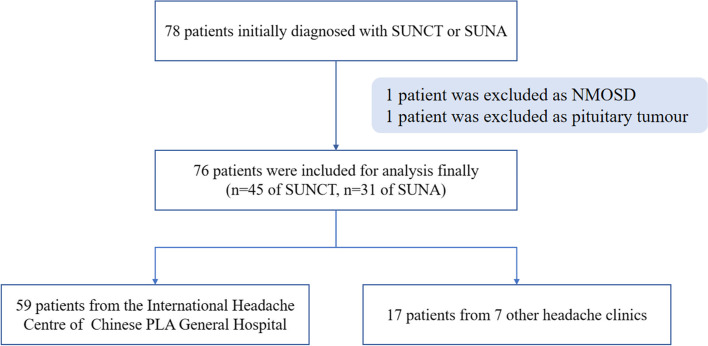
Patients with SUNCT or SUNA treated in a tertiary headache centre or seven other headache clinics of China between April 2009 and July 2022 were studied; we compared their demographics and clinical phenotypes.
The 45 patients with SUNCT and 31 patients with SUNA had mean ages at onset of 37.22 ± 14.54 years and 42.45 ± 14.72 years, respectively. The mean ages at diagnosis of SUNCT and SUNA were 41.62 ± 12.70 years and 48.68 ± 13.80 years, respectively (p = 0.024). The correct diagnosis of SUNCT or SUNA was made after an average of 2.5 (0-20.5) years or 3.0 (0-20.7) years, respectively. Both diseases had a female predominance (SUNCT: 1.14:1; SUNA: 2.10:1). The two diseases differed in the most common attack site (temporal area in SUNCT, p = 0.017; parietal area in SUNA, p = 0.002). Qualitative descriptions of the attacks included stabbing pain (44.7%), electric-shock-like pain (36.8%), shooting pain (25.0%), and slashing pain (18.4%). Lacrimation was the most common autonomic symptom in both SUNCT and SUNA patients, while eyelid oedema, ptosis, and miosis were less frequent. Triggers such as cold air and face washing were shared by the two diseases, and they were consistently ipsilateral to the attack site.
In contrast to Western countries, SUNCT and SUNA in China have a greater female predominance and an earlier onset. The shared core phenotype of SUNCT and SUNA, despite their partial differences, suggests that they are the same clinical entity.
由于数据有限,包括中国在内的许多国家对短暂单侧神经痛样头痛发作伴结膜充血和流泪(SUNCT)和短暂单侧神经痛样头痛发作伴颅自主神经症状(SUNA)的研究尚不充分。
研究了 2009 年 4 月至 2022 年 7 月期间在中国一家三级头痛中心或其他 7 家头痛诊所接受治疗的 SUNCT 或 SUNA 患者;比较了他们的人口统计学和临床表型。
45 例 SUNCT 患者和 31 例 SUNA 患者的发病年龄分别为 37.22±14.54 岁和 42.45±14.72 岁。SUNCT 和 SUNA 的诊断年龄分别为 41.62±12.70 岁和 48.68±13.80 岁(p=0.024)。正确诊断 SUNCT 或 SUNA 分别需要平均 2.5(0-20.5)年和 3.0(0-20.7)年。两种疾病均以女性为主(SUNCT:1.14:1;SUNA:2.10:1)。两种疾病的最常见发作部位不同(SUNCT 为颞区,p=0.017;SUNA 为顶区,p=0.002)。发作的定性描述包括刺痛(44.7%)、电击样疼痛(36.8%)、枪击样疼痛(25.0%)和切割样疼痛(18.4%)。流泪是 SUNCT 和 SUNA 患者最常见的自主神经症状,而眼睑水肿、上睑下垂和瞳孔缩小则较少见。冷空气和洗脸等触发因素在两种疾病中均有发生,且始终与发作部位同侧。
与西方国家相比,中国的 SUNCT 和 SUNA 女性患病率更高,发病年龄更早。尽管存在部分差异,SUNCT 和 SUNA 的共同核心表型表明它们是同一临床实体。