Thabit Abrar K, Eljaaly Khalid, Zawawi Ayat, Ibrahim Tarek S, Eissa Ahmed G, Elbaramawi Samar S, Hegazy Wael A H, Elfaky Mahmoud A
Pharmacy Practice Department, Faculty of Pharmacy, King Abdulaziz University, Jeddah 21589, Saudi Arabia.
Department of Medical Laboratory Sciences, Faculty of Applied Medical Sciences, King Abdulaziz University, Jeddah 21589, Saudi Arabia.
Microorganisms. 2022 Oct 6;10(10):1976. doi: 10.3390/microorganisms10101976.
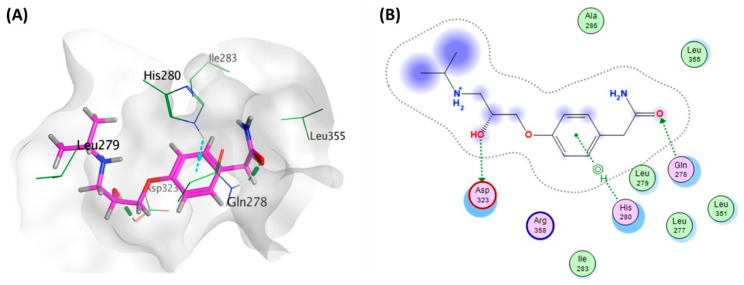
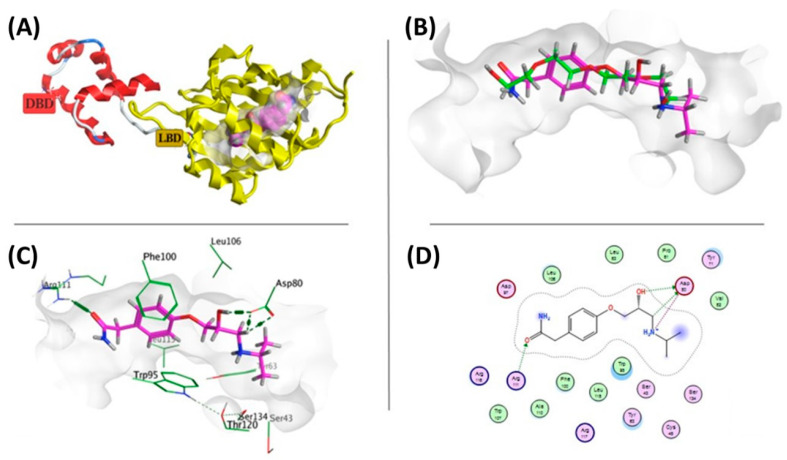
The targeting of bacterial virulence is proposed as a promising approach to overcoming the bacterial resistance development to antibiotics. is one of the most important gut pathogens that cause a wide diversity of local and systemic illnesses. The virulence is controlled by interplayed systems namely Quorum sensing (QS) and type three secretion system (T3SS). Furthermore, the spy on the host cell via sensing the adrenergic hormones enhancing its virulence. The current study explores the possible anti-virulence activities of β-adrenoreceptor blocker atenolol against serovar Typhimurium in vitro, in silico, and in vivo. The present findings revealed a significant atenolol ability to diminish the biofilm formation, invasion into HeLa cells, and intracellular replication inside macrophages. Atenolol significantly downregulated the encoding genes of the T3SS-type II, QS receptor Lux analogs , and norepinephrine membranal sensors qseC and qseE. Moreover, atenolol significantly protected mice against . For testing the possible mechanisms for atenolol anti-virulence activities, an in silico molecular docking study was conducted to assess the atenolol binding ability to QS receptor SdiA and norepinephrine membranal sensors QseC. Atenolol showed the ability to compete on the targets. In conclusion, atenolol is a promising anti-virulence candidate to alleviate the pathogenesis by targeting its QS and T3SS systems besides diminishing the eavesdropping on the host cells.
针对细菌毒力被认为是克服细菌对抗生素耐药性发展的一种有前景的方法。[具体细菌名称未给出]是最重要的肠道病原体之一,可引起多种局部和全身性疾病。该细菌的毒力由群体感应(QS)和三型分泌系统(T3SS)等相互作用的系统控制。此外,该细菌通过感知肾上腺素能激素来监视宿主细胞,从而增强其毒力。本研究在体外、计算机模拟和体内探索了β-肾上腺素能受体阻滞剂阿替洛尔对[具体细菌名称未给出]血清型鼠伤寒沙门氏菌可能的抗毒力活性。目前的研究结果显示,阿替洛尔具有显著降低该细菌生物膜形成、侵入HeLa细胞以及在巨噬细胞内进行细胞内复制的能力。阿替洛尔显著下调了T3SS-II型、QS受体Lux类似物以及去甲肾上腺素膜传感器qseC和qseE的编码基因。此外,阿替洛尔能显著保护小鼠免受[具体细菌名称未给出]感染。为了测试阿替洛尔抗毒力活性的可能机制,进行了一项计算机模拟分子对接研究,以评估阿替洛尔与QS受体SdiA和去甲肾上腺素膜传感器QseC的结合能力。阿替洛尔显示出在[具体细菌名称未给出]靶点上的竞争能力。总之,阿替洛尔是一种有前景的抗毒力候选药物,通过靶向其QS和T3SS系统,同时减少对宿主细胞的窃听,来减轻[具体细菌名称未给出]的发病机制。