Key Laboratory of Big Data Mining and Precision Drug Design of Guangdong Medical University, Key Laboratory of Computer-Aided Drug Design of Dongguan City, Key Laboratory for Research and Development of Natural Drugs of Guangdong Province, School of Pharmacy, Guangdong Medical University, Dongguan 523808, China.
The Second School of Clinical Medicine, Guangdong Medical University, Dongguan 523808, China.
Molecules. 2022 Oct 20;27(20):7103. doi: 10.3390/molecules27207103.
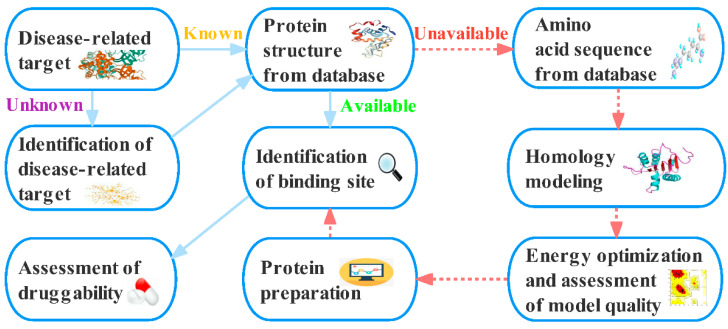
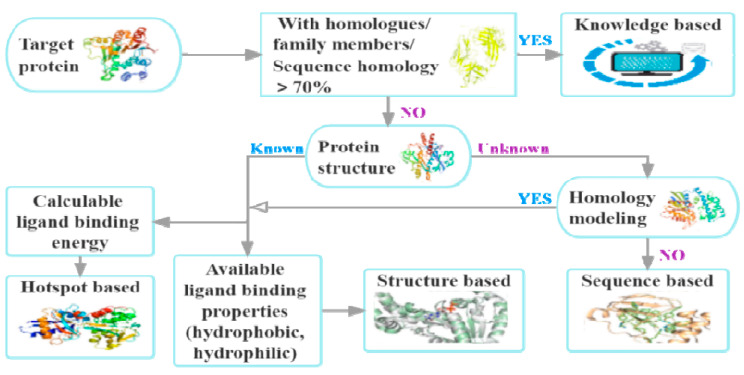
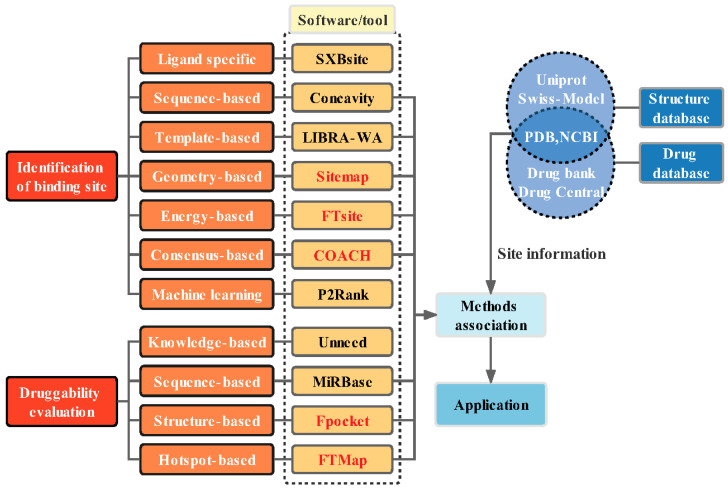
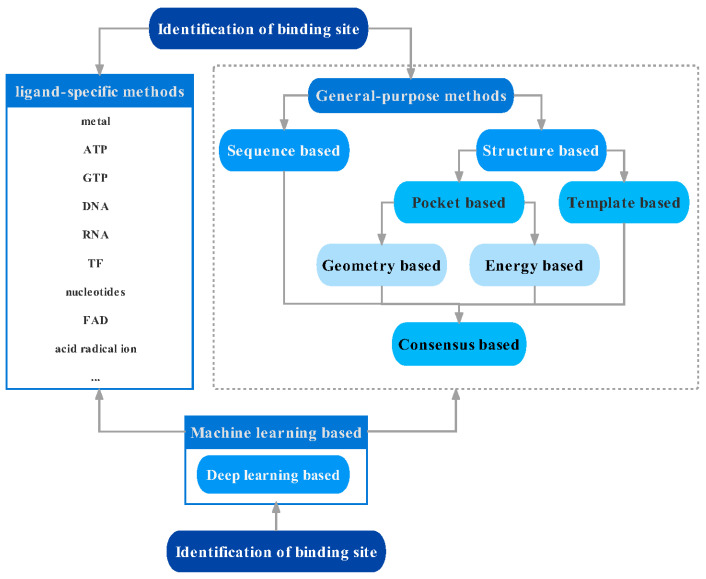
Target identification is an important step in drug discovery, and computer-aided drug target identification methods are attracting more attention compared with traditional drug target identification methods, which are time-consuming and costly. Computer-aided drug target identification methods can greatly reduce the searching scope of experimental targets and associated costs by identifying the diseases-related targets and their binding sites and evaluating the druggability of the predicted active sites for clinical trials. In this review, we introduce the principles of computer-based active site identification methods, including the identification of binding sites and assessment of druggability. We provide some guidelines for selecting methods for the identification of binding sites and assessment of druggability. In addition, we list the databases and tools commonly used with these methods, present examples of individual and combined applications, and compare the methods and tools. Finally, we discuss the challenges and limitations of binding site identification and druggability assessment at the current stage and provide some recommendations and future perspectives.
目标识别是药物发现的重要步骤,与耗时且昂贵的传统药物靶标识别方法相比,计算机辅助药物靶标识别方法正受到越来越多的关注。计算机辅助药物靶标识别方法可以通过识别疾病相关靶标及其结合位点,并评估预测的活性位点的成药性,从而大大缩小临床试验的目标搜索范围和相关成本。在本文中,我们介绍了基于计算机的活性位点识别方法的原理,包括结合位点的识别和成药性的评估。我们提供了一些选择方法的指导方针,用于识别结合位点和评估成药性。此外,我们列出了这些方法常用的数据库和工具,介绍了个别和联合应用的实例,并对方法和工具进行了比较。最后,我们讨论了现阶段结合位点识别和成药性评估的挑战和局限性,并提出了一些建议和未来展望。