Virology Lab 176, Water Pollution Research Department, Environment and Climate Change Institute, National Research Centre, Dokki, Giza 12622, Egypt.
Microbiology Department, Faculty of Pharmacy, Ain Shams University, El-Qobba Bridge, Cairo 11566, Egypt.
Viruses. 2022 Oct 4;14(10):2192. doi: 10.3390/v14102192.
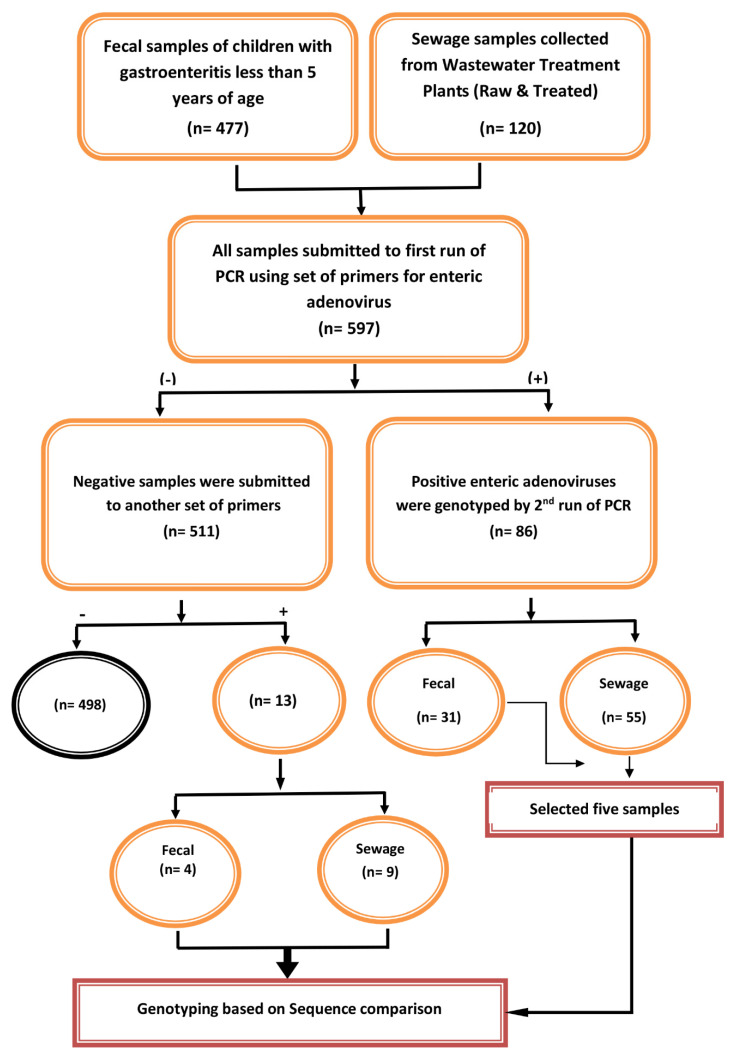
Human adenoviruses (HAdV) are a prevalent cause of diarrhea in children all over the world. Adenoviral infections are responsible for 2% to 10% of diarrheic cases. A long-term investigation was required to gain better knowledge about the incidence of HAdV in Egypt. Herein, we conducted 5 years of detection, isolation, and genotyping of HAdV in fecal and sewage samples from 2016 to 2020, in Cairo, Egypt using molecular and cell culture assays. Human adenoviruses were identified in 35 of 447 fecal samples (7.8%), but only 53.3% (64/120) of the sewage samples. Children under the age of two had the highest positive rate for HAdV infection (77.1%). Species F of HAdV was the most common prevalent genotype in fecal and sewage samples, at 88.5% and 85.9%, respectively. The most prevalent genotypes detected in fecal samples were HAdV-41 (71.2%), HAdV-40 (17.2%), HAdV-6 (5.7%), and HAdV-1 (5.7%). In contrast, the most common genotypes in sewage samples were HAdV-41 (64%), HAdVs-40 (21.8%), HAdV-6 (7.8%), HAdV-1 (4.7%), and HAdV-2 (1.6%). HAdV was detected in all months of the year, with a peak period for clinical samples from December to February (p < 0.001), which matched Egypt’s rainy season, while the monthly distribution of HAdV in sewage samples remained consistent throughout the year, with no statistically significant peak period. Interestingly, the HAdV-type 41 genotype was the most common genotype during all of the years of this study. Throughout a 5-year period, our work revealed the infection rate, seasonal distribution, virus isolates, and genetic diversity of HAdV infections in environmental and clinical samples in Cairo, Egypt. Non-enteric adenovirus types (1, 2 and 6), as well as enteric adenovirus (41 and 40), may play a key role in gastroenteritis in Egypt.
人类腺病毒(HAdV)是全世界儿童腹泻的主要病原体。腺病毒感染占腹泻病例的 2%至 10%。为了更好地了解埃及 HAdV 的发病率,需要进行长期的调查。本研究采用分子和细胞培养检测法,对 2016 年至 2020 年期间来自埃及开罗的 447 份粪便和污水样本进行了为期 5 年的 HAdV 检测、分离和基因分型。在 447 份粪便样本中,有 35 份(7.8%)检测到人类腺病毒,而在 120 份污水样本中仅检出 53.3%(64/120)。年龄在 2 岁以下的儿童 HAdV 感染阳性率最高(77.1%)。粪便和污水样本中最常见的 HAdV 流行基因型均为 F 型,分别为 88.5%和 85.9%。粪便样本中检测到的最常见基因型为 HAdV-41(71.2%)、HAdV-40(17.2%)、HAdV-6(5.7%)和 HAdV-1(5.7%)。相比之下,污水样本中最常见的基因型为 HAdV-41(64%)、HAdVs-40(21.8%)、HAdV-6(7.8%)、HAdV-1(4.7%)和 HAdV-2(1.6%)。HAdV 全年均可检测到,临床样本的高峰期为 12 月至 2 月(p<0.001),与埃及的雨季相吻合,而污水样本中 HAdV 的月分布全年保持一致,无统计学意义上的高峰期。有趣的是,HAdV-41 基因型在本研究的所有年份都是最常见的基因型。在 5 年期间,我们的工作揭示了埃及开罗环境和临床样本中 HAdV 感染的感染率、季节性分布、病毒分离株和遗传多样性。非肠道腺病毒(1、2 和 6 型)以及肠道腺病毒(41 和 40 型)可能在埃及的胃肠炎中发挥关键作用。