UCSF Benioff Children's Hospital Oakland, Oakland, CA 94609, USA.
Division of Genetics, Birth Defects & Metabolism, Ann & Robert H. Lurie Children's Hospital of Chicago, Chicago, IL, USA; Department of Pediatrics, Feinberg School of Medicine of Northwestern University, Chicago, IL, USA; Division of Human Genetics, Cincinnati Children's Hospital Medical Center, Cincinnati, OH, USA.
Mol Ther. 2022 Dec 7;30(12):3587-3600. doi: 10.1016/j.ymthe.2022.10.010. Epub 2022 Oct 25.
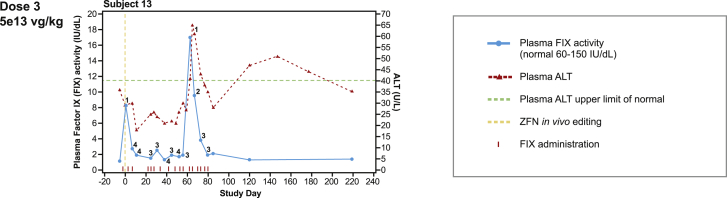
Zinc-finger nuclease (ZFN)-based in vivo genome editing is a novel treatment that can potentially provide lifelong protein replacement with single intravenous administration. Three first-in-human open-label ascending single-dose phase 1/2 studies were performed in parallel (starting November 2017) primarily to assess safety and tolerability of ZFN in vivo editing therapy in mucopolysaccharidosis I (MPS I) (n = 3), MPS II (n = 9), and hemophilia B (n = 1). Treatment was well tolerated with no serious treatment-related adverse events. At the 1e13 vg/kg dose, evidence of genome editing was detected through albumin-transgene fusion transcripts in liver for MPS II (n = 2) and MPS I (n = 1) subjects. The MPS I subject also had a transient increase in leukocyte iduronidase activity to the lower normal range. At the 5e13 vg/kg dose, one MPS II subject had a transient increase in plasma iduronate-2-sulfatase approaching normal levels and one MPS I subject approached mid-normal levels of leukocyte iduronidase activity with no evidence of genome editing. The hemophilia B subject was not able to decrease use of factor IX concentrate; genome editing could not be assessed. Overall, ZFN in vivo editing therapy had a favorable safety profile with evidence of targeted genome editing in liver, but no long-term enzyme expression in blood.
锌指核酸酶 (ZFN) 介导的体内基因组编辑是一种新型治疗方法,有可能通过单次静脉注射提供终身的蛋白质替代治疗。三项首次人体开放性递增单剂量 1/2 期平行研究(于 2017 年 11 月开始)主要评估 ZFN 在体内编辑治疗黏多糖贮积症 I (MPS I)(n=3)、MPS II(n=9)和血友病 B(n=1)中的安全性和耐受性。治疗耐受性良好,无严重与治疗相关的不良事件。在 1e13 vg/kg 剂量下,通过 MPS II(n=2)和 MPS I(n=1)受试者的肝白蛋白转基因融合转录本检测到基因组编辑的证据。MPS I 受试者的白细胞艾杜糖醛酸酶活性也短暂升高至正常下限。在 5e13 vg/kg 剂量下,1 名 MPS II 受试者的血浆艾杜糖醛酸-2-硫酸酯酶短暂升高至接近正常水平,1 名 MPS I 受试者的白细胞艾杜糖醛酸酶活性接近正常中位数,且无基因组编辑证据。血友病 B 受试者无法减少因子 IX 浓缩物的使用;无法评估基因组编辑。总体而言,ZFN 体内编辑治疗具有良好的安全性,在肝脏中具有靶向基因组编辑的证据,但血液中没有长期的酶表达。