Maternal Fetal Care Center, Boston Children's Hospital, Harvard Medical School, Boston, Massachusetts.
Medical Biology Research Center, Health Technology Institute, Kermanshah University of Medical Sciences, Kermanshah, Iran.
JAMA Netw Open. 2022 Oct 3;5(10):e2238941. doi: 10.1001/jamanetworkopen.2022.38941.
Primary studies proposed that aberrant maternal antiviral immunity and/or giving birth in quarantine, such as during the ongoing COVID-19 pandemic, may be associated with the risk of neurodevelopmental impairment (NDI) in offspring.
To evaluate the associations of birth and being raised during the COVID-19 pandemic with risk of NDI among infants and to assess the association of gestational exposure to SARS-CoV-2 with risk of NDI.
PubMed, Web of Science, Scopus, Embase, and preprint servers were systematically searched from inception to March 25, 2022.
Studies evaluating the neurodevelopment of infants born during the SARS-CoV-2 pandemic were included in this systematic review and meta-analysis. Studies using Ages and Stages Questionnaires, Third Edition (ASQ-3), were used for quantitative meta-analysis.
Following the Preferred Reporting Items for Systematic Reviews and Meta-analyses, a random-effects model meta-analysis was used to pool the proportion and odds ratios (ORs) of overall NDI, as well as each developmental domain on ASQ-3 with the corresponding 95% CI.
The primary outcome was the risk of overall NDI among infants screened during the pandemic vs prepandemic. The secondary outcome was the comparison of NDI by ASQ-3 domain among infants born to women with known gestational exposure to SARS-CoV-2 vs no exposure.
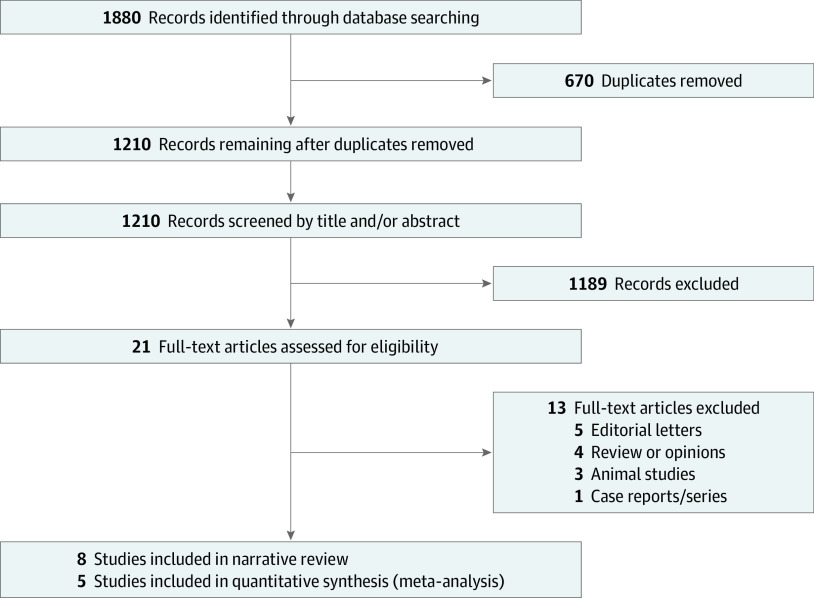
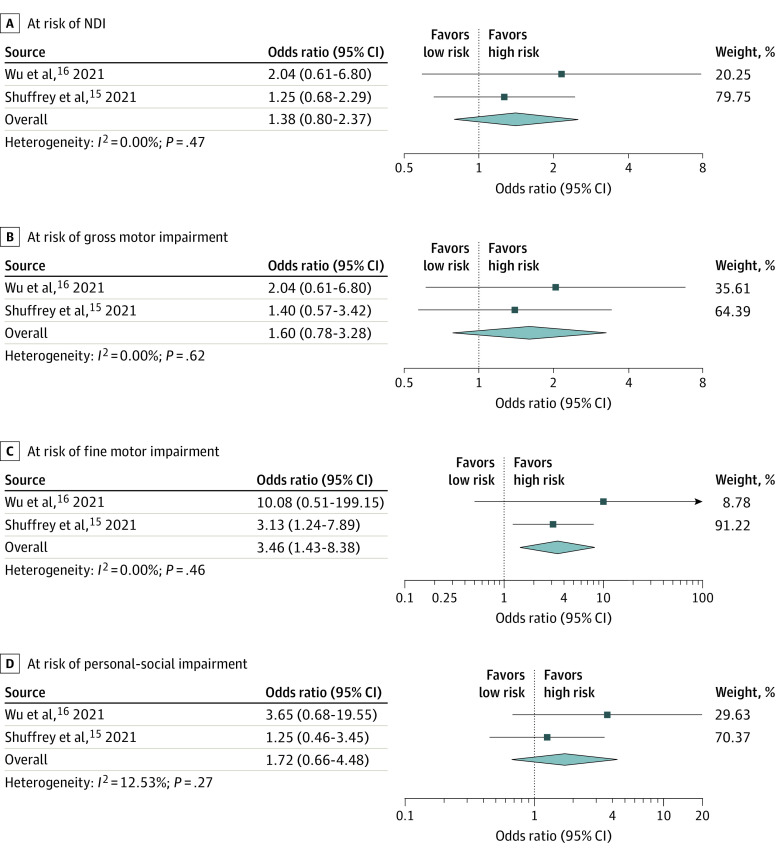
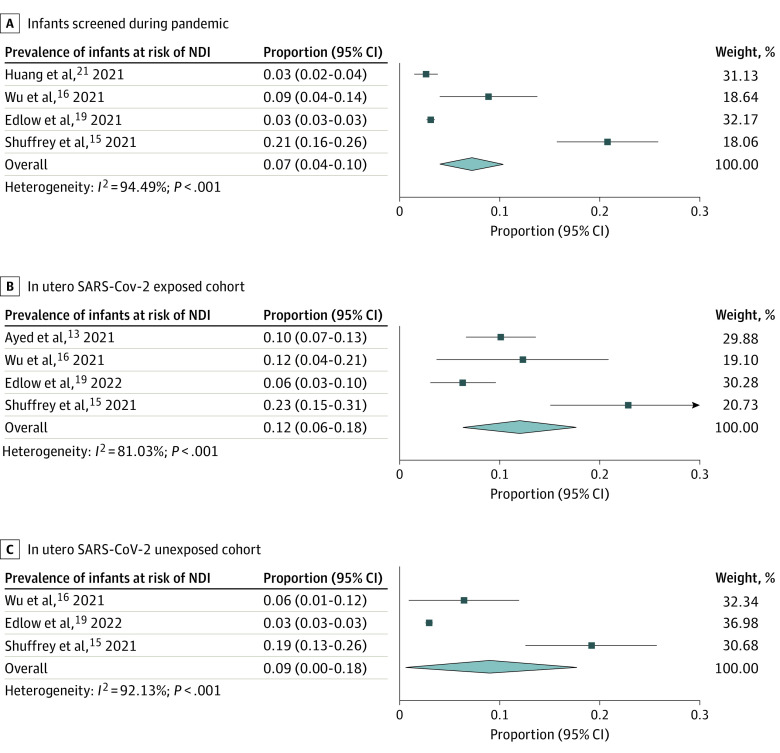
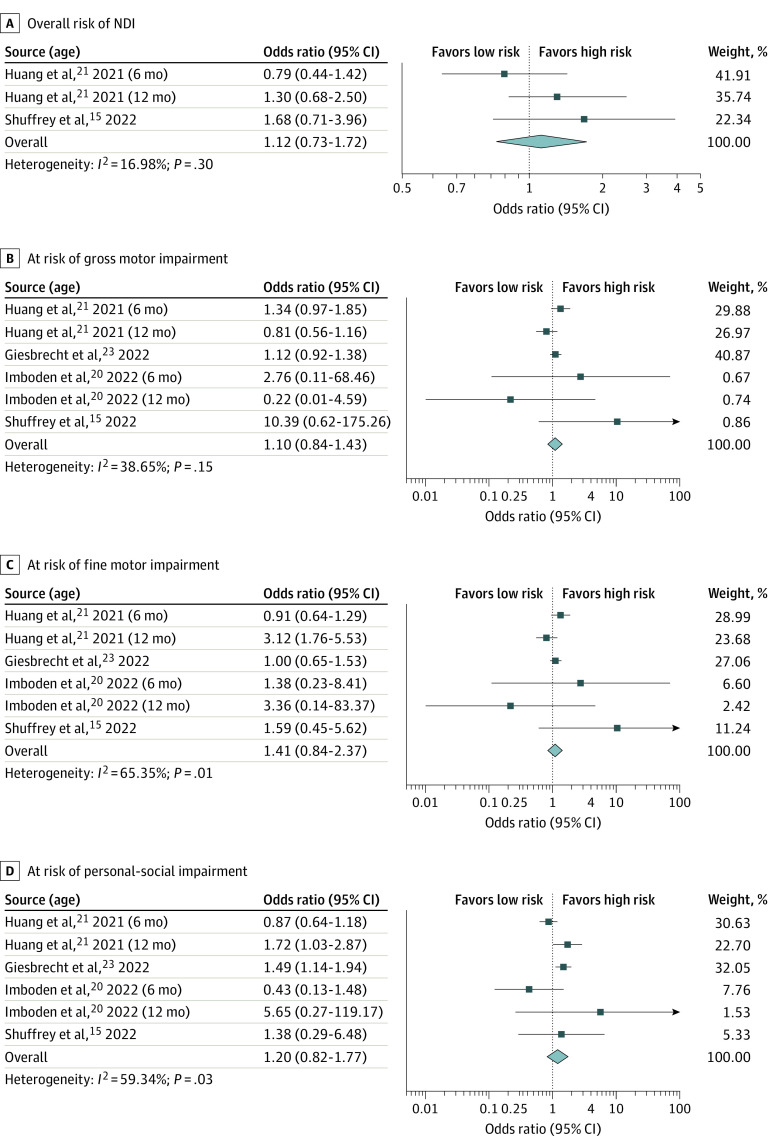
A total of 8 studies were included, including 21 419 infants (11 438 screened in pandemic and 9981 in prepandemic period). NDI was present in 330 of 8992 infants (7%; 95% CI, 4%-10%) screened during the COVID-19 pandemic from January 2020 to January 2021. Among the pandemic cohort, the prevalence of NDI among infants with gestational exposure to SARS-CoV-2 was 77 of 691 (12%; 95% CI, 6%-18%). Compared with the prepandemic cohort (2015-2019), the pandemic cohort was more likely to have communication impairment (OR, 1.70; 95% CI, 1.37-2.11; P < .001), without significant differences in other ASQ-3 domains (eg, gross motor, fine motor, personal-social, and problem-solving). In contrast, maternal SARS-CoV-2 infection was not associated with significant differences in any neurodevelopment domain in offspring, except for increasing the odds of fine motor impairment (OR, 3.46; 95% CI, 1.43-8.38; P < .001).
In this systematic review and meta-analysis examining the association between COVID-19 pandemic and the risk of NDI, findings suggest that overall neurodevelopment in the first year of life was not changed by either being born or raised during the SARS-CoV-2 pandemic or by gestational exposure to SARS-CoV-2. Interestingly, the first year of life during the COVID-19 pandemic, regardless of maternal infection, was significantly associated with the risk of communication delay among the offspring.
初步研究表明,母体抗病毒免疫异常和/或在检疫期间分娩,如在当前的 COVID-19 大流行期间,可能与后代神经发育障碍(NDI)的风险相关。
评估 COVID-19 大流行期间的分娩和养育与婴儿发生 NDI 的风险之间的关系,并评估妊娠期暴露于 SARS-CoV-2 与 NDI 风险之间的关系。
从开始到 2022 年 3 月 25 日,系统地在 PubMed、Web of Science、Scopus、Embase 和预印本服务器上进行了搜索。
本系统评价和荟萃分析纳入了评估 COVID-19 大流行期间出生的婴儿神经发育的研究。使用年龄与阶段问卷第三版(ASQ-3)的研究用于定量荟萃分析。
遵循系统评价和荟萃分析的首选报告项目,使用随机效应模型荟萃分析汇总了 NDI 总体发生率和每个发育领域的优势比(OR),以及 ASQ-3 对应的 95%置信区间。
主要结果是在大流行期间筛查的婴儿与大流行前相比发生 NDI 的风险。次要结果是比较已知妊娠期暴露于 SARS-CoV-2 的母亲所生婴儿与无暴露的婴儿在 ASQ-3 各领域的 NDI 差异。
共纳入 8 项研究,包括 21419 名婴儿(11438 名在大流行期间筛查,9981 名在大流行前筛查)。在 2020 年 1 月至 2021 年 1 月期间,从 COVID-19 大流行中筛查的 8992 名婴儿中有 330 名(7%;95%CI,4%-10%)患有 NDI。在大流行队列中,妊娠期暴露于 SARS-CoV-2 的婴儿中 NDI 的患病率为 691 例中的 77 例(12%;95%CI,6%-18%)。与大流行前队列(2015-2019 年)相比,大流行队列更有可能出现沟通障碍(OR,1.70;95%CI,1.37-2.11;P<0.001),但在其他 ASQ-3 领域(例如,粗大运动、精细运动、个人-社会和解决问题)没有显著差异。相比之下,母亲的 SARS-CoV-2 感染与后代任何神经发育领域的差异均无显著相关性,除了增加精细运动障碍的几率(OR,3.46;95%CI,1.43-8.38;P<0.001)。
在这项检查 COVID-19 大流行与 NDI 风险之间关联的系统评价和荟萃分析中,研究结果表明,无论是在 SARS-CoV-2 大流行期间出生还是养育,婴儿在生命的第一年整体神经发育都没有改变,妊娠期暴露于 SARS-CoV-2 也是如此。有趣的是,COVID-19 大流行期间的生命第一年,无论母亲是否感染,都与后代沟通延迟的风险显著相关。