Lyons-Reid Jaz, Ward Leigh C, Derraik José G B, Tint Mya-Thway, Monnard Cathriona R, Ramos Nieves Jose M, Albert Benjamin B, Kenealy Timothy, Godfrey Keith M, Chan Shiao-Yng, Cutfield Wayne S
Liggins Institute, The University of Auckland, Auckland, New Zealand.
School of Chemistry and Molecular Biosciences, The University of Queensland, Brisbane, QLD, Australia.
Front Nutr. 2022 Oct 13;9:980790. doi: 10.3389/fnut.2022.980790. eCollection 2022.
Bioelectrical impedance analysis (BIA) is widely used to measure body composition but has not been adequately evaluated in infancy. Prior studies have largely been of poor quality, and few included healthy term-born offspring, so it is unclear if BIA can accurately predict body composition at this age.
This study evaluated impedance technology to predict fat-free mass (FFM) among a large multi-ethnic cohort of infants from the United Kingdom, Singapore, and New Zealand at ages 6 weeks and 6 months ( = 292 and 212, respectively).
Using air displacement plethysmography (PEA POD) as the reference, two impedance approaches were evaluated: (1) empirical prediction equations; (2) Cole modeling and mixture theory prediction. Sex-specific equations were developed among ∼70% of the cohort. Equations were validated in the remaining ∼30% and in an independent University of Queensland cohort. Mixture theory estimates of FFM were validated using the entire cohort at both ages.
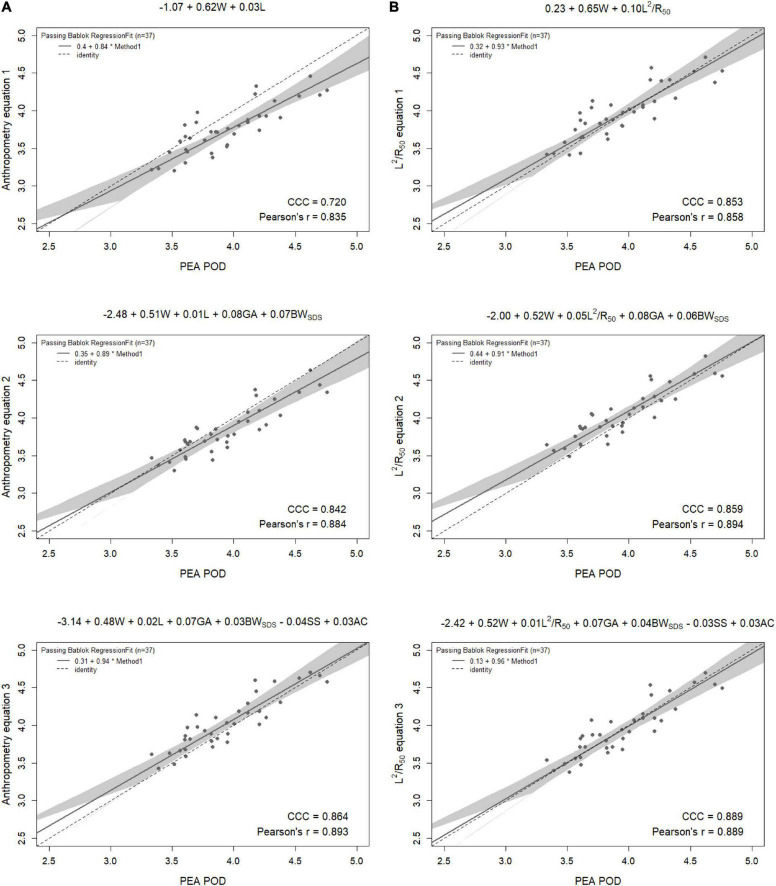
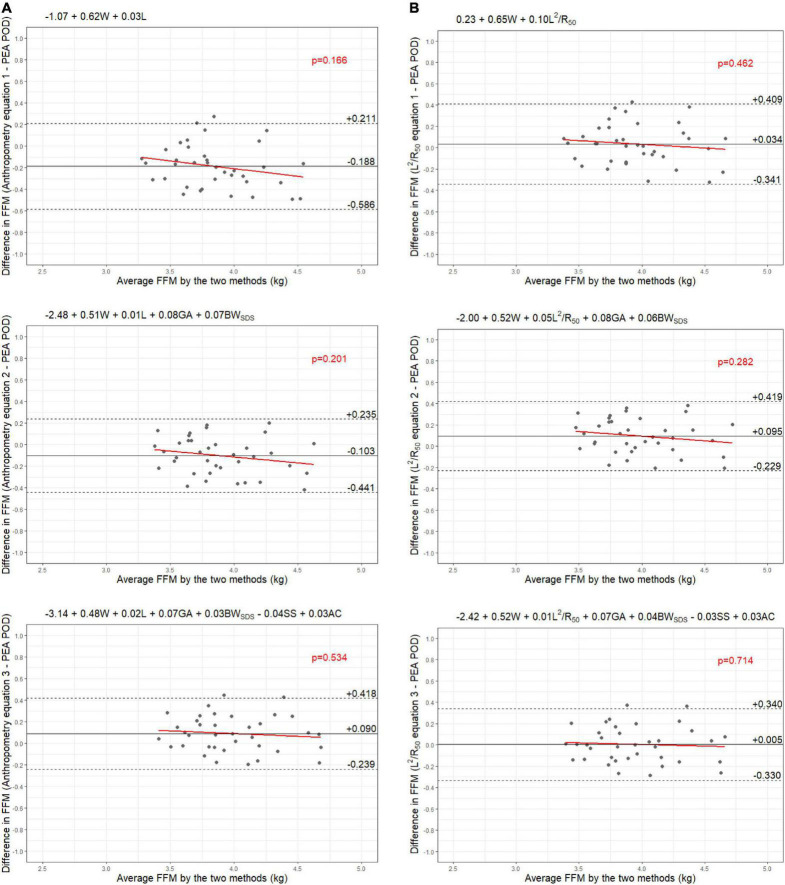
Sex-specific equations based on weight and length explained 75-81% of FFM variance at 6 weeks but only 48-57% at 6 months. At both ages, the margin of error for these equations was 5-6% of mean FFM, as assessed by the root mean squared errors (RMSE). The stepwise addition of clinically-relevant covariates (i.e., gestational age, birthweight SDS, subscapular skinfold thickness, abdominal circumference) improved model accuracy (i.e., lowered RMSE). However, improvements in model accuracy were not consistently observed when impedance parameters (as the impedance index) were incorporated instead of length. The bioimpedance equations had mean absolute percentage errors (MAPE) < 5% when validated. Limits of agreement analyses showed that biases were low (< 100 g) and limits of agreement were narrower for bioimpedance-based than anthropometry-based equations, with no clear benefit following the addition of clinically-relevant variables. Estimates of FFM from BIS mixture theory prediction were inaccurate (MAPE 11-12%).
The addition of the impedance index improved the accuracy of empirical FFM predictions. However, improvements were modest, so the benefits of using bioimpedance in the field remain unclear and require further investigation. Mixture theory prediction of FFM from BIS is inaccurate in infancy and cannot be recommended.
生物电阻抗分析(BIA)被广泛用于测量身体成分,但在婴儿期尚未得到充分评估。先前的研究质量大多较差,很少纳入足月健康出生的后代,因此尚不清楚BIA能否准确预测这个年龄段的身体成分。
本研究评估了阻抗技术在来自英国、新加坡和新西兰的一个大型多民族婴儿队列中预测6周龄和6月龄时去脂体重(FFM)的能力(分别为n = 292和212)。
以空气置换体积描记法(PEA POD)作为参考,评估了两种阻抗方法:(1)经验预测方程;(2)Cole模型和混合理论预测。在约70%的队列中建立了性别特异性方程。这些方程在其余约30%的队列以及昆士兰大学的一个独立队列中进行了验证。在两个年龄段均使用整个队列对基于混合理论的FFM估计值进行了验证。
基于体重和身长的性别特异性方程在6周龄时解释了FFM变异的75 - 81%,但在6月龄时仅解释了48 - 57%。在两个年龄段,根据均方根误差(RMSE)评估,这些方程的误差幅度为平均FFM的5 - 6%。逐步加入临床相关协变量(即胎龄、出生体重标准差评分、肩胛下皮褶厚度、腹围)提高了模型准确性(即降低了RMSE)。然而,当纳入阻抗参数(作为阻抗指数)而非身长时,并未始终观察到模型准确性的提高。生物电阻抗方程在验证时平均绝对百分比误差(MAPE)< 5%。一致性界限分析表明,偏差较低(< 100 g),基于生物阻抗的方程的一致性界限比基于人体测量学的方程更窄,加入临床相关变量后没有明显益处。基于BIS混合理论预测的FFM估计值不准确(MAPE为11 - 12%)。
加入阻抗指数提高了经验性FFM预测的准确性。然而,改善幅度不大,因此在该领域使用生物阻抗的益处仍不明确,需要进一步研究。BIS基于混合理论对FFM的预测在婴儿期不准确,不推荐使用。