Liggins Institute, University of Auckland, Auckland, New Zealand.
School of Chemistry and Molecular Biosciences, University of Queensland, Brisbane, QLD, Australia.
Eur J Clin Nutr. 2024 Oct;78(10):872-879. doi: 10.1038/s41430-023-01317-4. Epub 2023 Jul 31.
Bioimpedance devices are practical for measuring body composition in preschool children, but their application is limited by the lack of validated equations.
To develop and validate fat-free mass (FFM) bioimpedance prediction equations among New Zealand 3.5-year olds, with dual-energy X-ray absorptiometry (DXA) as the reference method.
Bioelectrical impedance spectroscopy (SFB7, ImpediMed) and DXA (iDXA, GE Lunar) measurements were conducted on 65 children. An equation incorporating weight, sex, ethnicity, and impedance was developed and validated. Performance was compared with published equations and mixture theory prediction.
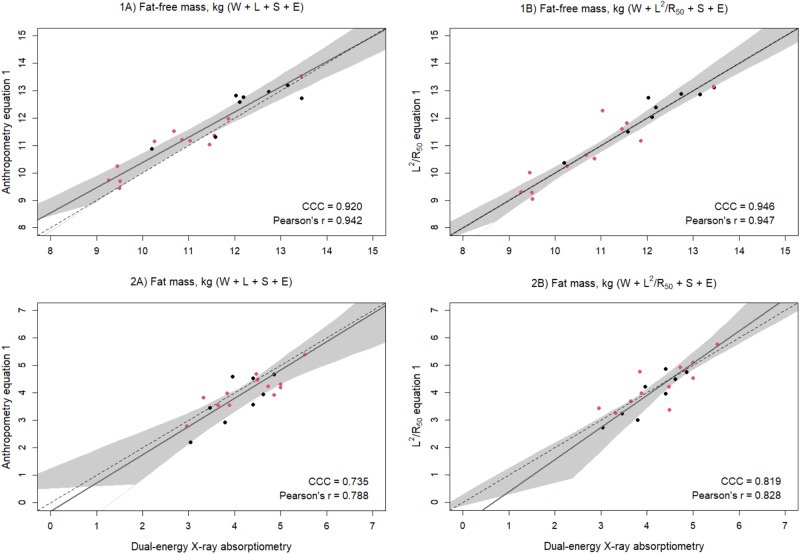
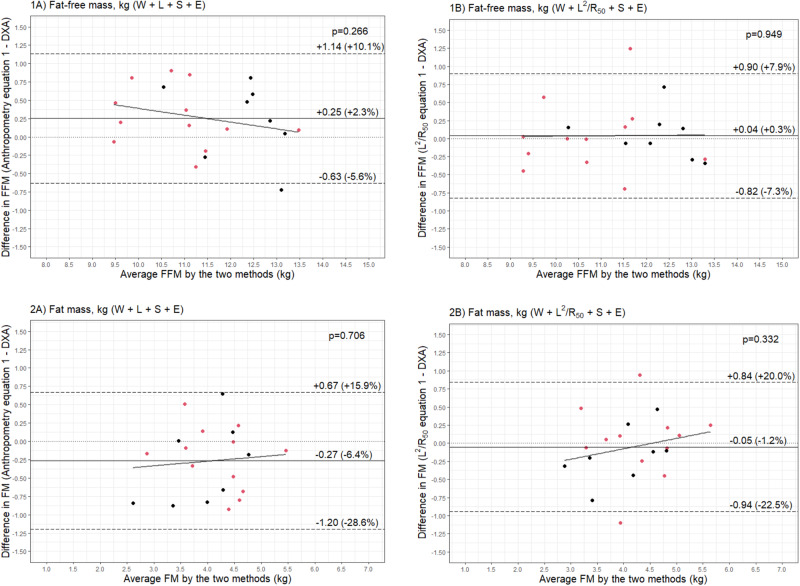
The equation developed in ~70% (n = 45) of the population (FFM [kg] = 1.39 + 0.30 weight [kg] + 0.39 length/resistance at 50 kHz [cm/Ω] + 0.30 sex [M = 1/F = 0] + 0.28 ethnicity [1 = Asian/0 = non-Asian]) explained 88% of the variance in FFM and predicted FFM with a root mean squared error of 0.39 kg (3.4% of mean FFM). When internally validated (n = 20), bias was small (40 g, 0.3% of mean FFM), with limits of agreement (LOA) ±7.6% of mean FFM (95% LOA: -0.82, 0.90 kg). Published equations evaluated had similar LOA, but with marked bias (>12.5% of mean FFM) when validated in our cohort, likely due to DXA differences. Of mixture theory methods assessed, the SFB7 inbuilt equation with personalized body geometry values performed best. However, bias and LOA were larger than with the empirical equations (-0.43 kg [95% LOA: -1.65, 0.79], p < 0.001).
We developed and validated a bioimpedance equation that can accurately predict FFM. Further external validation of the equation is required.
生物阻抗设备在测量学龄前儿童的身体成分方面具有实用性,但由于缺乏经过验证的方程,其应用受到限制。
用双能 X 射线吸收法(DXA)作为参考方法,为新西兰 3.5 岁儿童制定并验证瘦体重(FFM)的生物阻抗预测方程。
对 65 名儿童进行生物电阻抗谱(SFB7,ImpediMed)和 DXA(iDXA,GE Lunar)测量。建立并验证了一个包含体重、性别、种族和阻抗的方程。将其与已发表的方程和混合物理论预测进行了比较。
在约 70%(n=45)的人群中,所开发的方程(FFM[kg]=1.39+0.30 体重[kg]+0.39 长度/50kHz 时的电阻[cm/Ω]+0.30 性别[M=1/F=0]+0.28 种族[1=亚洲/0=非亚洲])可以解释 88%的 FFM 方差,并以均方根误差 0.39kg(FFM 的 3.4%)预测 FFM。当在内部进行验证(n=20)时,偏差较小(40g,FFM 的 0.3%),组内一致性界限(LOA)为 FFM 的平均±7.6%(95% LOA:-0.82,0.90kg)。评估的已发表方程具有相似的 LOA,但在我们的队列中验证时存在明显的偏差(>FFM 的 12.5%),这可能是由于 DXA 差异所致。在评估的混合物理论方法中,使用个性化身体几何形状值的 SFB7 内置方程表现最佳。然而,与经验方程相比,该方程的偏差和 LOA 更大(-0.43kg,95% LOA:-1.65,0.79,p<0.001)。
我们开发并验证了一种可以准确预测 FFM 的生物阻抗方程。还需要对该方程进行进一步的外部验证。