Department of Psychology, University of Tübingen, Schleichstraße 4, 72076, Tübingen, Germany.
Atten Percept Psychophys. 2023 Apr;85(3):949-959. doi: 10.3758/s13414-022-02563-7. Epub 2022 Oct 31.
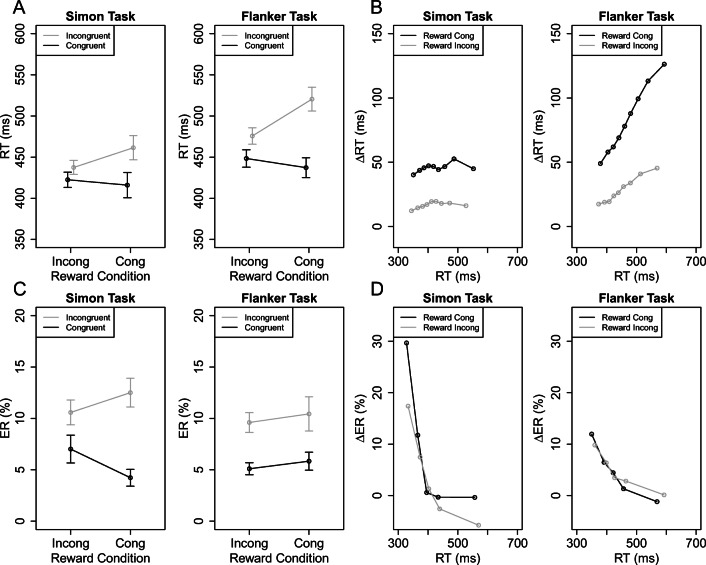
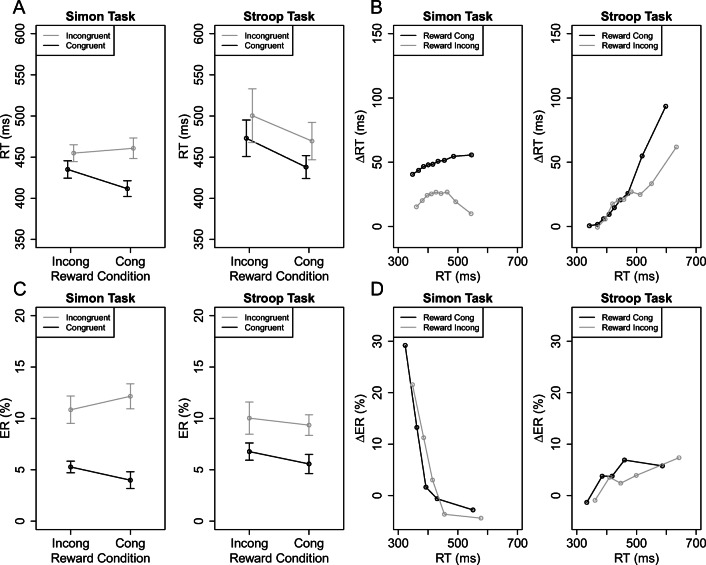
Previous studies have suggested that performance-contingent reward can modulate cognitive control by biasing irrelevant location-response associations in the Simon task. However, the influence of reward in the case of irrelevant words (Stroop task) or irrelevant flankers (Eriksen Flanker task) remains unclear. Across two preregistered experiments, the present study investigated the influence of reward on conflict processing with different types of distractors. Conflict effects on mean reaction time (RT) were reduced in the Simon task (Experiments 1 and 2) when incongruent versus congruent trials were rewarded, and this modulating effect of reward on conflict processing was also observed in the Eriksen flanker task (Experiment 2), but not in the Stroop task (Experiment 1). We propose that cognitive control adjustments to distractor-specific reward contingencies can be generalized across distractor types producing both perceptual-related (Flanker task) and motor-related (Simon task) conflict, but, if any, to a limited degree when distractors produce additional higher-level task conflict (Stroop task). In addition, distributional RT analyses (delta plots) revealed that rewarded distractor-response associations modulate cognitive control not only via biasing the strength (Simon and Eriksen tasks) but also the time-course of suppressing distractor processing (Eriksen task). Overall, the present study dissociated distractor-general and distractor-specific effects of reward on cognitive control.
先前的研究表明,绩效相关的奖励可以通过在西蒙任务中偏向无关的位置-反应关联来调节认知控制。然而,在无关单词(Stroop 任务)或无关侧翼(Eriksen 侧翼任务)的情况下,奖励的影响尚不清楚。在两项预先注册的实验中,本研究调查了不同类型分心物的奖励对冲突处理的影响。当不一致与一致的试验得到奖励时,Simon 任务中的冲突对平均反应时间(RT)的影响会降低(实验 1 和 2),奖励对冲突处理的这种调节作用也在 Eriksen 侧翼任务(实验 2)中观察到,但在 Stroop 任务(实验 1)中未观察到。我们提出,对分心物特定奖励结果的认知控制调整可以推广到不同的分心物类型,从而产生与知觉相关(Flanker 任务)和运动相关(Simon 任务)的冲突,但如果有的话,当分心物产生额外的更高层次的任务冲突(Stroop 任务)时,这种调整程度是有限的。此外,分布 RT 分析(delta 图)表明,奖励的分心物-反应关联不仅通过偏向于干扰处理的强度(Simon 和 Eriksen 任务),而且通过偏向于干扰处理的时间进程(Eriksen 任务)来调节认知控制。总体而言,本研究区分了奖励对认知控制的分心物一般效应和分心物特定效应。