School of Artificial Intelligence, School of Future Technology, University of Chinese Academy of Sciences, Beijing, China.
National Laboratory of Pattern Recognition, Institute of Automation, Chinese Academy of Sciences, Beijing, China.
BMC Bioinformatics. 2022 Oct 31;23(1):453. doi: 10.1186/s12859-022-04991-6.
Nanoscale connectomics, which aims to map the fine connections between neurons with synaptic-level detail, has attracted increasing attention in recent years. Currently, the automated reconstruction algorithms in electron microscope volumes are in great demand. Most existing reconstruction methodologies for cellular and subcellular structures are independent, and exploring the inter-relationships between structures will contribute to image analysis. The primary goal of this research is to construct a joint optimization framework to improve the accuracy and efficiency of neural structure reconstruction algorithms.
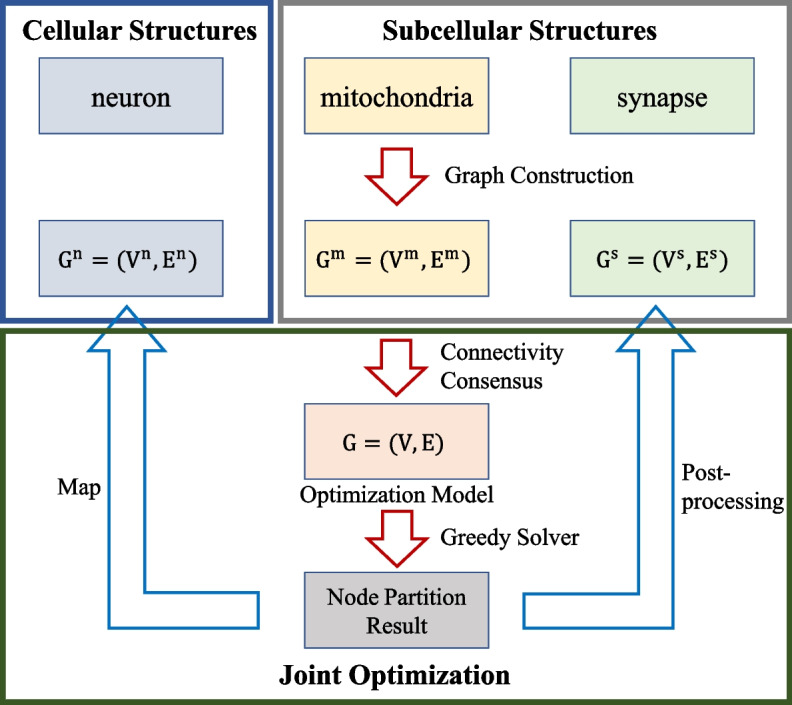
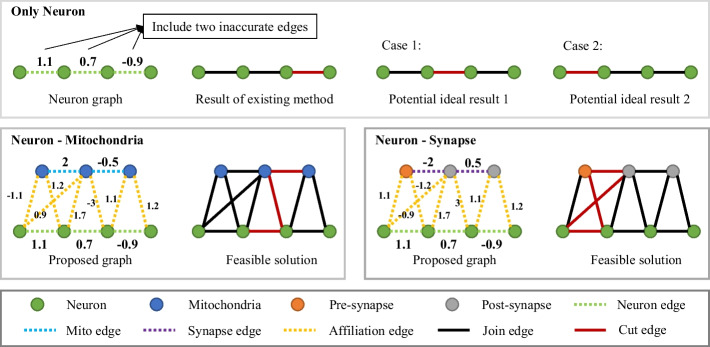
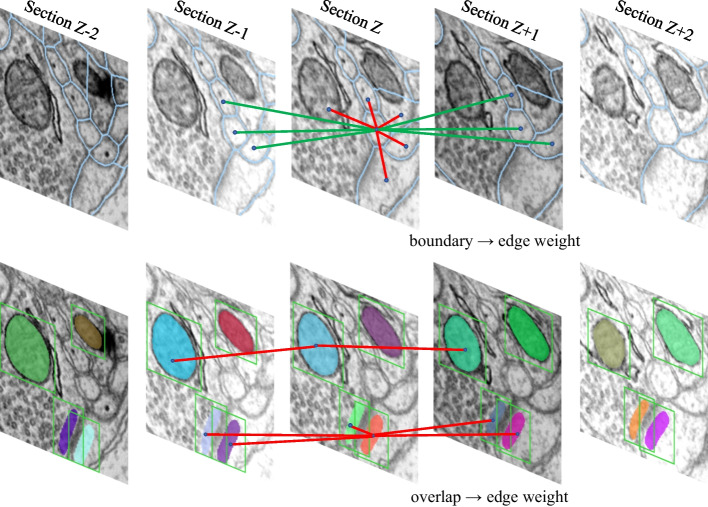
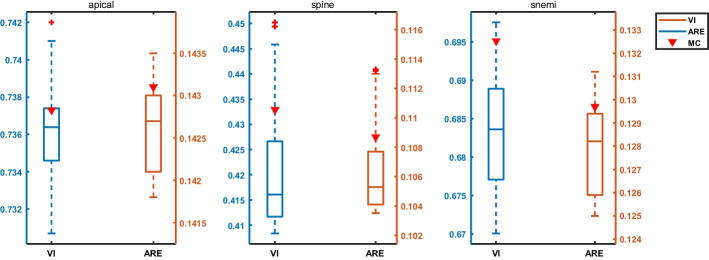
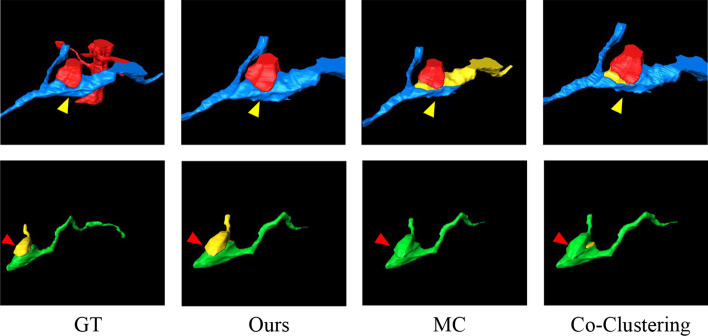
In this investigation, we introduce the concept of connectivity consensus between cellular and subcellular structures based on biological domain knowledge for neural structure agglomeration problems. We propose a joint graph partitioning model for solving ultrastructural and neuronal connections to overcome the limitations of connectivity cues at different levels. The advantage of the optimization model is the simultaneous reconstruction of multiple structures in one optimization step. The experimental results on several public datasets demonstrate that the joint optimization model outperforms existing hierarchical agglomeration algorithms.
We present a joint optimization model by connectivity consensus to solve the neural structure agglomeration problem and demonstrate its superiority to existing methods. The intention of introducing connectivity consensus between different structures is to build a suitable optimization model that makes the reconstruction goals more consistent with biological plausible and domain knowledge. This idea can inspire other researchers to optimize existing reconstruction algorithms and other areas of biological data analysis.
纳米级连接组学旨在以突触级细节绘制神经元之间的精细连接,近年来受到越来越多的关注。目前,电子显微镜体积中的自动化重建算法需求巨大。大多数现有的细胞和亚细胞结构的重建方法都是独立的,探索结构之间的相互关系将有助于图像分析。本研究的主要目标是构建一个联合优化框架,以提高神经结构重建算法的准确性和效率。
在这项研究中,我们基于生物领域知识,为神经结构聚集问题引入了细胞和亚细胞结构之间的连接一致性概念。我们提出了一种联合图划分模型来解决超微结构和神经元连接问题,以克服不同层次连接线索的局限性。优化模型的优势在于可以在一个优化步骤中同时重建多个结构。在几个公共数据集上的实验结果表明,联合优化模型优于现有的层次聚集算法。
我们提出了一种通过连接一致性进行联合优化的模型来解决神经结构聚集问题,并证明了其优于现有方法。引入不同结构之间连接一致性的目的是构建一个合适的优化模型,使重建目标更符合生物学合理性和领域知识。这个想法可以启发其他研究人员优化现有的重建算法和其他生物数据分析领域。