Xiao Chi, Chen Xi, Li Weifu, Li Linlin, Wang Lu, Xie Qiwei, Han Hua
Institute of Automation, Chinese Academy of Sciences, Beijing, China.
School of Future Technology, University of Chinese Academy of Sciences, Beijing, China.
Front Neuroanat. 2018 Nov 2;12:92. doi: 10.3389/fnana.2018.00092. eCollection 2018.
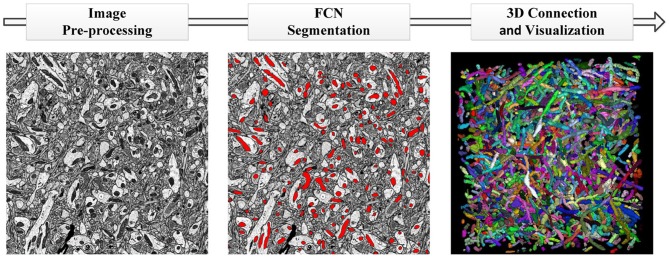
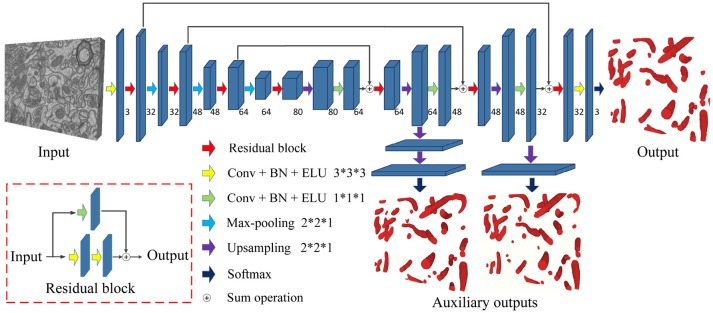
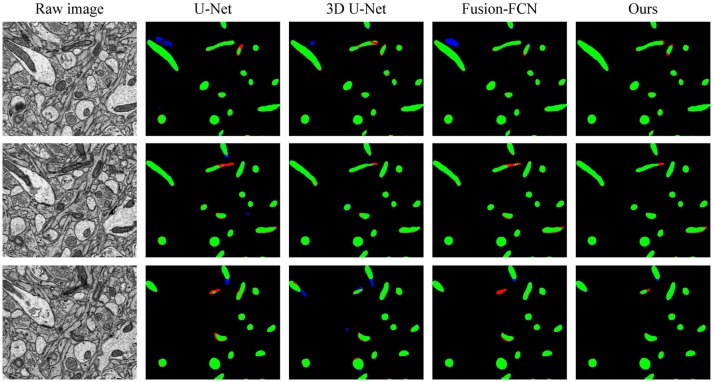
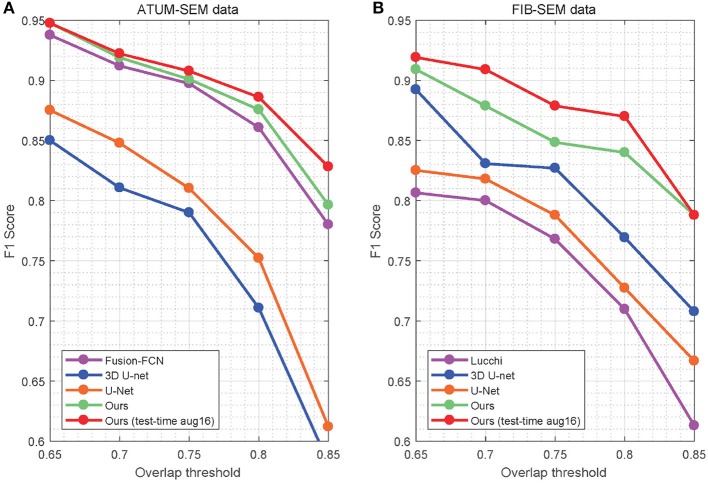
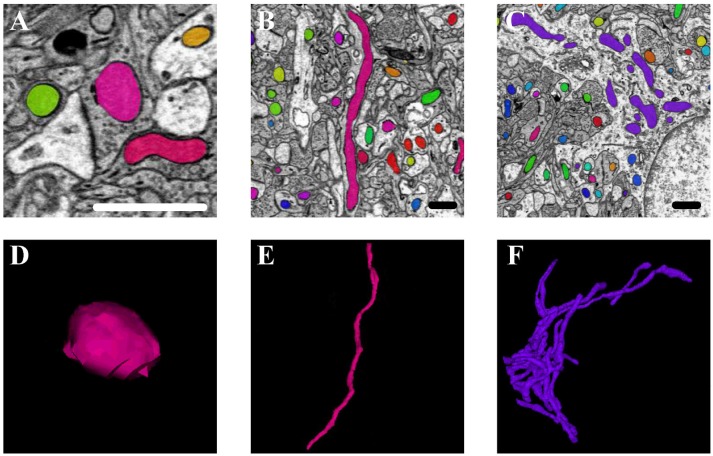
Recent studies have supported the relation between mitochondrial functions and degenerative disorders related to ageing, such as Alzheimer's and Parkinson's diseases. Since these studies have exposed the need for detailed and high-resolution analysis of physical alterations in mitochondria, it is necessary to be able to perform segmentation and 3D reconstruction of mitochondria. However, due to the variety of mitochondrial structures, automated mitochondria segmentation and reconstruction in electron microscopy (EM) images have proven to be a difficult and challenging task. This paper puts forward an effective and automated pipeline based on deep learning to realize mitochondria segmentation in different EM images. The proposed pipeline consists of three parts: (1) utilizing image registration and histogram equalization as image pre-processing steps to maintain the consistency of the dataset; (2) proposing an effective approach for 3D mitochondria segmentation based on a volumetric, residual convolutional and deeply supervised network; and (3) employing a 3D connection method to obtain the relationship of mitochondria and displaying the 3D reconstruction results. To our knowledge, we are the first researchers to utilize a 3D fully residual convolutional network with a deeply supervised strategy to improve the accuracy of mitochondria segmentation. The experimental results on anisotropic and isotropic EM volumes demonstrate the effectiveness of our method, and the Jaccard index of our segmentation (91.8% in anisotropy, 90.0% in isotropy) and F1 score of detection (92.2% in anisotropy, 90.9% in isotropy) suggest that our approach achieved state-of-the-art results. Our fully automated pipeline contributes to the development of neuroscience by providing neurologists with a rapid approach for obtaining rich mitochondria statistics and helping them elucidate the mechanism and function of mitochondria.
最近的研究证实了线粒体功能与衰老相关的退行性疾病(如阿尔茨海默病和帕金森病)之间的关系。由于这些研究揭示了对线粒体物理变化进行详细和高分辨率分析的必要性,因此有必要能够对线粒体进行分割和三维重建。然而,由于线粒体结构的多样性,在电子显微镜(EM)图像中实现线粒体的自动分割和重建已被证明是一项困难且具有挑战性的任务。本文提出了一种基于深度学习的有效且自动化的流程,以实现不同EM图像中的线粒体分割。所提出的流程包括三个部分:(1)利用图像配准和直方图均衡化作为图像预处理步骤,以保持数据集的一致性;(2)基于体积、残差卷积和深度监督网络提出一种有效的三维线粒体分割方法;(3)采用三维连接方法来获取线粒体之间的关系并展示三维重建结果。据我们所知,我们是首批利用具有深度监督策略的三维全残差卷积网络来提高线粒体分割准确性的研究人员。在各向异性和各向同性EM体积上的实验结果证明了我们方法的有效性,我们分割的杰卡德指数(各向异性中为91.8%,各向同性中为90.0%)和检测的F1分数(各向异性中为92.2%,各向同性中为90.9%)表明我们的方法取得了领先的结果。我们的全自动流程为神经科学家提供了一种快速获取丰富线粒体统计数据的方法,并帮助他们阐明线粒体的机制和功能,从而推动了神经科学的发展。