Zhou Yumei, Hu Linhan, Zhang Honglei, Zhang Haiyun, Liu Juntong, Zhao Xiaoshan, Wang Ji, Wang Qi
School of Chinese Medicine, National Institute of TCM Body Constitution and Preventive Medicine, Beijing University of Chinese Medicine, Beijing, China.
School of Traditional Chinese Medicine, Southern Medical University, Guangzhou, Guangdong, China.
Front Pharmacol. 2022 Oct 14;13:978421. doi: 10.3389/fphar.2022.978421. eCollection 2022.
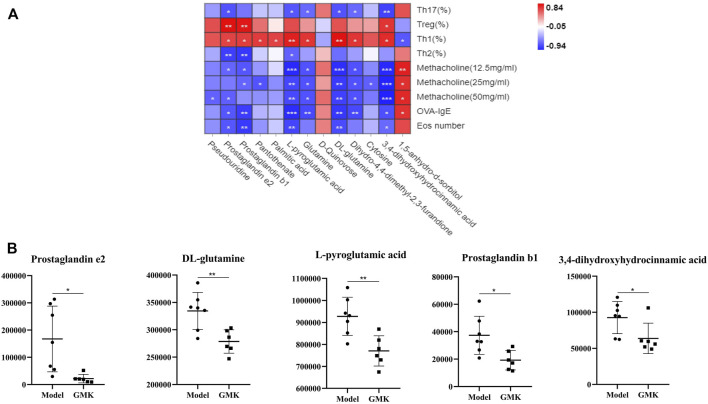
The number of patients with allergic asthma is rising yearly, and hormonal drugs, such as dexamethasone, have unique advantages and certain limitations. In the treatment of allergic diseases especially allergic asthma, increasing the percentage or the function of immunosuppressive cells, such as Treg cells, may achieve a good effect. On the basis of good clinical results, we found that Guominkang (GMK) especially high-concentration GMK can achieve a similar effect with dexamethasone in controlling the symptoms of allergic asthma and inhibiting inflammation of allergic asthma. In our study, GMK can inhibit the recruitment of inflammatory cells, decrease mucus production, and reduce airway resistance. Besides, GMK can reconstruct the cellular immune balance of Th1/2 and Treg/Th17 cells. Metabolome results show that DL-glutamine, L-pyroglutamic acid, prostaglandin b1, prostaglandin e2, and 3,4-dihydroxyhydrocinnamic acid are the metabolic biomarkers and are associated with Th1/2 and Treg/Th17 cell balance. GMK can also change the gut microbiota in the allergic asthma mouse model. The genus, genus, genus, , genusRikenellaceae , familyChitinophagaceae familyNocardioidaceae, and genus are gut microbiota biomarkers treated by GMK. Among these biomarkers, genus is the gut microbiota biomarker associated with Th1/2 and Treg/Th17 cell balance. Interestingly, we first found that DL-glutamine, L-pyroglutamic acid, prostaglandin b1, prostaglandin e2, and 3,4-dihydroxyhydrocinnamic acid are all associated with genus GMK will be a new strategy for the treatment of eosinophilic asthma, and biomarkers will also be a new research direction.
过敏性哮喘患者的数量逐年上升,而激素类药物,如地塞米松,具有独特的优势和一定的局限性。在治疗过敏性疾病尤其是过敏性哮喘时,增加免疫抑制细胞(如调节性T细胞)的比例或功能可能会取得良好效果。基于良好的临床结果,我们发现国敏康(GMK)尤其是高浓度GMK在控制过敏性哮喘症状和抑制过敏性哮喘炎症方面可达到与地塞米松相似的效果。在我们的研究中,GMK可抑制炎症细胞的募集,减少黏液分泌,并降低气道阻力。此外,GMK可重建Th1/2和调节性T细胞/Th17细胞的细胞免疫平衡。代谢组学结果表明,DL-谷氨酰胺、L-焦谷氨酸、前列腺素b1、前列腺素e2和3,4-二羟基氢化肉桂酸是代谢生物标志物,且与Th1/2和调节性T细胞/Th17细胞平衡相关。GMK还可改变过敏性哮喘小鼠模型中的肠道微生物群。理研菌科、噬几丁质菌科、诺卡氏菌科的属以及属是经GMK处理后的肠道微生物群生物标志物。在这些生物标志物中,属是与Th1/2和调节性T细胞/Th17细胞平衡相关的肠道微生物群生物标志物。有趣的是,我们首次发现DL-谷氨酰胺、L-焦谷氨酸、前列腺素b1、前列腺素e2和3,4-二羟基氢化肉桂酸均与属相关,GMK将成为治疗嗜酸性粒细胞性哮喘的新策略,而生物标志物也将成为一个新的研究方向。