Division of Diabetes, Endocrinology and Metabolism, Department of Medicine, Vanderbilt University Medical Center, Nashville, TN, USA; Department of Molecular Physiology and Biophysics, Vanderbilt University, Nashville, TN, USA; Department of Veterans Affairs, Tennessee Valley Healthcare System, Nashville, TN, USA.
Division of Diabetes, Endocrinology and Metabolism, Department of Medicine, Vanderbilt University Medical Center, Nashville, TN, USA.
Mol Metab. 2024 Dec;90:102050. doi: 10.1016/j.molmet.2024.102050. Epub 2024 Oct 20.
Dysregulated glucagon secretion and inadequate functional beta cell mass are hallmark features of diabetes. While glucagon receptor (GCGR) antagonism ameliorates hyperglycemia and elicits beta cell regeneration in pre-clinical models of diabetes, it also promotes alpha and delta cell hyperplasia. We sought to investigate the mechanism by which loss of glucagon action impacts pancreatic islet non-alpha cells, and the relevance of these observations in a human islet context.
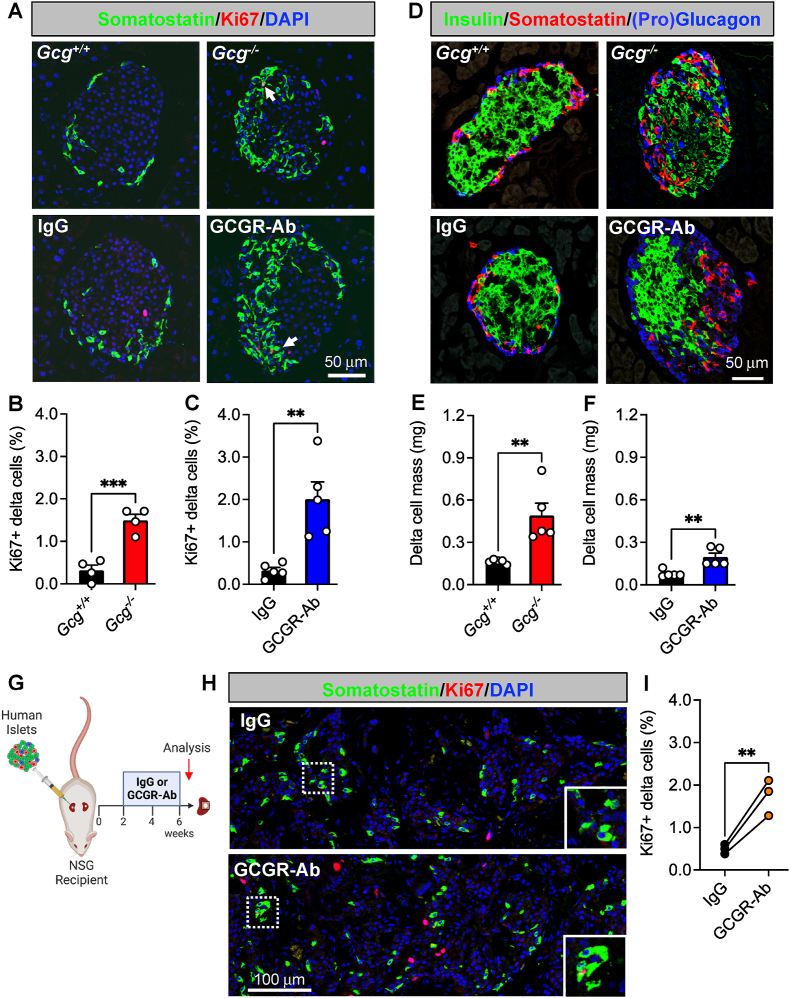
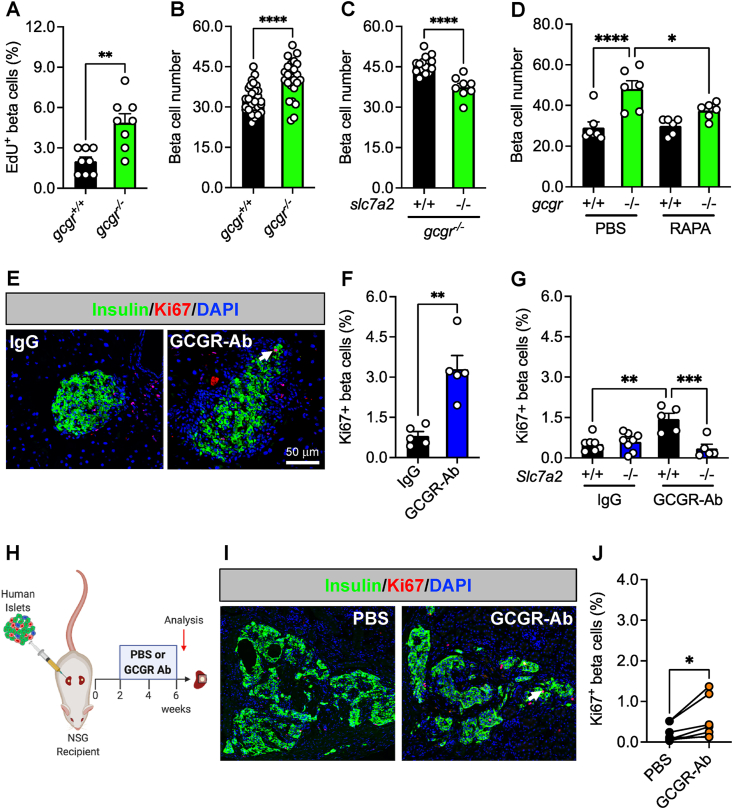
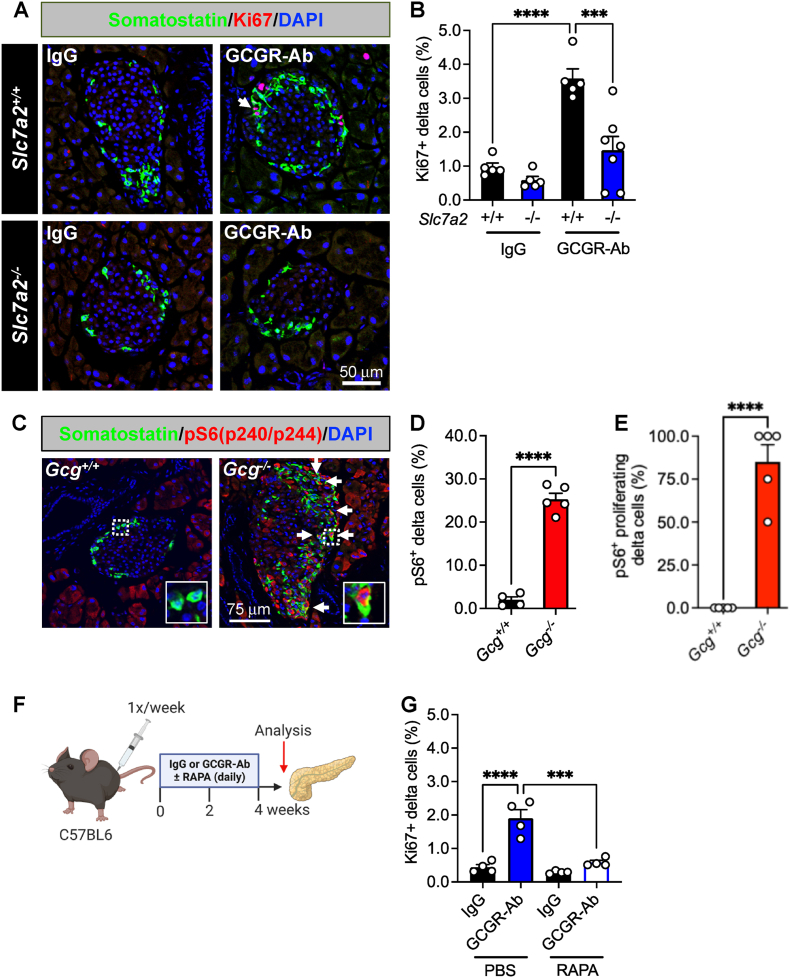
We used zebrafish, rodents, and transplanted human islets comprising six different models of interrupted glucagon signaling to examine their impact on delta and beta cell proliferation and mass. We also used models with global deficiency of the cationic amino acid transporter, SLC7A2, and mTORC1 inhibition via rapamycin, to determine whether amino acid-dependent nutrient sensing was required for islet non-alpha cell growth.
Inhibition of glucagon signaling stimulated delta cell proliferation in mouse and transplanted human islets, and in mouse islets. This was rapamycin-sensitive and required SLC7A2. Likewise, gcgr deficiency augmented beta cell proliferation via SLC7A2- and mTORC1-dependent mechanisms in zebrafish and promoted cell cycle engagement in rodent beta cells but was insufficient to drive a significant increase in beta cell mass in mice.
Our findings demonstrate that interruption of glucagon signaling augments islet non-alpha cell proliferation in zebrafish, rodents, and transplanted human islets in a manner requiring SLC7A2 and mTORC1 activation. An increase in delta cell mass may be leveraged for future beta cell regeneration therapies relying upon delta cell reprogramming.
胰高血糖素分泌失调和功能性β细胞数量不足是糖尿病的标志性特征。虽然胰高血糖素受体(GCGR)拮抗剂可改善高血糖,并在糖尿病的临床前模型中引发β细胞再生,但它也会促进α和δ细胞增生。我们试图研究胰高血糖素作用丧失对胰腺胰岛非α细胞的影响机制,以及这些观察结果在人类胰岛中的相关性。
我们使用斑马鱼、啮齿动物和移植的人类胰岛,包括六种不同的中断胰高血糖素信号的模型,来研究它们对δ和β细胞增殖和质量的影响。我们还使用阳离子氨基酸转运蛋白 SLC7A2 缺失的模型和雷帕霉素抑制 mTORC1,来确定氨基酸依赖性营养感应是否是胰岛非α细胞生长所必需的。
抑制胰高血糖素信号刺激了小鼠和移植的人类胰岛以及小鼠胰岛中的δ细胞增殖,这是雷帕霉素敏感的,需要 SLC7A2。同样,gcgr 缺失通过 SLC7A2 和 mTORC1 依赖的机制增强了斑马鱼和啮齿动物β细胞的细胞周期参与,并促进了β细胞增殖,但不足以在小鼠中导致β细胞质量的显著增加。
我们的研究结果表明,在斑马鱼、啮齿动物和移植的人类胰岛中,中断胰高血糖素信号会以依赖 SLC7A2 和 mTORC1 激活的方式增强胰岛非α细胞增殖。增加δ细胞质量可能会被用于未来依赖于δ细胞重编程的β细胞再生治疗。