Unit of Medical Statistics and Biometry, IRCCS National Cancer Institute of Milan, Milan, Italy.
Department of Clinical Sciences and Community Health, University of Milan, Via G. Celoria, 22, 20133, Milan, Italy.
Eur J Nutr. 2023 Mar;62(2):977-985. doi: 10.1007/s00394-022-03030-7. Epub 2022 Nov 6.
To evaluate whether the intake of specific fibers with prebiotic activity, e.g., inulin-type fructans (ITFs), fructo-oligosaccharides (FOSs), and galacto-oligosaccharides (GOSs), is associated with laryngeal cancer risk.
Within the PrebiotiCa study, we used data from a case-control study (Italy, 1992-2009) with 689 incident, histologically confirmed laryngeal cancer cases and 1605 controls. Six prebiotic molecules (ITFs, nystose [FOS], kestose [FOS], 1F-β-fructofuranosylnystose [FOS], raffinose [GOS] and stachyose [GOS]) were quantified in various foods via ad hoc conducted laboratory analyses. Subjects' prebiotic fiber intake was calculated by multiplying food frequency questionnaire intake by the prebiotic content of each food item. The odds ratios (OR) of laryngeal cancer for prebiotic fiber intake were calculated using logistic regression models, including, among others, terms for tobacco, alcohol, and total energy intake.
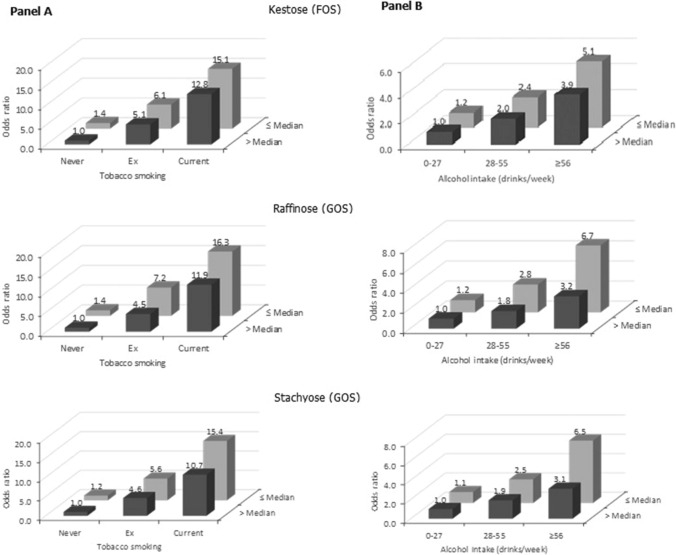
The intakes of kestose, raffinose and stachyose were inversely associated with laryngeal cancer, with ORs for the highest versus the lowest quartile of 0.70 (95% confidence interval, CI 0.50-0.99) for kestose, 0.65 (95% CI 0.45-0.93) for raffinose and 0.61 (95% CI 0.45-0.83) for stachyose. ITFs, nystose and 1F-β-fructofuranosylnystose were not associated with laryngeal cancer risk. Current smokers and heavy drinkers with medium-low intakes of such prebiotic fibers had, respectively, an over 15-fold increased risk versus never smokers with medium-high intakes and a five to sevenfold increased risk versus never/moderate drinkers with medium-high intakes.
Although disentangling the effects of the various components of fiber-rich foods is complex, our results support a favorable role of selected prebiotic fibers on laryngeal cancers risk.
评估摄入具有益生元活性的特定纤维(例如菊粉型果聚糖(ITF)、低聚果糖(FOS)和半乳寡糖(GOS))是否与喉癌风险相关。
在 PrebiotiCa 研究中,我们使用了一项病例对照研究(意大利,1992-2009 年)的数据,该研究包括 689 例经组织学证实的喉癌新发病例和 1605 名对照。通过专门进行的实验室分析,在各种食物中定量了 6 种益生元分子(ITF、棉子糖[FOS]、蜜二糖[FOS]、1F-β-果呋喃糖基棉子糖[FOS]、棉子糖[GOS]和水苏糖[GOS])。通过食物频率问卷摄入量乘以每种食物的益生元含量来计算受试者的益生元纤维摄入量。使用逻辑回归模型计算喉癌的益生元纤维摄入量的比值比(OR),其中包括烟草、酒精和总能量摄入等因素。
蜜二糖、棉子糖和水苏糖的摄入量与喉癌呈负相关,最高四分位与最低四分位的 OR 分别为 0.70(95%置信区间,0.50-0.99)、0.65(95%置信区间,0.45-0.93)和 0.61(95%置信区间,0.45-0.83)。ITF、棉子糖和 1F-β-果呋喃糖基棉子糖与喉癌风险无关。中等低摄入量的这些益生元纤维的当前吸烟者和重度饮酒者与从不吸烟者的比值比分别超过 15 倍,与从不/中度饮酒者的比值比分别为 5 至 7 倍。
尽管分解富含纤维的食物的各种成分的影响很复杂,但我们的结果支持某些益生元纤维对喉癌风险具有有利作用。