Macquarie University Centre for the Health Economy, Macquarie University, Level 5, 75 Talavera Road, Sydney, NSW, 2109, Australia.
Australian Institute of Health Innovation (AIHI), Macquarie University, Sydney, NSW, Australia.
Pharmacoeconomics. 2023 Feb;41(2):187-198. doi: 10.1007/s40273-022-01157-3. Epub 2022 Nov 7.
The Patient-Reported Outcomes Measurement Information System (PROMIS-29) is gaining popularity as healthcare system funders increasingly seek value-based care. However, it is limited in its ability to estimate utilities and thus inform economic evaluations. This study develops the first mapping algorithm for estimating EuroQol 5-Dimension 5-Level (EQ-5D-5L) utilities from PROMIS-29 responses using a large dataset and through extensive comparisons between econometric models.
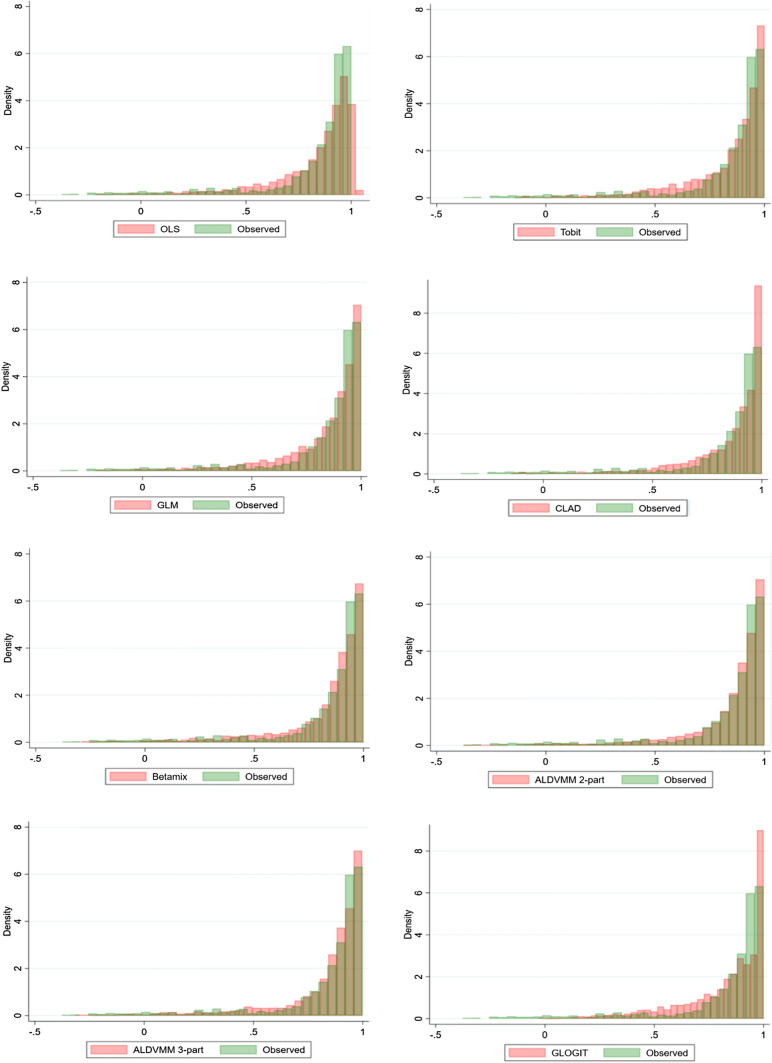
An online survey was conducted to collect responses to PROMIS-29 and EQ-5D-5L from the general Australian population (N = 3013). Direct and indirect mapping methods were explored, including linear regression, Tobit, generalised linear model, censored regression model, beta regression (Betamix), the adjusted limited dependent variable mixture model (ALDVMM) and generalised ordered logit. The most robust model was selected by assessing the performance based on average ten-fold cross-validation geometric mean absolute error and geometric mean squared error, the predicted mean, maximum and minimum utilities, as well as the fitting across the entire distribution.
The direct approach using ALDVMM was considered the preferred model based on lowest geometric mean absolute error and geometric mean squared error in cross-validation (0.0882, 0.0299) and its superiority in predicting the actual observed mean, full health states and lower utility extremes. The robustness and precision in prediction across the entire distribution of utilities with ALDVMM suggest it is an accurate and valid mapping algorithm. Moreover, the suggested mapping algorithm outperformed previously published algorithms using Australian data, indicating the validity of this model for economic evaluations.
This study developed a robust algorithm to estimate EQ-5D-5L utilities from PROMIS-29. Consistent with the recent literature, the ALDVMM outperformed all other econometric models considered in this study, suggesting that the mixture models have relatively better performance and are an ideal candidate model for mapping.
随着医疗保健系统资助者越来越多地寻求基于价值的护理,患者报告的结果测量信息系统(PROMIS-29)越来越受欢迎。然而,它在估计效用方面的能力有限,因此无法为经济评估提供信息。本研究使用大型数据集并通过对计量经济学模型进行广泛比较,为从 PROMIS-29 响应中估计欧洲五维健康量表 5 维度 5 级(EQ-5D-5L)效用开发了第一个映射算法。
进行了一项在线调查,以从澳大利亚普通人群(N=3013)中收集对 PROMIS-29 和 EQ-5D-5L 的反应。探索了直接和间接映射方法,包括线性回归、Tobit、广义线性模型、截尾回归模型、贝塔回归(Betamix)、调整有限因变量混合模型(ALDVMM)和广义有序逻辑回归。通过评估基于平均十折交叉验证几何均数绝对误差和几何均数平方误差、预测均值、最大和最小效用以及整个分布拟合的性能来选择最稳健的模型。
基于交叉验证中最低的几何均数绝对误差和几何均数平方误差(0.0882,0.0299),以及在预测实际观察到的均值、完全健康状态和较低效用极端值方面的优势,直接使用 ALDVMM 的方法被认为是首选模型。ALDVMM 在整个效用分布中的稳健性和预测精度表明它是一种准确有效的映射算法。此外,该映射算法在澳大利亚数据方面优于先前发表的算法,表明该模型适用于经济评估。
本研究开发了一种从 PROMIS-29 估计 EQ-5D-5L 效用的稳健算法。与最近的文献一致,ALDVMM 优于本研究中考虑的所有其他计量经济学模型,这表明混合模型的性能相对较好,是映射的理想候选模型。