Xiao Xia, Liu Ziyi, Chen Xiaojun, Peng Kai, Li Ruichao, Liu Yuan, Wang Zhiqiang
College of Veterinary Medicine, Yangzhou University, Yangzhou, Jiangsu, China.
Jiangsu Co-Innovation Center for Prevention and Control of Important Animal Infectious Diseases and Zoonoses, Yangzhou, Jiangsu, China.
Front Microbiol. 2022 Oct 19;13:1010387. doi: 10.3389/fmicb.2022.1010387. eCollection 2022.
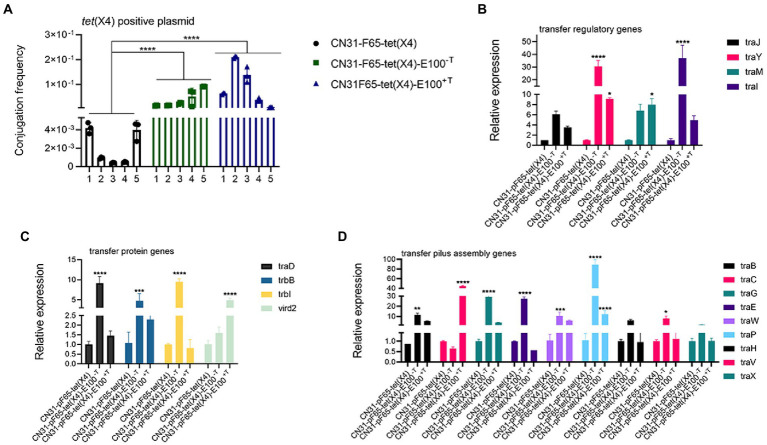
The prevalence of plasmid-mediated tigecycline resistance gene (X4) is presenting an increasing trend. Once (X4)-bearing plasmids are captured by multidrug-resistant bacteria, such as and -coharboring bacteria, it will promote bacteria to develop an ultra-broad resistance spectrum, limiting clinical treatment options. However, little is known about the destiny of such bacteria or how they will evolve in the future. Herein, we constructed a multidrug-resistant bacteria coharboring (X4), , and by introducing a (X4)-bearing plasmid into a and positive strain. Subsequently, the stability of (X4) and the plasmid was measured after being evolved under tigecycline or antibiotic-free circumstance. Interestingly, we observed both (X4)-bearing plasmids in tigecycline treated strains and non-tigecycline treated strains were stable, which might be jointly affected by the increased conjugation frequency and the structural alterations of the (X4)-positive plasmid. However, the stability of (X4) gene showed different scenarios in the two types of evolved strains. The (X4) gene in non-tigecycline treated strains was stable whereas the (X4) gene was discarded rapidly in tigecycline treated strains. Accordingly, we found the expression levels of (X4) gene in tigecycline-treated strains were several times higher than in non-tigecycline treated strains and ancestral strains, which might in turn impose a stronger burden on the host bacteria. SNPs analysis revealed that a myriad of mutations occurred in genes involving in conjugation transfer, and the missense mutation of gene in chromosome of tigecycline treated strains might account for the completely different stability of (X4)-bearing plasmid and (X4) gene. Collectively, these findings shed a light on the possibility of the emergence of multidrug resistant bacteria due to the transmission of (X4)-bearing plasmid, and highlighted that the antibiotic residues may be critical to the development of such bacteria.
质粒介导的替加环素耐药基因(X4)的流行呈上升趋势。一旦携带(X4)的质粒被多重耐药菌捕获,如同时携带 和 的细菌,它将促使细菌产生超广谱耐药性,限制临床治疗选择。然而,对于这类细菌的命运或它们未来将如何进化知之甚少。在此,我们通过将携带(X4)的质粒导入一株同时携带 和 的阳性菌株,构建了一株同时携带(X4)、 和 的多重耐药菌。随后,在替加环素或无抗生素环境下进化后,测定了(X4)和质粒的稳定性。有趣的是,我们观察到在替加环素处理的菌株和未处理的菌株中,携带(X4)的质粒均稳定,这可能是由接合频率增加和(X4)阳性质粒的结构改变共同影响的。然而,(X4)基因的稳定性在两种进化菌株中呈现不同情况。未用替加环素处理的菌株中(X4)基因稳定,而在替加环素处理的菌株中(X4)基因迅速丢失。因此,我们发现替加环素处理菌株中(X4)基因的表达水平比未处理菌株和原始菌株高出数倍,这可能反过来对宿主细菌造成更强的负担。单核苷酸多态性分析显示,参与接合转移的基因发生了大量突变,替加环素处理菌株染色体上 基因的错义突变可能解释了携带(X4)的质粒和(X4)基因稳定性完全不同的原因。总的来说,这些发现揭示了由于携带(X4)的质粒传播而出现多重耐药菌的可能性,并强调抗生素残留可能对这类细菌的发展至关重要。