Zhang Ming-Xu, Chen Yuan, Guo Jing-Xia, Zhang Ru, Bi Ya-Qiong, Wei Xin-Xin, Niu Hui, Zhang Chun-Hong, Li Min-Hui
Inner Mongolia Hospital of Traditional Chinese Medicine, Hohhot, China.
Inner Mongolia Institute of Traditional Chinese and Mongolian Medicine, Hohhot, China.
Front Pharmacol. 2022 Oct 19;13:979890. doi: 10.3389/fphar.2022.979890. eCollection 2022.
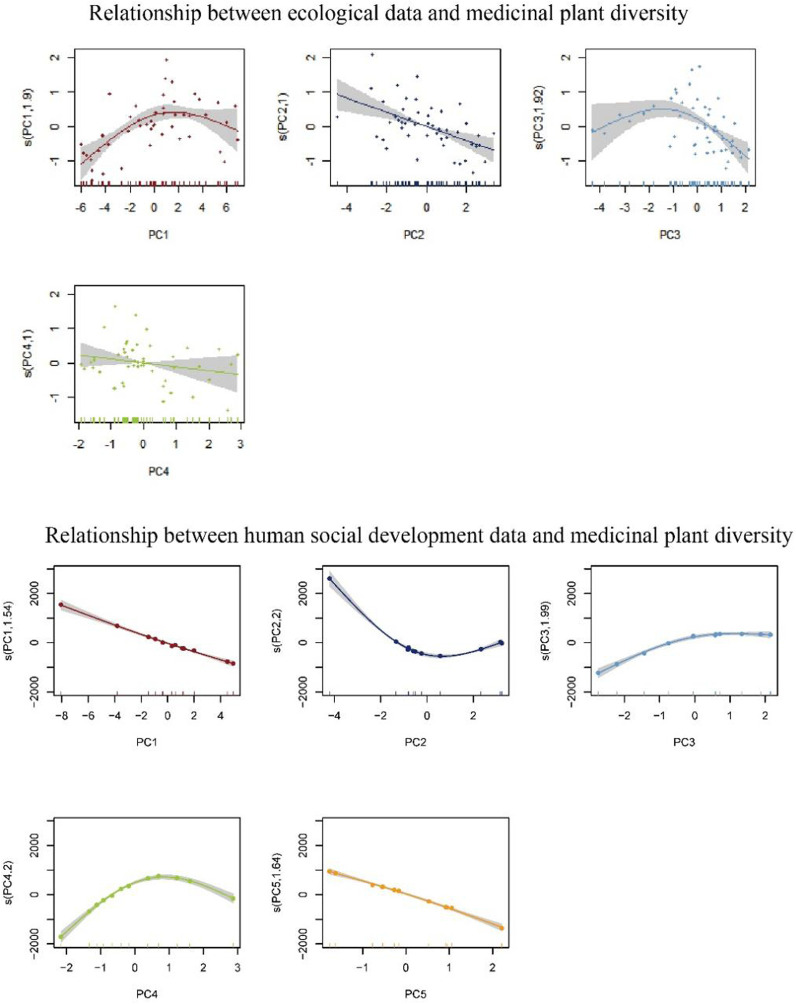
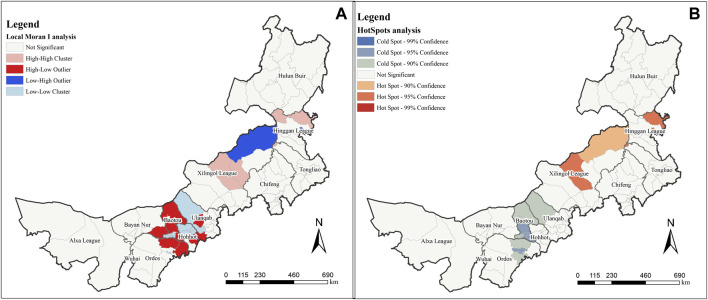
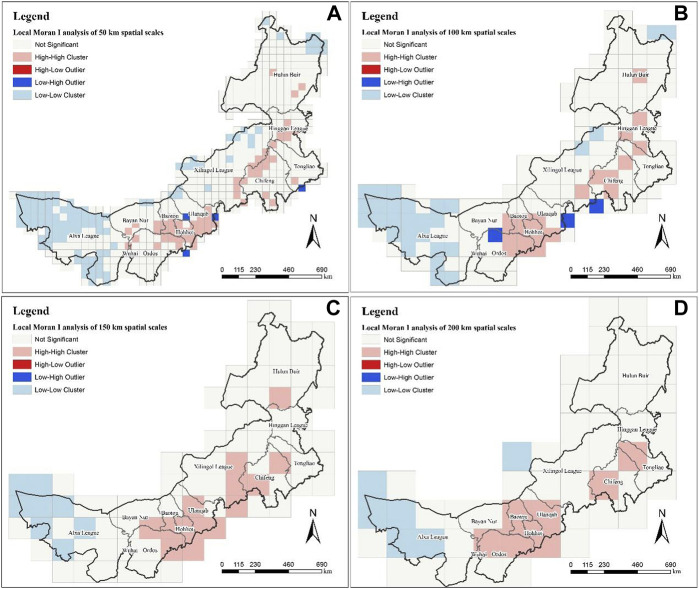
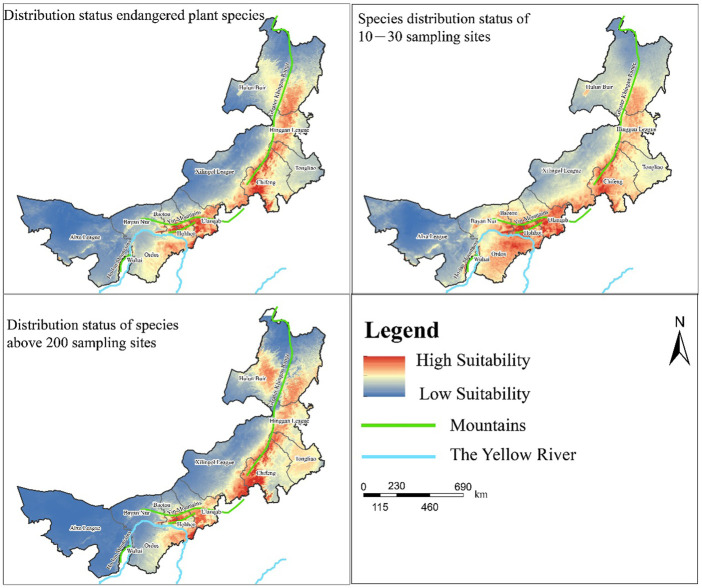
Medicinal plant diversity (MPD) is an important component of plant diversity. Over-collection based on medicinal and economic value has the potential to damage the stability of the regional ecosystem. It is important to understand the current distribution of MPD and the factors influencing it. However, it is still unclear whether environmental and socioeconomic conditions have an impact on their distribution. We selected the Inner Mongolia as a representative study area which covers a wide area, accounting for 12.29% of China's national land area and 0.79% of the world's land area. At the same time, the region is a long-standing traditional medicinal area for Mongolians in China. Therefore, the region is significantly influenced by changes in environmental factors and socio-economic factors. We used 9-years field survey of the distribution of medicinal plants in Inner Mongolia for assessing the distribution of MPD as influenced by environmental and socioeconomic activities by combining spatial analyses, species distribution models, and generalized additive models. The results from the spatial analysis show that the western region of Inner Mongolia is the main cold spot area of the MPD, and the central-eastern and northeastern regions of Inner Mongolia are the main hot spot areas of the MPD. At the same time, the distribution of cold spots and hot spots of MPD is more obvious at large spatial scales, and with the refinement of spatial scales, the cold spots in scattered areas are gradually revealed, which is indicative for the conservation and development of MPD at different spatial scales. Under the future climate change of shared socioeconomic pathways (SSP), areas with high habitat suitability for medicinal plants remain mainly dominated by the Yellow River, Yin Mountains, and Greater Khingan Range. Notably, the SSP245 development pathway remains the most significant concern in either long- or short-term development. The nonlinear relationship between the driving factors of MPD at different spatial scales shows that temperature, precipitation and socioeconomic development do have complex effects on MPD. The presence of a certain temperature, altitude, and precipitation range has an optimal facilitation effect on MPD, rather than a single facilitation effect. This complex nonlinear correlation provides a reference for further studies on plant diversity and sustainable development and management. In this study, the spatial distribution of medicinal plant resources and the extent to which they are driven by ecological and socioeconomic factors were analyzed through a macroscopic approach. This provides a reference for larger-scale studies on the environmental and socioeconomic influences on the distribution of plant resources.
药用植物多样性(MPD)是植物多样性的重要组成部分。基于药用和经济价值的过度采集有可能破坏区域生态系统的稳定性。了解MPD的当前分布及其影响因素很重要。然而,环境和社会经济条件是否对其分布产生影响仍不清楚。我们选择内蒙古作为代表性研究区域,该区域面积广阔,占中国国土面积的12.29%,占世界陆地面积的0.79%。同时,该地区是中国蒙古族长期以来的传统药用地区。因此,该地区受到环境因素和社会经济因素变化的显著影响。我们利用对内蒙古药用植物分布进行的9年实地调查,通过结合空间分析、物种分布模型和广义相加模型,评估环境和社会经济活动对MPD分布的影响。空间分析结果表明,内蒙古西部地区是MPD的主要冷点区域,内蒙古中东部和东北部地区是MPD的主要热点区域。同时,MPD冷点和热点的分布在大空间尺度上更为明显,随着空间尺度的细化,分散区域的冷点逐渐显现,这为不同空间尺度上MPD的保护和发展提供了指示。在共享社会经济路径(SSP)的未来气候变化下,药用植物栖息地适宜性高的地区仍然主要由黄河、阴山和大兴安岭主导。值得注意的是,SSP245发展路径在长期或短期发展中仍然是最显著的关注点。不同空间尺度上MPD驱动因素之间的非线性关系表明,温度、降水和社会经济发展确实对MPD有复杂影响。一定的温度、海拔和降水范围的存在对MPD具有最佳促进作用,而不是单一的促进作用。这种复杂的非线性相关性为进一步研究植物多样性以及可持续发展与管理提供了参考。在本研究中,通过宏观方法分析了药用植物资源的空间分布及其受生态和社会经济因素驱动的程度。这为关于环境和社会经济对植物资源分布影响的更大规模研究提供了参考。