
花生中的MIKC型MADS盒转录因子基因家族:非生物胁迫下的全基因组鉴定与表达分析
MIKC-type MADS-box transcription factor gene family in peanut: Genome-wide characterization and expression analysis under abiotic stress.
作者信息
Mou Yifei, Yuan Cuiling, Sun Quanxi, Yan Caixia, Zhao Xiaobo, Wang Juan, Wang Qi, Shan Shihua, Li Chunjuan
机构信息
Key Laboratory of Peanut Biology, Genetic & Breeding, Ministry of Agriculture and Rural Affairs, Shandong Peanut Research Institute, Qingdao, China.
出版信息
Front Plant Sci. 2022 Oct 20;13:980933. doi: 10.3389/fpls.2022.980933. eCollection 2022.
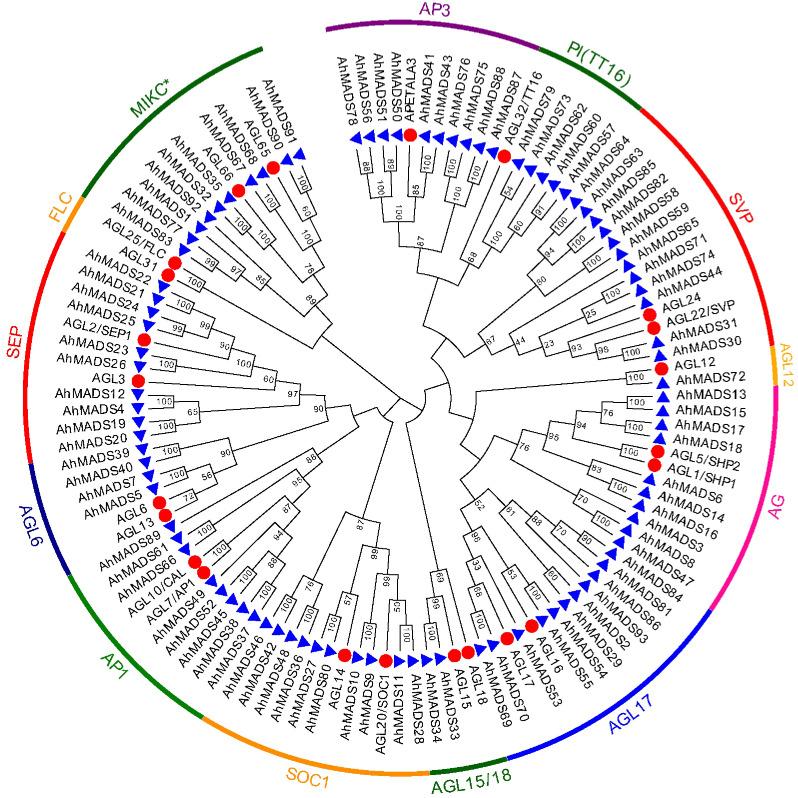
Peanut () is one of the most important economic crops around the world, especially since it provides vegetable oil and high-quality protein for humans. Proteins encoded by MADS-box transcription factors are widely involved in regulating plant growth and development as well as responses to abiotic stresses. However, the MIKC-type MADS-box TFs in peanut remains currently unclear. Hence, in this study, 166 MIKC-type MADS-box genes were identified in both cultivated and wild-type peanut genomes, which were divided into 12 subfamilies. We found a variety of development-, hormone-, and stress-related -acting elements in the promoter region of peanut MIKC-type MADS-box genes. The chromosomal distribution of peanut MADS-box genes was not random, and gene duplication contributed to the expansion of the MADS-box gene family. The interaction network of the peanut AhMADS proteins was established. Expression pattern analysis showed that AhMADS genes were specifically expressed in tissues and under abiotic stresses. It was further confirmed the qRT-PCR technique that five selected AhMADS genes could be induced by abiotic and hormone treatments and presented different expressive profiles under various stresses. Taken together, these findings provide valuable information for the exploration of candidate genes in molecular breeding and further study of AhMADS gene functions.
花生是世界上最重要的经济作物之一,特别是因为它为人类提供植物油和优质蛋白质。MADS-box转录因子编码的蛋白质广泛参与调节植物生长发育以及对非生物胁迫的响应。然而,花生中MIKC型MADS-box转录因子目前仍不清楚。因此,在本研究中,在栽培型和野生型花生基因组中鉴定出166个MIKC型MADS-box基因,它们被分为12个亚家族。我们在花生MIKC型MADS-box基因的启动子区域发现了多种与发育、激素和胁迫相关的作用元件。花生MADS-box基因的染色体分布并非随机,基因复制促成了MADS-box基因家族的扩张。建立了花生AhMADS蛋白的相互作用网络。表达模式分析表明,AhMADS基因在组织中以及在非生物胁迫下特异性表达。通过qRT-PCR技术进一步证实,5个选定的AhMADS基因可被非生物和激素处理诱导,并在各种胁迫下呈现不同的表达谱。综上所述,这些发现为分子育种中候选基因的探索以及AhMADS基因功能的进一步研究提供了有价值的信息。



 Zotero 插件