Xiyuan Hospital, China Academy of Chinese Medical Sciences, Beijing, China.
NMPA Key Laboratory for Clinical Research and Evaluation of Traditional Chinese Medicine, Beijing, China.
Medicine (Baltimore). 2022 Nov 4;101(44):e31436. doi: 10.1097/MD.0000000000031436.
Multiple studies have revealed that Traditional Chinese Medicine (TCM) prescriptions can provide protective effect on the cardiovascular system, increase the heart rate and relieve the symptoms of patients with bradyarrhythmia. In China, the TCM treatment of bradyarrhythmia is very common, which is also an effective complementary therapy. In order to further understand the application of Chinese medicines in bradyarrhythmia, we analyzed the medication rules of TCM prescriptions for bradyarrhythmia by data mining methods based on previous clinical studies.
We searched studies reporting the clinical effect of TCM on bradyarrhythmia in the PubMed and Chinese databases China National Knowledge Infrastructure database, and estimated publication bias by risk of bias tools ROB 2. Descriptive analysis, hierarchical clustering analysis and association rule analysis based on Apriori algorithm were carried out by Microsoft Excel, SPSS Modeler, SPSS Statistics and Rstidio, respectively. Association rules, co-occurrence and clustering among Chinese medicines were found.
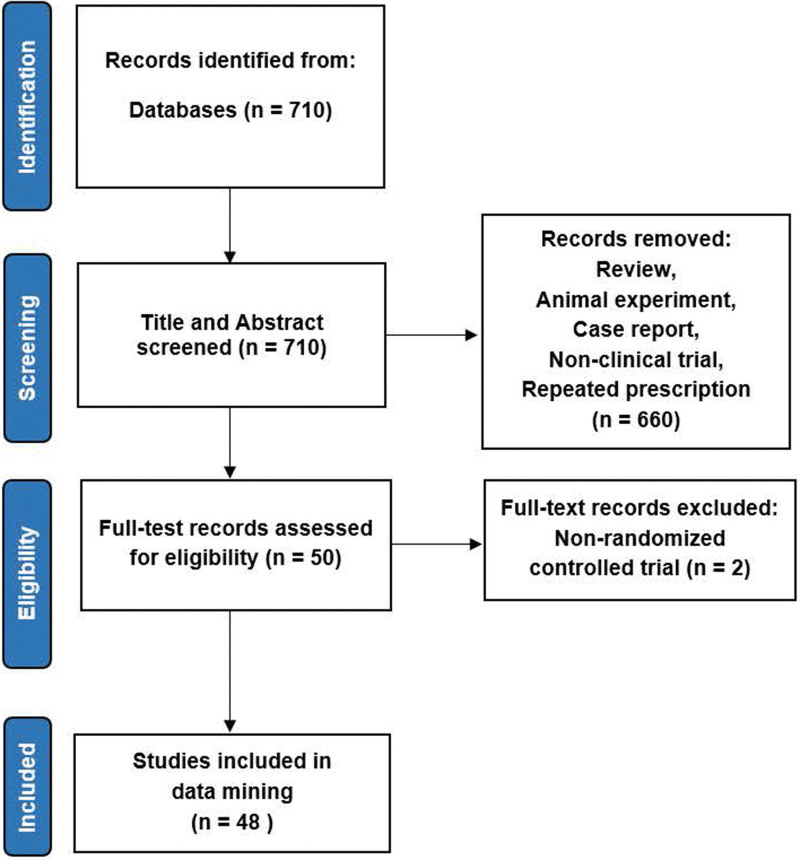
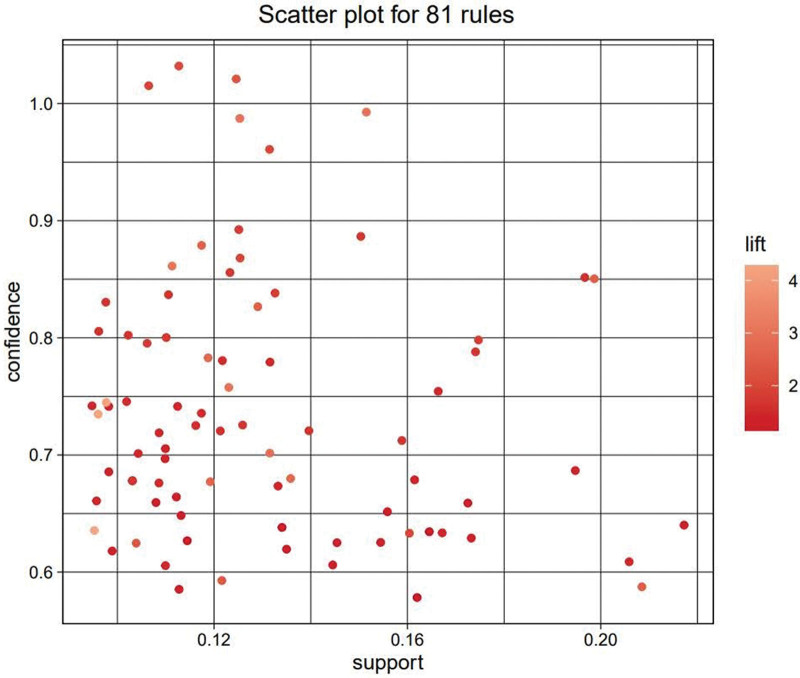
A total of 48 studies were included in our study. Among the total 99 kinds of Chinese medicines, 22 high-frequency herbs were included. Four new prescriptions were obtained by hierarchical cluster analysis. 81 association rules were found based on association rule analysis, and a core prescription was intuitively based on the grouping matrix of the top 15 association rules (based on confidence level), of which Guizhi, Zhigancao, Wuweizi, Chuanxiong, Danshen, Danggui, Huangqi, Maidong, Dangshen, Rougui were the most strongly correlated herbs and in the core position.
In this study, data mining strategy was applied to explore the TCM prescription for the treatment of bradyarrhythmia, and high-frequency herbs and core prescription were found. The core prescription was in line with the treatment ideas of TCM for bradyarrhythmia, which could intervene the disease from different aspects and adjust the patient's Qi, blood, Yin and Yang, so as to achieve the purpose of treatment.
多项研究表明,中医药(TCM)方剂对心血管系统具有保护作用,可提高心率,缓解缓慢性心律失常患者的症状。在中国,TCM 治疗缓慢性心律失常非常普遍,也是一种有效的补充治疗方法。为了进一步了解中药在缓慢性心律失常中的应用,我们基于以前的临床研究,通过数据挖掘方法分析了 TCM 治疗缓慢性心律失常的方剂用药规律。
我们检索了PubMed 和中国国家知识基础设施数据库中关于 TCM 治疗缓慢性心律失常的临床疗效的研究,并用风险偏倚工具 ROB 2 评估发表偏倚。通过 Microsoft Excel、SPSS Modeler、SPSS Statistics 和 Rstidio 分别进行描述性分析、层次聚类分析和基于 Apriori 算法的关联规则分析。找到中药之间的关联规则、共现和聚类。
共纳入 48 项研究。在总共 99 种中药中,包含 22 种高频草药。通过层次聚类分析得到了 4 个新处方。基于关联规则分析发现了 81 条关联规则,并根据前 15 条关联规则的分组矩阵(基于置信度)直观地得到了一个核心处方,其中最相关的草药为桂枝、炙甘草、乌梅、川芎、丹参、当归、黄芪、麦冬、党参、肉桂,处于核心位置。
本研究应用数据挖掘策略探讨了 TCM 治疗缓慢性心律失常的方剂,发现了高频草药和核心处方。核心处方符合 TCM 治疗缓慢性心律失常的思路,能从多方面干预疾病,调整患者的气、血、阴、阳,从而达到治疗目的。