Faculty of Medicine and Health, Sydney and School of Health Sciences, Discipline of Exercise and Sport Science, The University of Sydney, Charles Perkins Centre, Camperdown, Sydney, NSW, 2006, Australia.
Faculty of Medicine and Health, Sydney and School of Medical Sciences, Discipline of Pathology and Ramaciotti Facility for Human Systems Biology, The University of Sydney, Sydney, NSW, Australia.
Eur J Appl Physiol. 2023 Feb;123(2):407-415. doi: 10.1007/s00421-022-05058-3. Epub 2022 Nov 9.
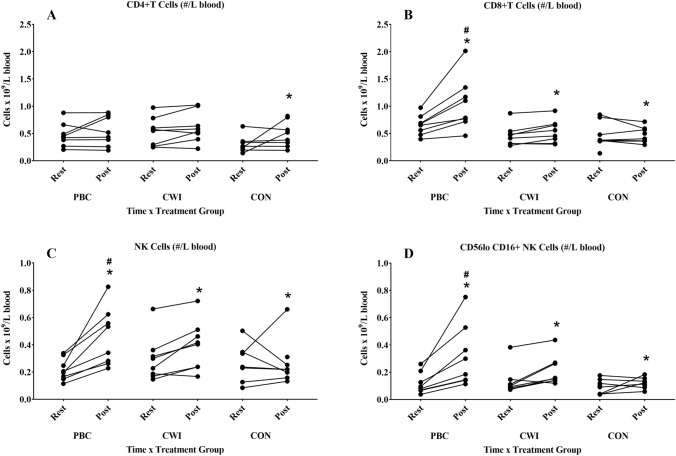
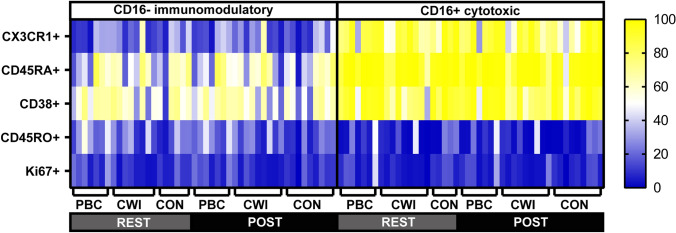
Partial body cryotherapy (PBC) is proposed to alleviate symptoms of exercise-induced muscle damage (EIMD) by reducing associated inflammation. No studies have assessed acute PBC exposure on peripheral blood mononuclear cell mobilisation or compared these with cold water immersion (CWI), which may inform how PBC impacts inflammatory processes. This trial examined the impact of a single PBC exposure on circulating peripheral blood mononuclear cells compared to CWI or a control. 26 males were randomised into either PBC (3 min at - 110 to - 140 °C), CWI (3 min at 9 °C), or control (3 min at 24 °C), with blood samples, heart rate, and blood pressure taken before and after exposure. Cytometric analysis determined that CD8 T-cell populations were significantly elevated after treatments, with PBC increasing CD8 T cells to a greater degree than either CWI or CON. Natural killer cell counts were also elevated after PBC, with the increase attributed specifically to the CD56CD16 cytotoxic subset. This provides the first evidence for the effect of PBC exposure on redistribution of immune cells. An increase in circulating leukocyte subsets such as CD8 T cells and CD56CD16 natural killer cells suggests that PBC may induce a transient mobilisation of lymphocytes. PBC may thus enable a more efficient trafficking of these cells from the circulation to the site of initial cellular insult from exercise, potentially accelerating the process of cellular recovery. This provides novel evidence on the use of PBC as a recovery treatment and may also have applicability in other clinical settings involving the recovery of damaged skeletal muscle.
部分身体冷冻疗法(PBC)通过减轻相关炎症来缓解运动引起的肌肉损伤(EIMD)的症状。尚无研究评估急性 PBC 暴露对周围血单核细胞动员的影响,也未将其与冷水浸泡(CWI)进行比较,而这可能会说明 PBC 对炎症过程的影响。本试验比较了单次 PBC 暴露与 CWI 或对照(24°C,3 分钟)对循环外周血单核细胞的影响。26 名男性随机分为 PBC(-110 至-140°C,3 分钟)、CWI(9°C,3 分钟)或对照(24°C,3 分钟)组,在暴露前后采集血样、心率和血压。流式细胞术分析表明,治疗后 CD8 T 细胞群显著升高,PBC 使 CD8 T 细胞增加的程度大于 CWI 或对照。PBC 后自然杀伤细胞计数也升高,增加归因于 CD56CD16 细胞毒性亚群。这首次提供了 PBC 暴露对免疫细胞再分布影响的证据。循环白细胞亚群(如 CD8 T 细胞和 CD56CD16 自然杀伤细胞)的增加表明,PBC 可能诱导淋巴细胞短暂动员。因此,PBC 可能使这些细胞从循环中更有效地迁移到运动引起的初始细胞损伤部位,从而加速细胞恢复过程。这为 PBC 作为恢复治疗的应用提供了新的证据,也可能适用于涉及受损骨骼肌恢复的其他临床环境。