Wang Bo, Wu Caihong, Cui Lianzhi, Wang Hui, Liu Ya, Cui Weiwei
Department of Nutrition and Food Hygiene, School of Public Health Jilin University Changchun China.
Department of Physical and Chemical Test Jilin Provincial Center for Disease Control and Prevention Changchun China.
Food Sci Nutr. 2022 Jun 20;10(11):3574-3584. doi: 10.1002/fsn3.2955. eCollection 2022 Nov.
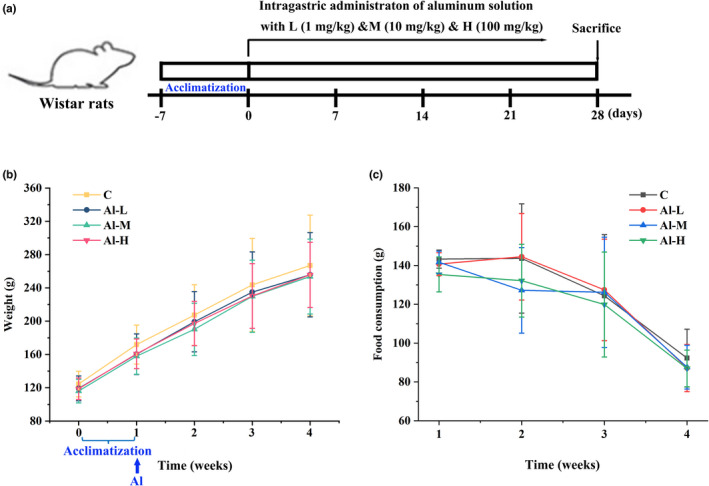
Approximately, 40% of ingested dietary aluminium accumulates in the intestine, which has been considered a target organ for dietary aluminium exposure. The gut microbiota may be the first protective barrier against the toxic metal aluminium and a crucial mediator of the bioavailability of metal aluminium. We previously evaluated dietary aluminium intake and its health risks in a population from Jilin Province, China, and found that the average daily intake of aluminium in the diet of residents in Jilin Province was 0.163 mg/kg after the total diet survey. In the present study, the equivalent concentration of aluminium in rats was extrapolated by the average dietary aluminium intake in the population of Jilin Province based on body surface area. Furthermore, healthy adult Wistar rats were randomly divided into four groups ( = 15 for each group): a control group and three groups treated with aluminium solution (1, 10, and 100 mg/kg/day, intragastrically) for 28 days. Following treatment, necrosis of renal tubular epithelial cells, hyperplasia of bile ducts and hyperplasia of heart tissue, as well as fiber in the liver, kidney, and heart tissues of aluminium-treated rats were observed, although there were no significant changes in the spleen and brain. Subsequently, fecal samples were withdrawn for 16S rRNA gene sequence analysis. It was found that aluminium decreased the microbiota diversity and changed the overall community structure of the gut microbiota, including three phyla and four genera, together with the regulation of 12 signaling pathways. Collectively, treatment with aluminium markedly altered the structure of the gut microbiota, suggesting that the disorders of intestinal flora induced by aluminium may be an important mechanism for aluminium toxicity.
大约40%摄入的膳食铝会在肠道中蓄积,肠道一直被认为是膳食铝暴露的靶器官。肠道微生物群可能是抵御有毒金属铝的第一道保护屏障,也是金属铝生物利用度的关键调节因子。我们之前评估了中国吉林省人群的膳食铝摄入量及其健康风险,在总膳食调查后发现吉林省居民饮食中铝的平均每日摄入量为0.163毫克/千克。在本研究中,根据体表面积,通过吉林省人群的平均膳食铝摄入量推算出大鼠体内铝的等效浓度。此外,将健康成年Wistar大鼠随机分为四组(每组n = 15):一组为对照组,另外三组经胃内给予铝溶液(1、10和100毫克/千克/天),持续28天。处理后,观察到铝处理组大鼠的肾小管上皮细胞坏死、胆管增生和心脏组织增生,以及肝脏、肾脏和心脏组织中的纤维化,不过脾脏和大脑没有明显变化。随后,采集粪便样本进行16S rRNA基因序列分析。发现铝降低了微生物群多样性,改变了肠道微生物群的整体群落结构,包括三个门和四个属,同时还调节了12条信号通路。总体而言,铝处理显著改变了肠道微生物群的结构,表明铝诱导的肠道菌群紊乱可能是铝毒性的重要机制。