Alkhalifah Essraa A R, Alobaid Amjad A, Almajed Marwah A, Alomair Manar K, Alabduladheem Lama S, Al-Subaie Sarah F, Akbar Abdullah, Attimarad Mahesh V, Younis Nancy S, Mohamed Maged E
Department of Pharmaceutical Sciences, College of Clinical Pharmacy, King Faisal University, Al-Hofuf 31982, Saudi Arabia.
Reference Laboratory for Food Chemistry, Saudi Food and Drug Authority (SFDA), Riyadh 11561, Saudi Arabia.
Curr Issues Mol Biol. 2022 Nov 2;44(11):5390-5404. doi: 10.3390/cimb44110365.
Acetaminophen (APAP) is the most extensively used and safest analgesic and antipyretic drug worldwide; however, its toxicity is associated with life-threatening acute liver failure. Cardamom (CARD), a sweet, aromatic, commonly used spice, has several pharmacological actions. In the current study, we tried to explore the chemical composition and the hepato-protective effect of ethanolic aqueous extract of CARD to mitigate APAP-induced hepatic toxicity and elucidate its underlying mechanism of action.
Aqueous CARD extract was subjected to LC-TOF-MS analysis to separate and elucidate some of its components. In vivo animal experiments involved five groups of animals. In the normal and cardamom groups, mice were administered either saline or CARD (200 mg/kg), respectively, orally daily for 16 days. In the APAP group, the animals were administered saline orally daily for 15 days, and on the 16th day, animals were administered APAP (300 mg/kg) IP for the induction of acute hepatic failure. In the CARD 200 + APAP group, mice were administered CARD (200 mg/kg) for 15 days, followed by APAP on the 16th day.
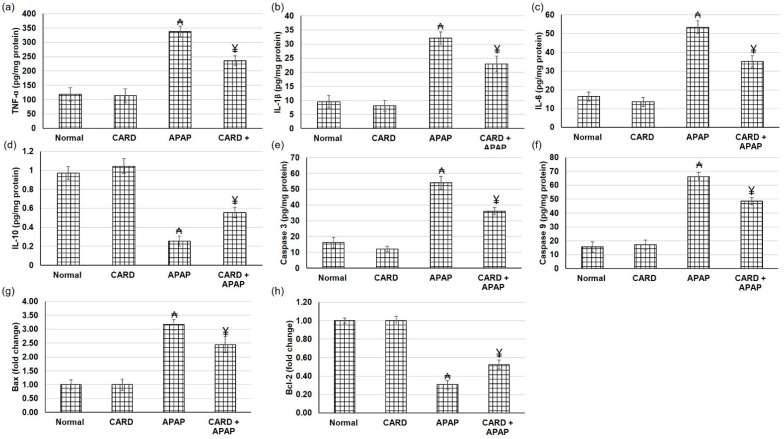
The aqueous extract of CARD showed several compounds, belonging to polyphenol, flavonoids, cinnamic acid derivatives and essential oil components. In the in vivo investigations, APAP-induced impaired liver function, several histopathological alterations, oxidative stress and inflammatory and apoptotic status signified severe hepatic failure. Whereas, pretreatment with the CARD extract prior to APAP administration diminished serum levels of the hepatic function test and augmented Nrf2 nucleoprotein and HO-1 and NQO-1. CARD down-regulated MDA, inflammatory mediators (IL-1β, IL-6, TNF-α and NF-κB) and apoptotic markers (caspase 3 and 9 and Bax) and amplified the activities of SOD, catalase, GSH-Px and GSH-R in hepatic tissue samples.
CARD extract mitigated the hepatic toxicity induced by APAP. The underlying mechanism of action of such hepato-protective action may be through upregulation of the Nrf2/HO-1/NQO-1 pathway with subsequent alleviation of the oxidative stress, inflammation and apoptosis induced by APAP. Many of the compounds identified in the CARD extract could be attributed to this pharmacological action of the extract.
对乙酰氨基酚(APAP)是全球使用最广泛且最安全的镇痛和解热药物;然而,其毒性与危及生命的急性肝衰竭有关。小豆蔻(CARD)是一种甜味、芳香的常用香料,具有多种药理作用。在本研究中,我们试图探究小豆蔻乙醇水提取物的化学成分及其肝保护作用,以减轻APAP诱导的肝毒性,并阐明其潜在作用机制。
对小豆蔻水提取物进行液相色谱-飞行时间质谱(LC-TOF-MS)分析,以分离并阐明其部分成分。体内动物实验涉及五组动物。在正常组和小豆蔻组中,小鼠分别每天口服生理盐水或小豆蔻(200mg/kg),持续16天。在APAP组中,动物每天口服生理盐水15天,在第16天腹腔注射APAP(300mg/kg)以诱导急性肝衰竭。在CARD 200 + APAP组中,小鼠连续15天给予小豆蔻(200mg/kg),然后在第16天给予APAP。
小豆蔻水提取物显示出多种化合物,属于多酚、黄酮类、肉桂酸衍生物和精油成分。在体内研究中,APAP诱导肝功能受损、多种组织病理学改变、氧化应激以及炎症和凋亡状态,表明严重肝衰竭。然而,在给予APAP之前用小豆蔻提取物预处理可降低肝功能测试的血清水平,并增加Nrf2核蛋白、HO-1和NQO-1。小豆蔻下调丙二醛、炎症介质(IL-1β、IL-6、TNF-α和NF-κB)以及凋亡标志物(caspase 3和9以及Bax),并增强肝组织样本中SOD、过氧化氢酶、谷胱甘肽过氧化物酶(GSH-Px)和谷胱甘肽还原酶(GSH-R)的活性。
小豆蔻提取物减轻了APAP诱导的肝毒性。这种肝保护作用的潜在作用机制可能是通过上调Nrf2/HO-1/NQO-1途径,随后减轻APAP诱导的氧化应激、炎症和凋亡。在小豆蔻提取物中鉴定出的许多化合物可能归因于该提取物的这种药理作用。