Healthcare Management, Winterthur Institute of Health Economics, Zurich University of Applied Sciences, Winterthur, Switzerland.
University Hospital Zurich, Zurich, Switzerland.
JMIR Mhealth Uhealth. 2022 Nov 10;10(11):e37624. doi: 10.2196/37624.
New digital health technologies are considered one solution to challenges in the health sector, which include rising numbers of chronic diseases and increased health spending. As digitalization in health care is still in its infancy, there are many unanswered questions about the impact of digital health on management.
This paper assesses the current state of knowledge in the field of digital health from a management perspective. It highlights research gaps within this field to determine future research opportunities.
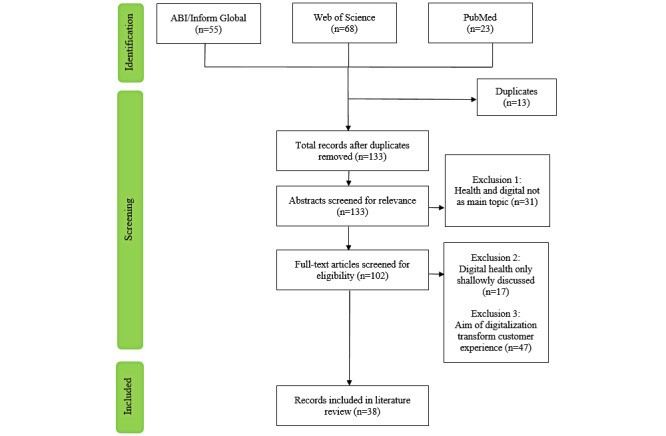
A systematic review of digital health literature was conducted using 3 databases. The chosen articles (N=38) were classified according to a taxonomy developed for the purpose, and research gaps were identified based on the topic areas discussed.
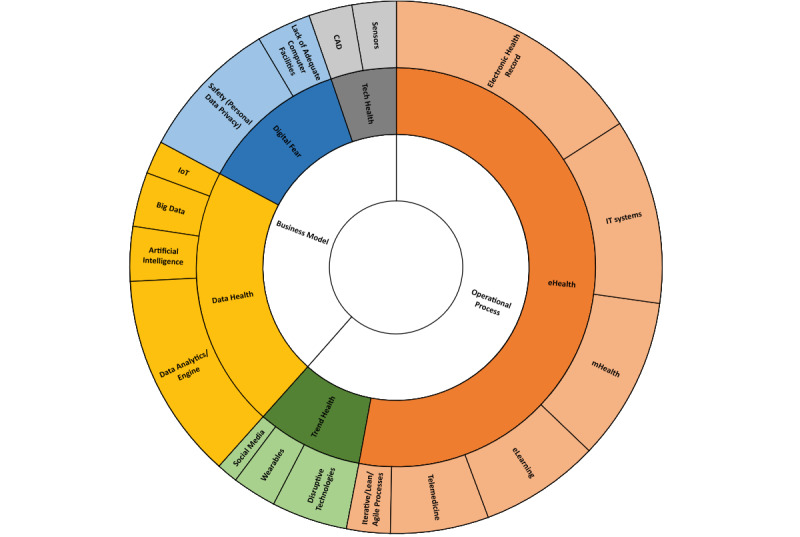
The literature review revealed a slight prevalence of practical (n=21, 55%) over theoretical (n=17, 45%) approaches. Most of the papers (n=23, 61%) deal with information technology (IT) and are, therefore, focused more on technology and less on management. The research question in most of the papers (n=31, 82%) deals with the creation of concepts, and very few (n=4, 11%) evaluate or even question existing solutions. Most consider the main reason for digitalization to be the optimization of operational processes (n=26, 68%), and 42% (n=16) deal with new business models. The topic area discussed most frequently was found to be eHealth (n=30, 79%). By contrast, the field of tech health with topics such as sensors receives the least attention (n=3, 8%), despite its significant potential for health care processes and strategy.
Three main research propositions were identified. First, research into digital health innovation should not focus solely on the technology aspects but also on its implications for strategic and operational management. Second, the research community should target other domains besides eHealth. Third, we observed a lack of quantitative research on the real impact of digital health on organizations and their management. More quantitative evidence is required regarding the expected outcome and impact of the implementation of digital health solutions into our health care organizations.
新的数字健康技术被认为是解决医疗保健领域挑战的一种方法,这些挑战包括慢性病患者数量增加和医疗保健支出增加。由于医疗保健领域的数字化仍处于起步阶段,因此关于数字健康对管理的影响还有许多尚未解决的问题。
本文从管理角度评估数字健康领域的现有知识状况。它突出了该领域内的研究空白,以确定未来的研究机会。
使用 3 个数据库对数字健康文献进行了系统回顾。所选文章(N=38)根据为此目的制定的分类法进行分类,并根据讨论的主题领域确定了研究空白。
文献综述显示,实用(n=21,55%)方法略高于理论(n=17,45%)方法。大多数论文(n=23,61%)涉及信息技术(IT),因此更关注技术,而较少关注管理。大多数论文(n=31,82%)的研究问题涉及概念的创建,而很少有(n=4,11%)评估甚至质疑现有解决方案。大多数人认为数字化的主要原因是优化运营流程(n=26,68%),42%(n=16)涉及新的商业模式。讨论最多的主题领域是电子健康(n=30,79%)。相比之下,主题如传感器的技术健康领域受到的关注最少(n=3,8%),尽管它对医疗保健流程和战略具有重要意义。
确定了三个主要的研究命题。首先,数字健康创新的研究不应仅关注技术方面,还应关注其对战略和运营管理的影响。其次,研究界应该关注电子健康以外的其他领域。第三,我们观察到缺乏关于数字健康对组织及其管理的实际影响的定量研究。需要更多关于数字健康解决方案在我们的医疗保健组织中的实施的预期结果和影响的定量证据。