Liro Marcin, Śniadecki Marcin, Wycinka Ewa, Wojtylak Szymon, Brzeziński Michał, Jastrzębska Joanna, Wydra Dariusz
Department of Gynecology and Obstetrics, Medical University of Gdańsk, 80-210 Gdańsk, Poland.
Department of Statistics, Faculty of Management, Gdańsk University, 80-309 Gdańsk, Poland.
Diagnostics (Basel). 2022 Oct 27;12(11):2604. doi: 10.3390/diagnostics12112604.
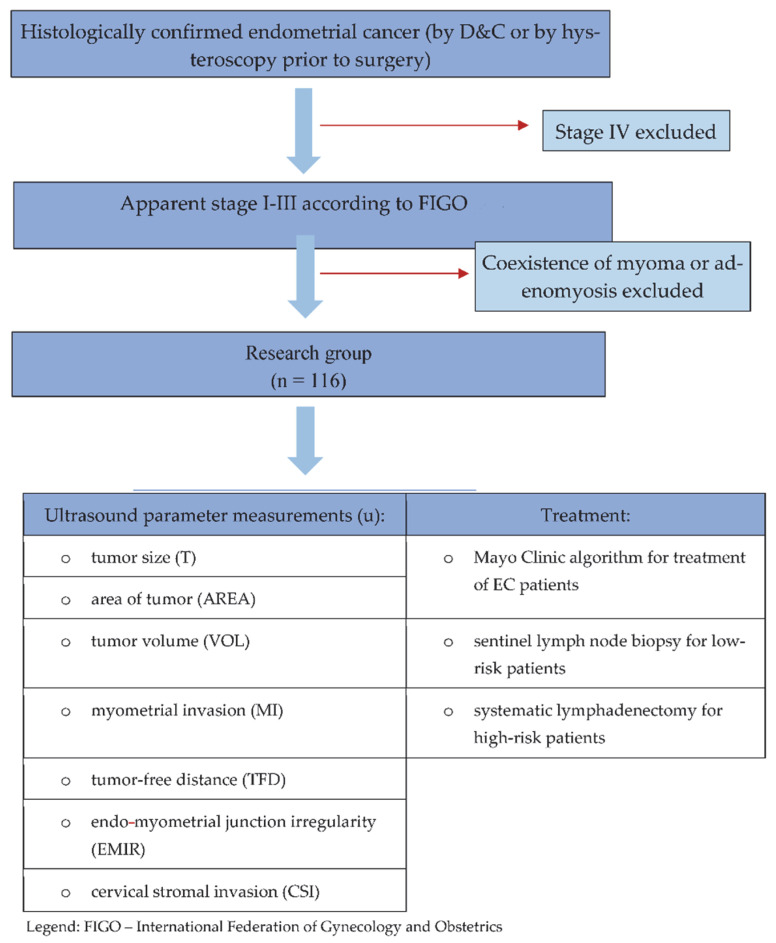
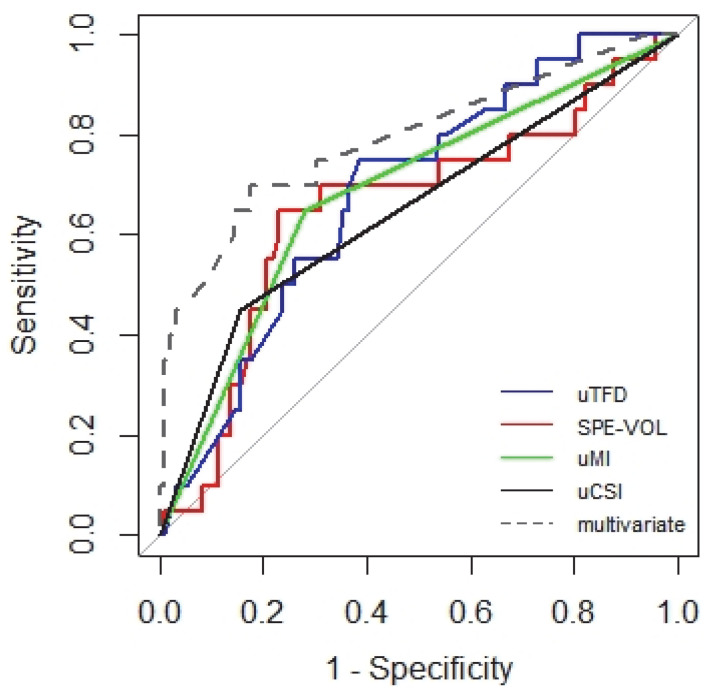
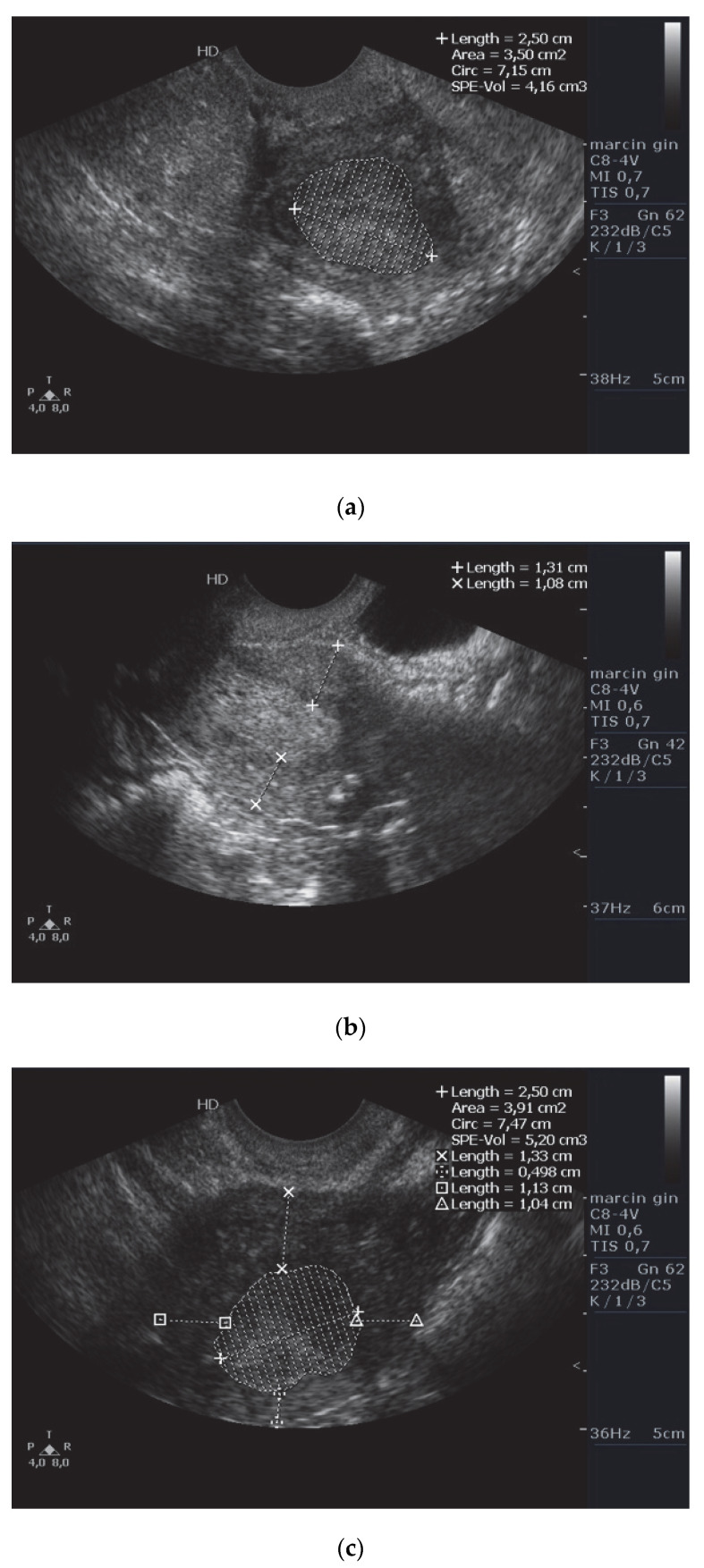
Myometrial invasion (MI) is a parameter currently used in transvaginal ultrasound (TVS) in endometrial cancer (EC) to determine local staging; however, without molecular diagnostics, it is insufficient for the selection of high-risk cases, i.e., those with a high risk of lymph node metastases (LNM). The study’s objective was to answer the question of which TVS markers, or their combination, reflecting the molecular changes in EC, can improve the prediction of LNM. Methods: The TVS examination was performed on 116 consecutive EC patients included in this prospective study. The results from the final histopathology were a reference standard. Univariate and multivariate logistic models of analyzed TVS biomarkers (tumor [T] size, T area [AREA], T volume [SPE-VOL], MI, T-free distance to serosa [TFD], endo-myometrial irregularity, [EMIR], cervical stromal involvement, CSI) were evaluated to assess the relative accuracy of the possible LNM predictors., Spline functions were applied to avoid a potential bias in assuming linear relations between LNM and continuous predictors. Calculations were made in R using libraries splines, glmulti, and pROC. Results: LNM was found in 20 out of the 116 (17%) patients. In univariate analysis, only uMI, EMIR, uCSI and uTFD were significant predictors of LNM. The accuracy was 0.707 (AUC 0.684, 95% CI 0.568−0.801) for uMI (p < 0.01), 0.672 (AUC 0.664, 95% CI 0.547−0.781) for EMIR (p < 0.01), 0.776 (AUC 0.647, 95% CI 0.529−0.765) for uCSI (p < 0.01), and 0.638 (AUC 0.683, 95% CI 0.563−0.803) for uTFD (p < 0.05). The cut-off value for uTFD was 5.2 mm. However, AREA and VOL revealed a significant relationship by nonlinear analysis as well. Among all possible multivariate models, the one comprising interactions of splines of uTFD with uMI and splines of SPE-VOL with uCSI showed the most usefulness. Accuracy was 0.802 (AUC 0.791, 95% CI 0.673−0.91) Conclusions: A combination of uTFD for patients with uMI > 50%, and SPE-VOL for patients with uCSI, allows for the most accurate prediction of LNM in EC, rather than uMI alone.
肌层浸润(MI)是目前经阴道超声(TVS)用于子宫内膜癌(EC)局部分期的一个参数;然而,在缺乏分子诊断的情况下,它不足以用于筛选高危病例,即那些有高淋巴结转移风险(LNM)的病例。该研究的目的是回答以下问题:哪些TVS标志物或其组合能够反映EC中的分子变化,从而改善对LNM的预测。方法:对纳入本前瞻性研究的116例连续EC患者进行TVS检查。最终组织病理学结果作为参考标准。对分析的TVS生物标志物(肿瘤[T]大小、T面积[AREA]、T体积[SPE-VOL]、MI、至浆膜的无瘤距离[TFD]、子宫内膜肌层不规则性[EMIR]、宫颈间质受累[CSI])进行单变量和多变量逻辑模型评估,以评估可能的LNM预测指标的相对准确性。应用样条函数以避免在假设LNM与连续预测指标之间存在线性关系时产生潜在偏差。使用R语言中的样条、glmulti和pROC库进行计算。结果:116例患者中有20例(17%)发现有LNM。在单变量分析中,只有uMI、EMIR、uCSI和uTFD是LNM的显著预测指标。uMI的准确率为0.707(AUC 0.684,95%CI 0.568−0.801)(p<0.01),EMIR的准确率为0.672(AUC 0.664,95%CI 0.547−0.781)(p<0.01),uCSI的准确率为0.776(AUC 0.647,95%CI 0.529−0.765)(p<0.01),uTFD的准确率为0.638(AUC 0.683,95%CI 0.563−0.803)(p<0.05)。uTFD的截断值为5.2mm。然而,AREA和VOL通过非线性分析也显示出显著关系。在所有可能的多变量模型中,包含uTFD样条与uMI相互作用以及SPE-VOL样条与uCSI相互作用的模型显示出最大的实用性。准确率为0.802(AUC 0.791,95%CI 0.673−0.91)。结论:对于uMI>50%的患者,联合使用uTFD,对于uCSI患者联合使用SPE-VOL,能够最准确地预测EC中的LNM,而不是单独使用uMI。