Glycation and Diabetes Complications Group, Mater Research Institute-The University of Queensland, Translational Research Institute, Woolloongabba 4102, Australia.
School of Biomedical Sciences, Faculty of Medicine, The University of Queensland, St Lucia 4072, Australia.
Cells. 2022 Nov 4;11(21):3503. doi: 10.3390/cells11213503.
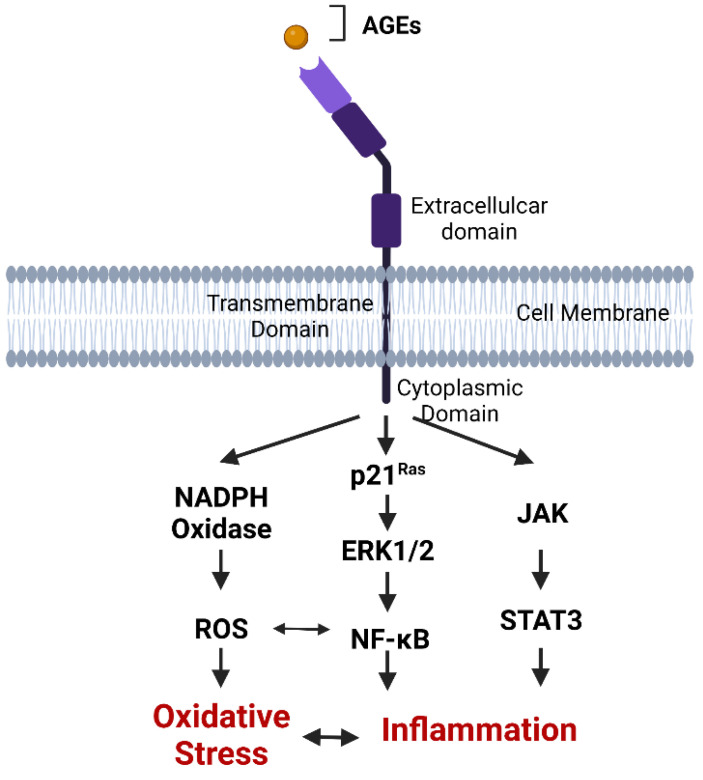
Type 1 diabetes (T1D) is an autoimmune disease in which the β-cells of the pancreas are attacked by the host's immune system, ultimately resulting in hyperglycemia. It is a complex multifactorial disease postulated to result from a combination of genetic and environmental factors. In parallel with increasing prevalence of T1D in genetically stable populations, highlighting an environmental component, consumption of advanced glycation end products (AGEs) commonly found in in Western diets has increased significantly over the past decades. AGEs can bind to cell surface receptors including the receptor for advanced glycation end products (RAGE). RAGE has proinflammatory roles including in host-pathogen defense, thereby influencing immune cell behavior and can activate and cause proliferation of immune cells such as islet infiltrating CD8 and CD4 T cells and suppress the activity of T regulatory cells, contributing to β-cell injury and hyperglycemia. Insights from studies of individuals at risk of T1D have demonstrated that progression to symptomatic onset and diagnosis can vary, ranging from months to years, providing a window of opportunity for prevention strategies. Interaction between AGEs and RAGE is believed to be a major environmental risk factor for T1D and targeting the AGE-RAGE axis may act as a potential therapeutic strategy for T1D prevention.
1 型糖尿病(T1D)是一种自身免疫性疾病,其中胰腺的β细胞受到宿主免疫系统的攻击,最终导致高血糖。它是一种复杂的多因素疾病,据推测是由遗传和环境因素共同作用的结果。在遗传稳定的人群中,T1D 的患病率不断增加,这突出了环境因素的作用,同时,在过去几十年中,西方饮食中常见的晚期糖基化终产物(AGEs)的摄入量显著增加。AGEs 可以与细胞表面受体结合,包括晚期糖基化终产物受体(RAGE)。RAGE 具有促炎作用,包括在宿主-病原体防御中,从而影响免疫细胞的行为,并可激活和引起胰岛浸润的 CD8 和 CD4 T 细胞等免疫细胞的增殖,并抑制 T 调节细胞的活性,导致β细胞损伤和高血糖。对处于 T1D 风险中的个体的研究表明,从出现症状到诊断的进展可以有所不同,从数月到数年不等,为预防策略提供了机会之窗。AGEs 与 RAGE 的相互作用被认为是 T1D 的一个主要环境风险因素,靶向 AGE-RAGE 轴可能是 T1D 预防的一种潜在治疗策略。