Perikleous Evanthia P, Fouzas Sotirios, Michailidou Magdalena, Patsourou Anna, Tsalkidis Dimos, Steiropoulos Paschalis, Nena Evangelia, Chatzimichael Athanasios, Paraskakis Emmanouil
Medical School, Democritus University of Thrace, 691 00 Alexandroupolis, Greece.
Pediatric Respiratory Unit, University Hospital of Patras, 26504 Patras, Greece.
Children (Basel). 2022 Nov 8;9(11):1708. doi: 10.3390/children9111708.
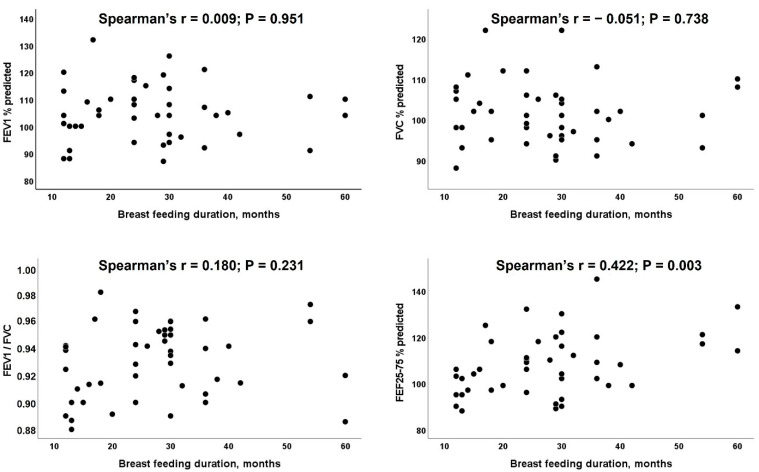
Although the propitious effects of breastfeeding on children's health are indisputable, the impact of exclusive breastfeeding on the lung function later in life remains controversial. Our objective was to explore the possible associations between breastfeeding and the lung function of children who were exclusively breastfed for an extensive period of time. This was a cross-sectional study of children who were exclusively breastfed for more than 12 months. Demographics and anthropometric data were collected; the body mass index (BMI), % body fat, and % central obesity were calculated; and all the participants underwent standard spirometry with reversibility testing. The relationship between breastfeeding duration and spirometric parameters was assessed by Spearman's correlation and multivariable regression, after adjustment for other confounders. Forty-six children (21 boys), aged 9.2 ± 2.4 years, with a reported breastfeeding duration of 27.5 ± 12.5 months (range 12-60 months) were included; 13% were overweight (none were obese) and 21.7% had central obesity. The average FEV1 was 104.7 ± 10.4% and the average FEF25-75 was 107.9 ± 13.3%. The duration of exclusive breastfeeding was positively correlated with FEF25-75% (r = 0.422, = 0.003). Multivariable linear regression analysis confirmed the above finding (beta coefficient 0.478, = 0.002), independently of age, overweight, and central obesity. No correlation was noted between the duration of breastfeeding and other spirometric parameters. In addition to its favorable impact on the metabolic profile, prolonged exclusive breastfeeding seems to exert a propitious effect on the function of smaller airways throughout childhood.
尽管母乳喂养对儿童健康的有益影响无可争议,但纯母乳喂养对儿童后期肺功能的影响仍存在争议。我们的目的是探讨长时间纯母乳喂养与儿童肺功能之间可能存在的关联。这是一项对纯母乳喂养超过12个月儿童的横断面研究。收集了人口统计学和人体测量数据;计算了体重指数(BMI)、体脂百分比和中心性肥胖百分比;所有参与者均接受了具有可逆性测试的标准肺功能测定。在对其他混杂因素进行调整后,通过Spearman相关性分析和多变量回归评估母乳喂养持续时间与肺功能参数之间的关系。纳入了46名儿童(21名男孩),年龄为9.2±2.4岁,报告的母乳喂养持续时间为27.5±12.5个月(范围为12 - 60个月);13%超重(无肥胖者),21.7%有中心性肥胖。平均第一秒用力呼气容积(FEV1)为104.7±10.4%,平均用力呼气中期流速(FEF25 - 75)为107.9±13.3%。纯母乳喂养持续时间与FEF25 - 75%呈正相关(r = 0.422,P = 0.003)。多变量线性回归分析证实了上述发现(β系数为0.478,P = 0.002),且独立于年龄、超重和中心性肥胖。未发现母乳喂养持续时间与其他肺功能参数之间存在相关性。除了对代谢状况有有利影响外,长时间纯母乳喂养似乎对儿童期整个小气道功能也有有益作用。