APC Microbiome Ireland, Biosciences Institute, University College Cork, Cork T12 YT20, Ireland.
Department of Anatomy and Neuroscience, University College Cork, Cork T12 YT20, Ireland.
Nutrients. 2021 Jan 28;13(2):423. doi: 10.3390/nu13020423.
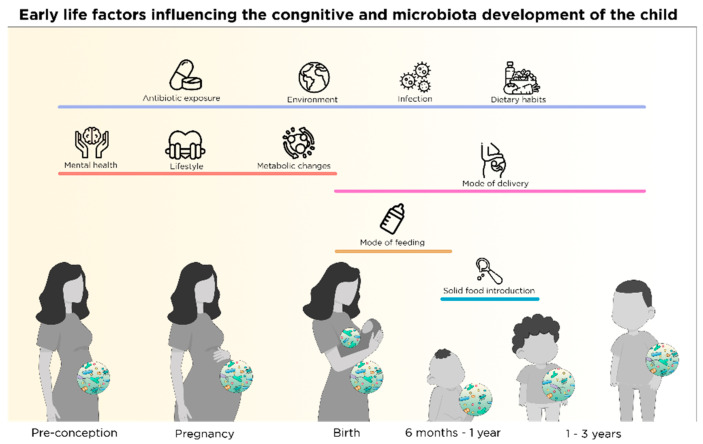
Microbes colonize the human body during the first moments of life and coexist with the host throughout the lifespan. Intestinal microbiota and their metabolites aid in the programming of important bodily systems such as the immune and the central nervous system during critical temporal windows of development, with possible structural and functional implications throughout the lifespan. These critical developmental windows perinatally (during the first 1000 days) are susceptible timepoints for insults that can endure long lasting effects on the microbiota-gut-brain axis. Environmental and parental factors like host genetics, mental health, nutrition, delivery and feeding mode, exposure to antibiotics, immune activation and microbiota composition antenatally, are all factors that are able to modulate the microbiota composition of mother and infant and may thus regulate important bodily functions. Among all these factors, early life nutrition plays a pivotal role in perinatal programming and in the modulation of offspring microbiota from birth throughout lifespan. This review aims to present current data on the impact of early life nutrition and microbiota priming of important bodily systems and all the factors influencing the microbial coexistence with the host during early life development.
微生物在生命的最初时刻就定植在人体上,并与宿主在整个生命周期中共存。肠道微生物群及其代谢产物在发育的关键时间窗内有助于重要身体系统(如免疫和中枢神经系统)的编程,这可能对整个生命周期的结构和功能产生影响。在围产期(生命最初的 1000 天),这些关键的发育窗口期容易受到干扰,这些干扰可能会对微生物群-肠道-大脑轴产生持久的影响。环境和父母因素,如宿主遗传学、心理健康、营养、分娩和喂养方式、暴露于抗生素、免疫激活和产前的微生物组成,都是能够调节母亲和婴儿的微生物组成的因素,从而可能调节重要的身体功能。在所有这些因素中,早期生命营养在围产期编程和调节后代从出生到整个生命周期的微生物群中起着关键作用。本综述旨在介绍早期生命营养和重要身体系统的微生物启动对其的影响的最新数据,以及所有影响宿主早期生命发育过程中微生物共存的因素。