Fatima Anum, Shafi Imran, Afzal Hammad, Díez Isabel De La Torre, Lourdes Del Rio-Solá M, Breñosa Jose, Espinosa Julio César Martínez, Ashraf Imran
National Centre for Robotics, National University of Sciences and Technology (NUST), Islamabad 44000, Pakistan.
College of Electrical and Mechanical Engineering, National University of Sciences and Technology (NUST), Islamabad 44000, Pakistan.
Healthcare (Basel). 2022 Oct 31;10(11):2188. doi: 10.3390/healthcare10112188.
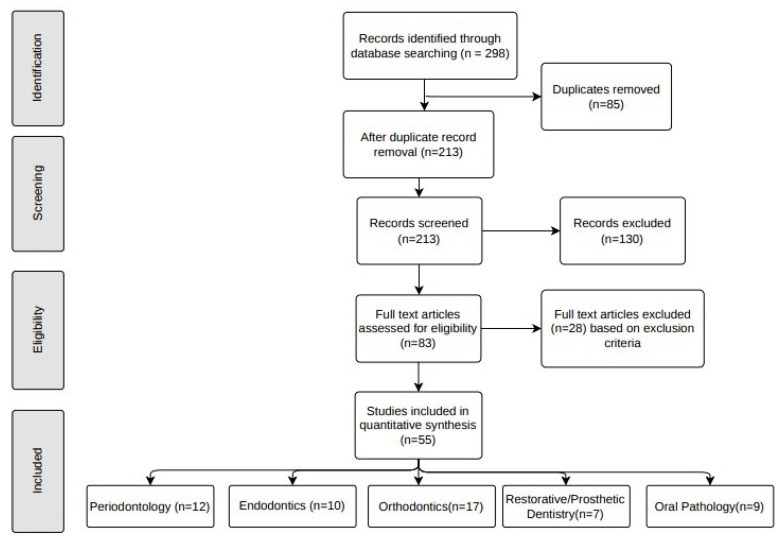
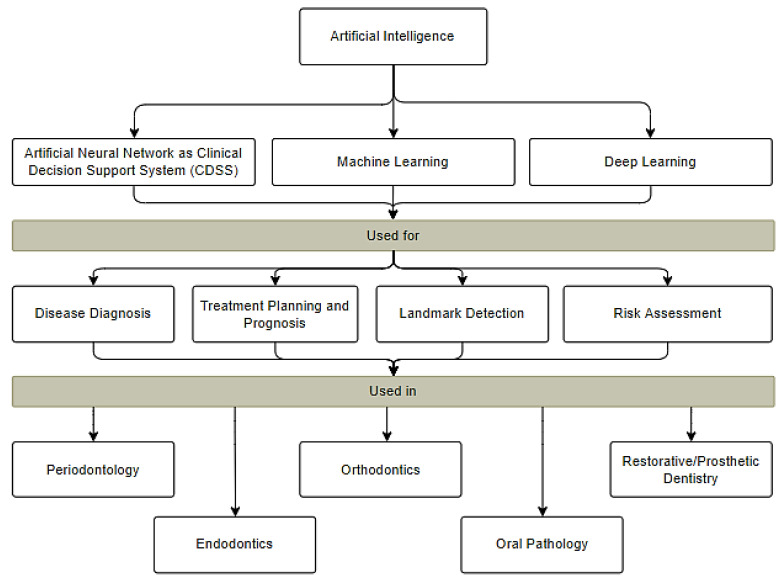
Artificial intelligence has been widely used in the field of dentistry in recent years. The present study highlights current advances and limitations in integrating artificial intelligence, machine learning, and deep learning in subfields of dentistry including periodontology, endodontics, orthodontics, restorative dentistry, and oral pathology. This article aims to provide a systematic review of current clinical applications of artificial intelligence within different fields of dentistry. The preferred reporting items for systematic reviews (PRISMA) statement was used as a formal guideline for data collection. Data was obtained from research studies for 2009-2022. The analysis included a total of 55 papers from Google Scholar, IEEE, PubMed, and Scopus databases. Results show that artificial intelligence has the potential to improve dental care, disease diagnosis and prognosis, treatment planning, and risk assessment. Finally, this study highlights the limitations of the analyzed studies and provides future directions to improve dental care.
近年来,人工智能已在牙科领域得到广泛应用。本研究重点介绍了在牙周病学、牙髓病学、正畸学、修复 dentistry 和口腔病理学等牙科子领域中整合人工智能、机器学习和深度学习的当前进展和局限性。本文旨在对人工智能在牙科不同领域的当前临床应用进行系统综述。系统评价的首选报告项目 (PRISMA) 声明被用作数据收集的正式指南。数据来自2009 - 2022年的研究。分析共纳入来自谷歌学术、IEEE、PubMed 和 Scopus 数据库的55篇论文。结果表明,人工智能有潜力改善牙科护理、疾病诊断和预后、治疗计划和风险评估。最后,本研究强调了所分析研究的局限性,并为改善牙科护理提供了未来方向。